
Constitutional Freedom of Press and Media in Uganda
Fundamental Rights are not Gifts from the State; They Inhere in a Person Because of His Birth and therefore are before the State and the Law.
30 Jun, 2025
Share
Save
The history of freedom of expression, which includes the right to disseminate views and opinions, has not been a happy one in Uganda. At stake has been the extent to which free expression is protected, especially concerning criminal matters, with political overtones such as sedition, criminal defamation and incitement.
Arising from the foregoing, the question before the courts has always been whether the restrictions set up in the laws against sedition, publishing false news, and administrative measures such as censorship and the banning and closure of newspapers and radio stations are permissible as limitations under Article 43(2), a provision that we will turn to subsequently.
Thus, in Charles Onyango Obbo and Andrew Mwenda v. Attorney General [2], the two journalists were charged with the publication of false news contrary to section 50 of the Penal Code Act. The petitioners contended that section 50 was inconsistent with, among others, Articles 29(1)(a) and (b), 40(2) and 43(2)(c) of the 1995 Constitution. The case was lost in the Constitutional Court, with only Justice Twinomujuni in a powerful dissent agreeing with the petitioners. On appeal to the Supreme Court, Justice Mulenga stated that the protection of guaranteed rights is the primary objective of the Constitution and that the limitation of their enjoyment is an exception to their protection and is therefore a secondary objective. The court, therefore, concluded that section 50 of the Penal Code Act was inconsistent with Article 29(1)(a) and thus void.
The Onyango Obbo case represented a significant landmark in the struggle for the improved respect of press freedoms, although it had wider implications for constitutional interpretation and for the question of what limitations were acceptable to the exercise of human rights [3]. Following on from the standard set in that case by the Supreme Court, subsequent decisions on press freedoms in particular, and free expression in general, have generally been progressive and supportive [4].
The right to freedom of expression extends to holding, receiving and imparting all forms of opinions, ideas and information; it is not confined to categories such as correct opinions, sound ideas or truthful information; a person‘s expression or statement is not precluded from the constitutional protection simply because it is thought by another or others to be erroneous, controversial or unpleasant.
Everyone has the right to freely express his or her views. This protection is most crucial when an individual's views are challenged or rejected by society or any part of it as being ‘false’ or ‘wrong’. In a democracy, it cannot be said that the public interest is served by allowing individuals to make false or alarming statements under the guise of freedom of speech and expression. The primary objective of the Constitution is to protect guaranteed rights, while any limitation on their enjoyment is an exception and, thus, a secondary consideration.
Domestic frameworks and safeguards.
‘Fundamental rights are not gifts from the state; they inhere in a person because of his birth and therefore are before the state and the law.’ [5]. This means that these rights are merely restated, but the Constitution does not purport to create them, for they already exist. To that extent, they must be looked at in a different light from other legal rights. It is therefore important that the state should in all ways always require permission from its organs and agencies in order for the citizens to enjoy these rights. Article 20(1) [6] provides for the inherence of human rights; meanwhile, clause (2) requires that all organs and agencies of government and all persons respect, uphold and promote human rights. In effect, the observance of human rights is not only on the part of the state but also of the private sectors and entities.
Article 21 of the 1995 constitution ensures equality before the law, guaranteeing equal protection and non-discrimination based on factors like sex, race, colour, ethnicity, religion, political opinion, or disability. Additionally, it empowers Parliament to enact laws addressing social, economic, and other imbalances to promote equality.
Freedom of speech and expression entails the right to disseminate views and opinions, and the corollary right of the public to the informed. Article 29 of the 1995 constitution[7] provides for the protection of freedom of conscience, expression, movement, religion, assembly and association; this protects the freedom of speech and expression, which includes academic freedom in institutions of learning. The case of Charles Onyango Obbo and Andrew Mujuni Mwenda v A, G Constitutional Appeal No. 2 of 2002 brings out a point that some rights and freedoms under the constitution are subject to a limitation of the enjoyment as provided for under Article 43 of the constitution. This includes the freedom of expression; a citizen can express themselves freely except where the expression would prejudice the fundamental or other human rights and freedoms of others or the public interest [8]. Any limitation as to the enjoyment of the freedom of expression should be a limitation permitted by Article 43 of the 1995 constitution (general limitation on fundamental and other human rights and freedoms)
Whereas there is freedom of expression, the enjoyment of this right and freedom is subject to a general limitation under Article 43.
Article 41 asserts the right to access information in the possession of the state or any organ or agency of the state, except where the release of the information is likely to prejudice the security or sovereignty of the state or interfere with the right to the privacy of any other person. Article 50 provides for the enforcement of rights and freedoms through courts of law; this requires an application to court by any person with a valid claim that a fundamental or other right or freedom guaranteed under the constitution has been infringed or threatened; this enforcement can be brought as an action by any person or organisation for the violation of another person’s or group’s human rights.
Foreign judgments (reciprocal enforcement) act Uganda requires ratification of treaties; this provides for ratifications by parliament. Thereon, Article 123 provides for the execution of treaties, conventions and agreements [9]. Article 287 also provides for the international agreements, treaties and conventions binding with obligations unto the state according to respective conventions. For example, the human rights conventions create obligations upon states like Uganda, an obligation to promote, protect and uphold human rights. The international legal frameworks have created an obligation whose compliance can be witnessed in the national objectives and directive principles of state policy [10]. Article 287 of the 1995 constitution of the Republic of Uganda has been put to practice in various precedential cases, such as The Susan Kigula case, where various international human rights conventions were applied, and Charles Onyango Obbo and Andrew Mujuni Mwenda v A, G constitutional appeal No.2 of 2002.
UN Commissioner for Human Rights Zeid Ra’ad Al Hussein, as quoted in the introduction of the UDHR, “Human rights abuses did not end when the universal declaration was adopted, but since then, countless people have gained greater freedom. Violations have been prevented; independence and autonomy have been attained. Many people, though not all, have been able to secure freedom from torture, unjustified imprisonment … The power of the Universal Declaration is the power of ideas to change the world. It inspires us to continue working to ensure that all people can gain freedom, equality and dignity. One vital aspect of this task is to demand what should be guaranteed: their human rights” [11]
Article 1 of the UDHR is to the effect that human beings are born free and equal in dignity and rights. Also, the Preamble to the UN International Covenant on Civil and Political Rights reaffirms that human dignity is the foundation of global freedom, justice, and peace [12]. The African Charter on Human and Peoples' Rights, adopted by the Organisation of African Unity (OAU) and later the African Union (AU), came into effect in 1986, establishing key principles that underpin human rights. Article 2 of the African Charter ensures equal entitlement to rights and freedoms [13]. Article 5 also guarantees every individual's right to respect for inherent human dignity [14].
The development of human rights in Uganda is consistent with its obligations under binding international conventions, treaties, and agreements. This development is embodied in domestic legal frameworks established under the 1995 Constitution of the Republic of Uganda, particularly Chapter Four, which guarantees fundamental rights and freedoms. Particularly, Article 50 of the constitution provides for the enforcement of human rights through courts of judicature as mandated under Article 126 of the 1995 constitution of the Republic of Uganda.
Article 50 of the constitution provides for the enforcement of human rights by individuals and organisations, but mainly through the courts of judicature, whose statutes of operation have been or are enacted by the Parliament, among other things, with the intention to uphold human rights and freedoms.
State institutions are entrusted with specific mandates to ensure compliance with these international obligations. The Judiciary, under Article 126 of the Constitution [15], is mandated to administer justice, including the adjudication of human rights violations and the provision of effective remedies. The Parliament, under Article 79, is empowered to enact laws necessary for the protection and promotion of human rights in line with Uganda’s international commitments. Together, these institutional mandates function to actualise Uganda’s duty to respect, protect, and fulfil human rights as required by both national and international legal instruments.
Therefore, the global recognition of human dignity, equality, and autonomy has significantly influenced the development of fundamental rights, especially freedom of expression.
Freedom of expression is thus a fundamental human right, internationally protected because it reflects the inherent dignity, equality, and individuality of every person. By expressing themselves, individuals reveal their thoughts, beliefs, and identities, making freedom of expression essential for human fulfilment and worthy of respect and protection.
Democracy relies heavily on freedom of expression to function effectively. The core idea is that citizens must be informed and able to participate freely in public discourse to make informed decisions in elections and when engaging with the government [16]. This means that people must be able to express their opinions, criticise those in power, and access information without fear of censorship or retribution. Freedom of expression is thus the foundation of democratic governance, allowing for the exchange of ideas, holding governments accountable, and promoting social change.
Various international legal instruments provide for the freedom of expression to make it an obligation for various states and state agencies to respect and adhere to the same.
Article 19 of the Universal Declaration of Human Rights ensures the freedom of expression, and it provides that ‘Everyone has the right to freedom of opinion and expression; this right includes freedom to hold opinions without interference and to seek, receive and impart information and ideas through any media and regardless of frontiers.’ [17]
Article 19 of the ICCPR guarantees the right to hold opinions without interference and freedom of expression, including seeking, receiving, and imparting information and ideas; this also permits the use of any media regardless of frontiers. Exercise of these rights comes with special duties and responsibilities that may be subject to restrictions, but only if provided by law and necessary for respecting others' rights or reputations and protecting national security, public order, health, or morals.
International human rights instruments emphasise that freedom of expression encompasses not only the right to express oneself but also the right to do so through various media, including print, broadcast, and electronic platforms. Michael Bratton notes that for citizens to engage in political activity, they need access to communication channels to discuss and debate governance issues, highlighting the importance of public communications media, including print and electronic outlets [18]
International human rights instruments establish that freedom of expression includes the right to receive information and ideas, a crucial aspect of this right. When a state restricts or silences the media, it violates not only the media's and journalists' expressive rights but also citizens' rights to access information and ideas freely. Therefore, the right to freedom of expression inherently protects the media's freedom of expression as well. Individual and media expressive and information rights are deeply interconnected.
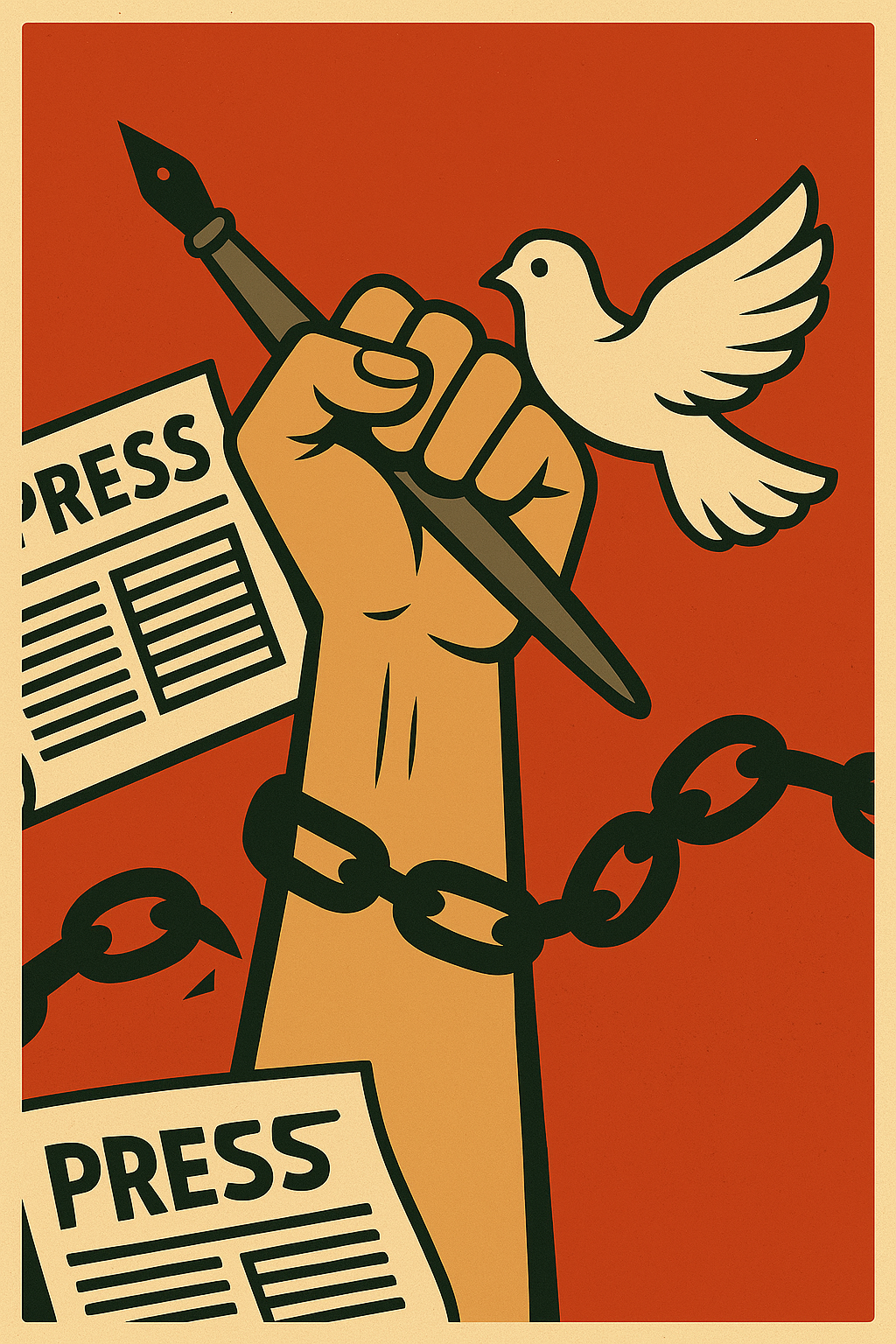
While Article 29(1)(a) of the Constitution of the Republic of Uganda, 1995 guarantees the freedom of speech and expression, including freedom of the press and other media, the practical enjoyment of this right remains significantly curtailed. Despite this constitutional protection, the realisation of press freedom is impeded by a host of restrictive laws. These statutes have often been applied arbitrarily, leading to censorship, harassment, and intimidation of journalists and media houses. Although the legal framework appears progressive in form, recognising media freedom and plurality, it is regressive in practice, characterised by political interference and inconsistent enforcement. Despite these challenges, the press continues to play a crucial role in the democratic process, uncovering corruption, disseminating information, and ensuring government accountability. However, such efforts are increasingly under threat from state actors and repressive legislative tools that undermine the very rights enshrined in the Constitution.
[1] Rev. Christopher Mtikila V A.G of Tanzania Civil Case No. 1993
[2] Constitutional Appeal No. 2/2002.
[3] G.P. Tumwine-Mukubwa, ‘Opening the Floodgates of the Jurisprudence of Free Expression’, in East African Journal of Peace & Human Rights, 11/1 (2005) at 21-66.
[4] Uganda v. Frank Nyakairu & 2 Ors. Criminal Case No. 1600/202 (MC
[5] Rev. Christopher Mtikila V A.G of Tanzania Civil Case No. 1993
[6] Article 20 of the 1995 Constitution of the Republic of Uganda
[7] Article 29 of the 1995 constitution
[8] Charles Onyango Obbo and Andrew Mujuni Mwenda v A, G constitutional appeal No.2 of 2002
[9] Article 123 of the Constitution of the Republic of Uganda
[10] Constitution of the Republic of Uganda.
[11] Zeid Ra’ad Al Hussein, UN high commissioner for Human rights
[12] UN International Covenant on Civil and Political Rights
[13] The African Charter on Human and Peoples' Rights
[14] The African Charter on Human and Peoples' Rights
[15] Article 126 of the 1995 Constitution of the Republic of Uganda
[16] https://abogadosgold.com/constitution/democracy-and-freedom-of-expression/
[17] Article 19 of the Universal declaration of human rights
[18] Michael Bratton, ‘Civil Society and Political Transition in Africa’. Institute for Development Research Reports, 11(6), 1994, p 2.
About the author
Thesis at LLB: Legal analysis of the protection of the right to a fair trial of accused persons in criminal cases.