Uganda: The Most Expensive Country in the World
Anyone who knows East Africa knows that the most dangerous sentence is not “I have a gun.” It is: “Don’t worry about the money.”
06 Jun, 2026
Share
Save
Until a few weeks ago, I believed Germany was an expensive country. The Germans certainly think so. Entire evenings in Berlin can be spent in bitter discussions about electricity prices, rents, and the rising cost of butter. Uganda, on the other hand, enjoys a reputation among Europeans for being affordable. You exchange euros for shillings and, for a brief moment, experience the intoxicating feeling of temporary wealth.
Naively, I thought my wallet—never bursting, but at least reasonably regularly filled—could handle sharing what I had to help my friend Emmanuel Mukasa hide out for a while.
Emmanuel had made the mistake of publicly voicing criticism. Worse still: he had told the truth while doing so. This brought him into conflict with a local potentate. One day, he received an urgent recommendation to disappear for a while.
When the news reached me in Berlin, I promised to help. Through mutual acquaintances, I found a supposedly safe place in Jinja with a woman named Charity Nansubuga. She responded with the swift empathy of a deeply religious person. This was a humanitarian case, she wrote via WhatsApp. There was plenty of room. Rent was out of the question. She was delighted to show Christian solidarity. There would only be a few minor expenses for his upkeep.
Anyone who knows East Africa knows that the most dangerous sentence is not “I have a gun.” It is: “Don’t worry about the money.”
The first invoice arrived two days later. The room in the outbuilding had not been used for a long time and needed to be cleaned first. For this, a broom, a mop, a plastic bucket, and various other utensils were required. Furthermore, power lines had to be checked, a lamp installed, and some minor repairs carried out. The total came to 830,000 shillings. At the time, that was a good 200 euros.
Two days later, another message followed. Some unforeseen costs had arisen. When a man is on the run, you do not start a debate about the economic lifespan of a plastic bucket. So I paid.
In the following week, the focus of the billing shifted from infrastructure to nutrition. The lists read like the shopping list of a family of four: beef, chicken, rice, matooke, potatoes, eggs, bread, milk, sugar, fruit, vegetables, cooking oil, laundry detergent, soap, and toilet paper.
In between, there were always minor surprises. New keys. Transport costs. Gas. A kettle. And once, even popcorn.
To this day, I do not know the exact role popcorn plays in protecting politically persecuted persons. Presumably, it is a hitherto underestimated factor of democratic resilience.
From then on, the invoices arrived with the reliability of Swiss clockwork. Sometimes it was 600,000 shillings, sometimes 700,000, occasionally even more. Via a transfer app, I transferred a total of more than three million shillings within five weeks.
At some point, I started doing the math. I live in Berlin. I buy my groceries at German prices. I cook for myself. I clean for myself. I wash my own laundry. I pay taxes, social security contributions, and electricity bills that are traditionally viewed in Germany as an assault on human dignity.
Despite this, my weekly living costs were regularly lower than the costs for Emmanuel’s stay in a rent-free outbuilding in Jinja.
The astonishing thing was not the sum. The astonishing thing was the complete naturalness with which it was demanded.
No one in the neighbourhood found these prices strange, for the simple reason that no one but me ever saw the invoices that Charity sent punctually to my smartphone on Monday mornings. To the shopkeepers, neighbours, and domestic staff, she remained the God-fearing woman who bought vegetables in the market for a few cheap shillings.
Only on their digital journey to Berlin did the tomatoes and chickens mutate into luxury goods through a small miracle of Christian arithmetic.
There was no whispering, no guilty conscience. While life in Jinja ran its normal, affordable course, a parallel world existed on my display in which a single kettle possessed the equivalent value of half a month’s rent.
Yet Charity was no fraudster. Rather, she was a remarkably typical representative of that Ugandan middle class, which is simultaneously sincerely religious, generous, business-minded, and fully convinced that these qualities do not contradict one another.
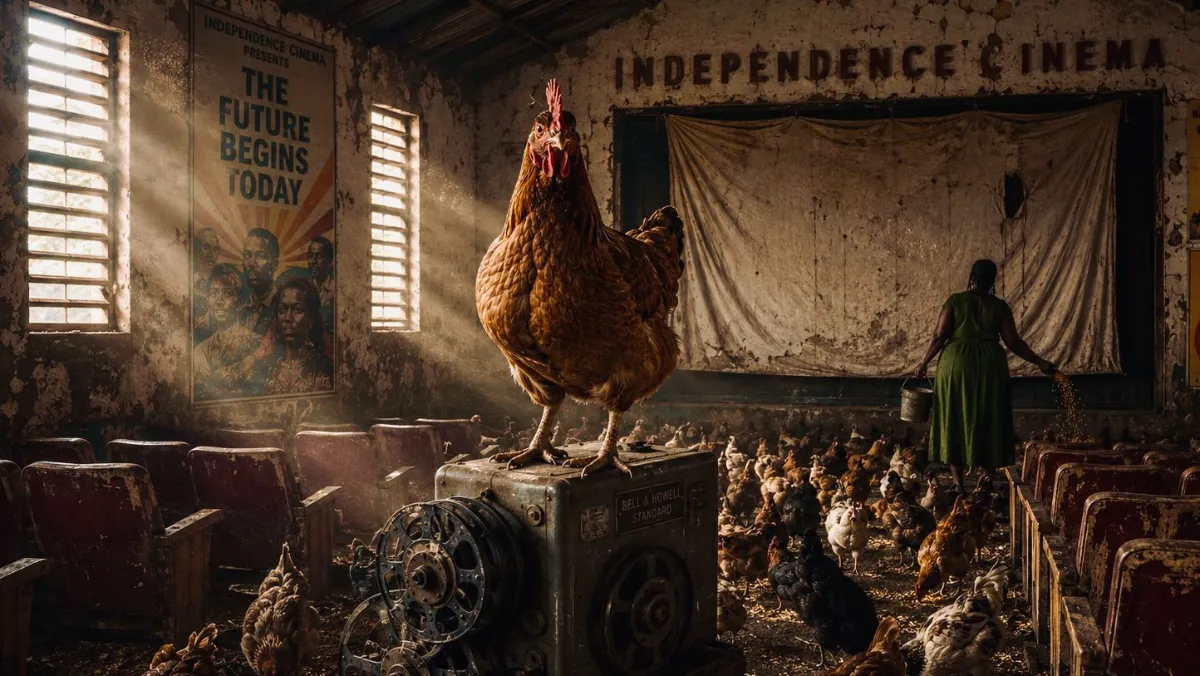
Particularly impressive was a building on her property: an old private cinema that her father had built in the 1970s. Back then, teachers, doctors, and civil servants met there to watch films and discuss politics, education, and the future of the country.
Today, the cinema is a chicken coop.
The screen has vanished. The projector likewise. Instead, hundreds of chickens cackle among the remnants of a bygone hope.
The eggs of these chickens appeared regularly on the invoices for Emmanuel. Occasionally, the chickens themselves appeared on the invoices as well, although in a form that precluded any further egg-laying activity.
As a satirist, one should distrust such images. They seem too perfect. If the cinema-turned-chicken-coop motif were invented, any editor would probably recommend making it a little more believable.
Of course, it would be easy at this point to write a piece about individual greed. But that would miss the actual point.
Charity did not invent this system. She merely navigates it very skillfully.
For decades, Ugandans have observed how political power is used primarily as an opportunity for private enrichment. They see ministers, generals, and speakers of parliament treating public office like a private enterprise. They see political elites purchasing luxury vehicles while hospitals lack even basic bandages.
Anyone who watches long enough learns.
And perhaps the most important lesson is that every situation has a market value.
Why should compassion, of all things, be exempt?
In Uganda, corruption has long ceased to be merely a moral problem. It has become a societal logic. Every crisis opens an opportunity. Every favour creates a claim. Every relationship contains an economic component.
Emmanuel made it to a safe place.
Admittedly, he had to climb over the wall with his suitcases. The spare key to the garden gate, which had been billed to me, never actually reached him.
He climbed. He remained uninjured.
What I was left with in the final tally, however, was an insight that appears in no World Bank report. Uganda is not the most expensive country in the world because rice, fuel, or chicken cost more than elsewhere. It is expensive because trust has become one of the country’s rarest commodities.
Once trust disappears, everything acquires a price tag. Every favour. Every relationship. Every act of solidarity. Even the rescue of a man in danger.
By the time I paid the final invoice, I no longer knew whether I had rescued a politically persecuted man, supported a local business model, or unwittingly participated in a field experiment on the economics of mistrust.
Emmanuel was safe. That was what mattered.
Yet I left the experience with a lingering suspicion: in societies where trust collapses, nothing is truly cheap anymore—no matter what the exchange rate says.
About the author
Konrad Hirsch is a filmmaker and journalist based in Berlin. He works across East Africa and Europe and writes about society, power and the fragile art of coexistence.