
Move the Body, Listen to Music, and Play Musical Instruments
Why Moving Your Body, Listening to Music, and Playing Musical Instruments Boosts Brain Power
17 Jun, 2026
Share
Save
A pigeon hatches from its egg on an island. Its mother is nowhere to be seen. The mother, probably, upon laying her egg, was killed or wandered into the bushes and got lost. This pigeon finds herself in the wilderness all alone. No animal is around, so all she sees is grass, trees, and stones. “I have no idea why I’m here and what this all means, but I guess there is more to this,” she says to herself. By default, she becomes an orphan. She learns how to feed herself since no one is there for her. It’s not much of a struggle since her surroundings are full of food, so she doesn’t have to move much to look for food. She has to learn what is good to eat and what is not.
One day, this pigeon moves a little further away from the area she’s used to, only to find something so strange—a sleeping blue giant that seems to have creatures resembling her sitting on its back. “I can’t walk long distances. I’ve never walked them before, so I won’t bother walking to that place to see what exactly is there,” she tells herself. Three years pass by, and all she does is wake up, gaze at the nearby grass, feed on the food that’s nearby, and rest.
As fate would have it, one day, a sailor sets off with his wife by boat to the island where the pigeon is. After gliding several meters into the sleeping blue giant, the sailor gets exhausted and requests his wife to take over the wheel while he opts to rest, passing the hours by playing his flute. As he plays the flute, the wife enjoys the music so much that she tells her husband to stick to the flute for the entire journey. Even though sailing for long distances is exhausting, she is more than willing to endure it until they reach their destination. The music from the flute is as sweet as wild honey. Not only can the sailor’s wife not play the flute, but she also cannot bear to continue the journey without its sweet music.
As they approach the island where the pigeon lives, the drifting music strikes the pigeon’s ears, stirring a rich blend of intrigue and pleasure within her. “What exactly is that?” she mutters to herself. This is the beginning of utter restlessness. Within seconds, she is smart enough to figure out where the music is coming from. She figures out that the music is coming from the direction of the motionless kingdom. But there is just one problem: she had told herself never to move further away from the only home she had ever known. Going toward the sleeping blue giant is definitely something not to be entertained by. As the sailor and his wife near the island, the music from the flute being played by the sailor grows louder with every passing moment. Inevitably, the pigeon’s excitement and curiosity outgrow her caution, shattering the invisible boundaries within which she had kept herself caged.
For the first time in her five-year existence, she feels a sudden burst of courage to leave her small home behind and run toward the endless floor of undisturbed blue. As she launches herself forward, her stiff joints pop with a dry, audible snap. It is a painless cracking, the sound of five years of caution breaking apart at once. A deep, radiating heat swells beneath her feathers, dampening her skin as she pushes her body to its absolute limit. On reaching the edge of the sleeping blue giant, she inevitably starts jumping up and down—driven by pure, unfiltered excitement. The sailor and his wife quickly notice her frantic movements. Intrigued, they move toward where she is, choosing to bank their boat right next to her. Interestingly, as they near the pigeon, the sweetness of the music from the flute being played by the sailor overwhelms her. She flaps her wings harder and faster. Surprisingly, she sees herself flying in the air toward the boat. While in the air, she just cannot believe that, by herself, she has managed to shatter the gravity that held her captive. She had never dared anything like this before; it is by far the greatest leap of her entire existence.
Just as the pigeon floats directly above the boat, the music stops. The sailor trades his flute for a bow, draws back an arrow, and shoots her dead. As lifeless as a handful of scattered feathers, the pigeon falls from the sky into the boat. Looking down at the fallen bird, the wife sighs with profound relief: “Finally, we have something to eat.”
Dear reader, the pigeon represents people who neglect physical movement, confining their existence to familiar spaces while pursuing intellectual growth within the safety of a static environment. These people prefer to anchor themselves in a single, unyielding corner of the world. On the other hand, the sailor and his wife represent unpredictable elements of the natural world whose sudden interruptions inevitably disrupt stagnation and trigger unexpected happenings, such as the creation of music. Though the curtain falls on the pigeon’s five-year existence without warning, undeniably, those final moments she experiences are the most remarkable of her entire existence. Additionally, this story teaches us that music is an inescapable gravity for the human soul. It is a force that ultimately finds us, no matter how far we try to retreat. This is because it directly affects emotion, since it activates brain regions connected to reward, emotion, and dopamine release. Secondly, since the human brain loves patterns, it finds music deeply satisfying—music is comprised of patterns, surprise, and timing. Music has the power to express what words cannot: grief, longing, joy, spiritual depth, and so much more (check out this song by Michael Bennet).
Retrospectively, it is the sailor’s flute music that finally compels the pigeon to break out of her shell, driving her to fly and move long distances for the first time in her entire existence. Moving a long distance for the first time in her life, combined with the stimulating effect of music, triggers a massive mental awakening in the pigeon’s brain. With this sudden surge in intelligence, the pigeon immediately sets out to strike her wings faster and harder, conquering the sky for the very first time.
As human beings, our brains function significantly better—especially when it comes to learning—the moment we integrate study (whether academic or non-academic) with physical movement, active listening, and the mastery of a musical instrument. What I am trying to say is all about bridging the gap between what you do with your body and what happens in your brain. I like to call this the Chronokinetic Framework. This framework combines chrono (timing/rhythm) and kinetic (movement) to describe a highly sophisticated cognitive workflow. Specifically, this framework focuses on when you ingest information, why and when you move your body, what music you listen to and when, and why and when to practice a musical instrument. Most people try to study hard on a cold brain. This is similar to playing a symphony on an out-of-tune musical instrument. With the chrono-kinetic framework, you use music and movement to prime the neural pathways for the data that follows. The truth is that traditional learning methods—to be specific: teacher-led instruction, textbook learning, testing and examination, sequential curriculum, classroom structure, authority and discipline, repetition and practice, and, lastly, memorisation and recall—are insufficient when we use them today in the precise way they were engineered and intended to function many years ago. Additionally, it is sad that classical education, whose aim is to cultivate wisdom, virtue, and critical thinking through the study of Western literature and Western history (African literature and African history, as of now, are not richer than Western literature and Western history, but still, much can be learned from it), is nonexistent in African learning environments. Dear reader, I would like to pose a question: how can we learn by doing less and reduce the time to mastery?
Firstly, listen to music. This is what I like to call “creating an auditory entrainment and beta-flow window.” It’s not about listening to any kind of music, by the way. There is a particular kind of music meant for this. If you listen to low-tempo, 60 BPM baroque or ambient music (for example, classic cinematic ambient, electronic ambient techno, and modern experimental ambient music), you’ll induce alpha waves. Such music is great for the absorption of information. On the other hand, if you listen to high-tempo, 130+ BPM percussive play, you’ll induce beta waves, which are great for recalling information.
Secondly, move your body. When you break a sweat, whether it’s through running, lifting weights, practising callisthenics, or swimming, a highly important protein found in the brain and spinal cord called brain-derived neurotrophic factor (BDNF) spikes in your body. It acts like a fertiliser for your brain, driving neuroplasticity, which is your brain’s ability to grow, adapt, and rewrite its own wiring. Actually, just after exercise, BDNF creates a 20-minute window of heightened neuroplasticity. Neuroplasticity is the brain’s ability to physically reorganise, rewire, and adapt its structure and functions in response to new experiences, learning, or injury. Neuroplasticity enables learning through strengthening synapses, structural growth of neurons, myelination for speed, and pruning unused pathways.
Thirdly, learn how to play a musical instrument such as an acoustic guitar, bass guitar, piano, saxophone, flute, or drums. Let’s look at the science! Learning and playing a musical instrument acts as a “total brain workout,” engaging almost every area of the central nervous system simultaneously. Unlike passive listening, playing a musical instrument requires a complex integration of sensory information, fine motor control, and emotional processing. Learning an instrument increases the volume and activity in the brain’s corpus callosum, the bridge between the left and right hemispheres. This allows messages to move across the brain faster and through more diverse routes. For people who get to experience musical training for a long period, the quality of white matter pathways, which are responsible for efficient communication between different brain regions, improves. Actually, studies show that musicians often have a larger primary motor cortex and cerebellum—areas responsible for planning and executing movements—which translates to better physical coordination. Playing musical instruments strengthens the high-level processes that allow us to focus, plan, and multitask. This is done through working memory and inhibitory control. Think about this deeply: a musician must hold the notes they just played in their mind while preparing for the notes ahead, effectively “stretching the brain’s short-term storage capacity.” Additionally, reading music requires the brain to ignore distractions and focus on precise timing, which helps in school/work environments where sustained attention is required.
The brain processes music and language using similar pathways. Because music requires high-fidelity processing of pitch, timing, and timbre, the brain becomes more sensitive to the nuances of human speech. As a result, musicians are often better at picking up foreign languages because their brains are trained to distinguish between subtle sound variations. More to this, there is a direct correlation between rhythmic proficiency and reading ability. The rhythm of a sentence is easier to decode for a brain trained in musical meter.
Playing a musical instrument provides a unique cognitive environment that balances pleasure and effort. Successfully playing a difficult passage triggers a release of dopamine, which reinforces the “habit” of learning. When you practice a passage you cannot play, friction is created, and that friction builds grit. It teaches the brain that struggle is a prerequisite for mastery. This is a mindset that is highly transferable to other areas like mathematics, coding, complex problem-solving, or sports.
Engaging in playing musical instruments also acts as a form of “cognitive insurance.” It builds a more robust neural network that can better withstand age-related decline. Actually, research suggests that older adults who played musical instruments in their youth (or continue to do so) perform better on memory and cognitive flexibility tests than non-musicians. Musical training improves attention, enhances verbal and working memory capacity, improves spatial-temporal reasoning (the ability to visualise patterns), and also reduces stress by reducing cortisol levels, hence creating a better “chemical environment for learning.”
You might wonder which musical instrument is the best to learn. If we are looking for the maximum return on investment for accelerated learning, neuroplasticity, and focus, the piano is the gold standard for brain integration. This is because of its unique physical and causal layout. Unlike a violin or guitar, where each hand does a fundamentally different job, the piano often requires both hands to perform complex, independent yet synchronised movements. This forces the left and right hemispheres of the brain to communicate at high speeds. Furthermore, the piano is a perfect visual map of music theory. Low notes are on the left while the high notes are on the right. This linear representation helps the brain build spatial-temporal reasoning, which is the same skill used in advanced mathematics and engineering. With the piano, you see the note on the page, you see the key on the board, you feel the weight of the hammer, and you hear the pitch. The 4-way sensory loop is a massive stimulant for synaptic pruning and growth.
For someone whose goal is executive function and stress regulation, drums are the best choice. Drumming trains the brain’s “timing” circuits. Better internal timing is linked to better emotional regulation and faster linguistic processing. When it comes to body integration, drumming is the most “kinetic” of all instruments. It requires 4-limb independence (left hand, right hand, left foot, right foot). This is an extreme version of the movement pillar in the chrono-kinetic framework, spiking BDNF more than almost any other instrument.
If we are to look at the guitar, its benefits specifically focus on tactile memory and pattern recognition. Since the guitar requires intricate fine motor skills in the fretting hand, the guitar stimulates the motor cortex in a highly localised, intense way. Learning the fretboard requires understanding geometric shapes and intervals, which strengthens the brain’s ability to recognise patterns in “messy” or non-linear data.
Overall, the piano is the ultimate best instrument to choose for maximum brain benefits, especially for learning. It offers an almost infinite ceiling of “desirable difficulty.” You can always make a piece harder by adding voices, which keeps the brain in a state of constant adaptation.
If you’re curious about brainpower, you might wonder what drives learning faster: physical exercise or musical training. It is now so clear that these two factors function as different parts of the “learning engine.” BDNF from exercise or movement is the soil, while music is the trellis. As earlier discussed, brain-derived neurotrophic factor (BDNF) is a protein that supports the survival of existing neurons and encourages the growth of new ones (neurogenesis). It creates a state of high plasticity. When its levels are high (usually after intense movement or “play”), the brain is physically “softened” and ready to be reshaped. Nevertheless, it is important to note that even if the brain is softened by BDNF generated by exercise, it remains directionless. BDNF makes the brain ready to learn, but it doesn’t do the learning for you. If you spike your BDNF and then sit in front of TikTok for hours, your brain will become “better” at scrolling. BDNF is best for creating the capacity for change and erasing “mental fog.”
As regards playing music, the brain is forced to solve complex problems in real time. Music strengthens the corpus callosum (the bridge between brain halves) and improves executive functions. It builds the hardware of the brain. So to speak, if the brain is “chemically stagnant”—that is to say, if you have low BDNF, high cortisol, and low movement—the structural changes from music will happen more slowly. You would be trying to carve a statue out of dry, brittle clay. Playing music is best for building skills like memory, pattern recognition, and focus. In a word, BDNF (derived from exercise or movement) has a stronger immediate effect on the “readiness” to learn, while music has a stronger long-term effect on the “quality” of the brain’s hardware.
So, if you don’t have much time but want to enhance your brain capacity, which should you prioritise: playing music or movement? If you only have time for one thing, choose high-intensity movement/play. Movement is the “master key.” As earlier discussed, it triggers the release of BDNF and dopamine (the local “good” hormone that is great for stress reduction). Additionally, movement/active play triggers a rapid, coordinated physiological chain reaction that directly addresses the brain’s metabolic demand. For those who didn’t know, although the adult brain represents only about 2% of the total body weight, it consumes roughly 20% of the body’s oxygen supply.
To conclude, movement and active play prepare your brain to receive and hold new information. Without them, your “study” time is spent fighting a sluggish, uncooperative brain. When it comes to play, the “unpredictability” factor embedded in it forces the cerebellum to wake up. If you only have 15 minutes of free time but want to enhance your brain’s learning capacity, prioritise movement or active play over playing music. Alternatively, you could do both. Spend the first 5 minutes on intense movement or active play to flood the brain with BDNF, the next 5 minutes on playing a musical instrument to sync the left and right brain hemispheres, and the last 5 minutes listening to high BPM (beta wave) music while opening your study materials. While playing a musical instrument, don’t practice things you already know. Instead, play complex scales or passages you find slightly “friction-heavy” to create a mental “grip” for your brain. While movement creates the capacity to learn, playing a musical instrument forces the brain into a state of active focus.
About the author
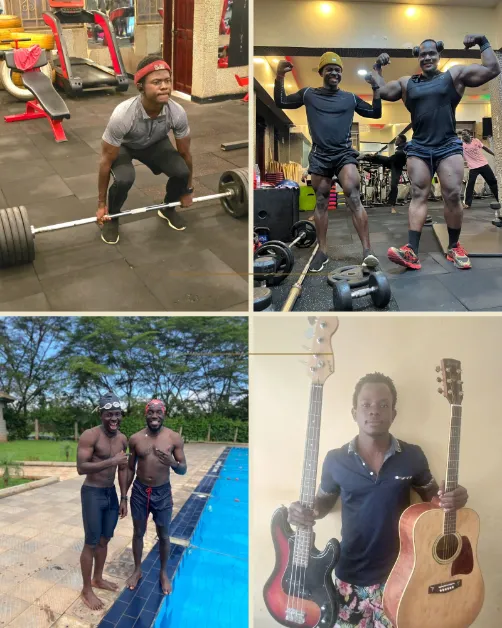
Mununuzi Timothy Kisakye is a writer and creative thinker who blends storytelling with critical reflection. With a background in Human Nutrition, he is passionate about crafting articles that explore deeper perspectives and connect meaningfully with readers. Timothy is the creator and chief author of the bookmeal1 blog and continues to sharpen his voice through thought-provoking commentary in particular- book reveiws. He is also is the voice behind Insightful Perspectives 360, a YouTube platform dedicated to deep discussions on global and local controversies and lifelong learning. This platform explores the intersections of politics, science, philosophy, and culture with a critical, red-pill approach. Through book reviews and opinion pieces, he aims to expand minds and ignite meaningful conversations. Timothy enjoys swimming, gym, callisthenics, and playing the piano, always seeking fresh inspiration when not writing. He believes in writing that not only informs but leaves an impact.