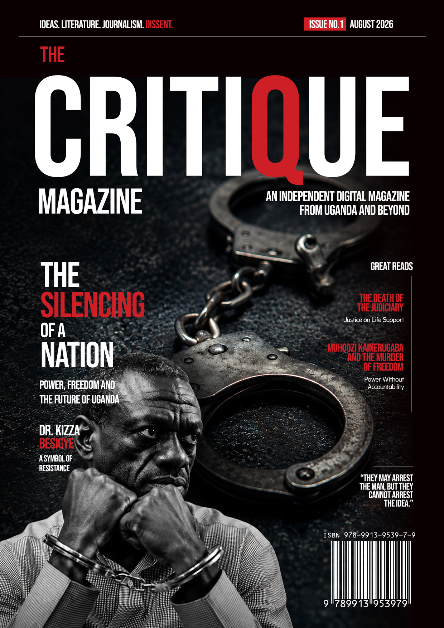

The Silencing of a Nation
An Editorial on Memory, Truth, and the Refusal to Be Silent.
29 Jul, 2026
Share
Save
Silence is a dangerous inheritance. It is the language every oppressor wishes to pass on to the oppressed. Before prisons are built, before constitutions are mutilated, before the law is bent into a walking stick for the powerful, silence must first be planted in the hearts of ordinary people. Once a people begin to fear their own voices, tyranny no longer needs to knock on their doors; it has already made itself at home.
The Critique Magazine is born from our refusal to inherit that silence.
We have not founded this magazine because there is a shortage of publications. There are newspapers. There are television stations. There are radio programmes. Countless voices are speaking every hour. Yet a nation may speak endlessly and still fail to say the things that matter. Noise is not courage. Commentary is not criticism. Information is not truth. A society that fears asking difficult questions eventually forgets how to answer them.
This magazine exists because words have consequences. A sentence can awaken a sleeping conscience. A poem can preserve the memory that a government wishes buried. An essay can expose the hypocrisy that official speeches perfume. A novel can tell the truth after history has been rewritten. Literature, journalism and criticism are not decorations for peaceful societies. They become necessities precisely when a people are taught that comfort is preferable to conscience.
As my academic friend Timothy says, we reject that lesson.
We reject the convenient lie that criticism is hatred. We reject the expectation that writers should first seek permission before naming injustice. We reject the belief that journalism exists merely to record events without examining the forces that produce them. Above all, we reject silence masquerading as neutrality.
Neutrality has become the refuge of frightened consciences. History has never been changed by those who watched from the fence while injustice marched through the village. Every generation is remembered either for the questions it asked or for the silence it defended.
This inaugural issue, The Silencing of a Nation, is therefore more than a collection of articles. It is an argument with our time. It asks why institutions established to protect citizens increasingly struggle to inspire public confidence. It asks whether journalism still possesses the courage to scrutinise power. It asks what becomes of a nation when corruption ceases to shock, when fear becomes ordinary, when citizens begin to mistake survival for freedom, and when silence is celebrated as wisdom.
Within these pages, our contributors wrestle with questions of press freedom, human rights, corruption, constitutionalism, the economy, literature, minority rights, women in public life, the judiciary, and the future of our democracy. They do not write because they possess all the answers. They write because difficult societies demand difficult questions.
That is the responsibility of this magazine.
We shall publish essays that disturb comfortable lies. We shall publish poems that remember what official records forget. We shall publish stories that rescue ordinary people from historical oblivion. We shall review books because books remain among the few places where truth is still allowed to breathe without interruption. We shall disagree with one another where necessary, but we shall never surrender the right to think, to question, and to write.
The greatest tragedy that can befall a nation is not that its people are oppressed. History is full of oppressed peoples who eventually liberated themselves. The greater tragedy is when oppression becomes familiar; when citizens adapt to injustice as though it were the natural order of things; when fear is inherited like family land, passed from one generation to the next without protest.
I reiterate, that is the silence we refuse.
If these pages provoke debate, they have succeeded. If they disturb complacency, they have served their purpose. If they encourage even one reader to think independently, one writer to refuse self-censorship, one journalist to ask a more difficult question, or one young person to discover that ideas are themselves a form of resistance, then this magazine will already have justified its existence.
For nations are not rescued by silence.
They are rescued by memory.
They are rescued by truth.
They are rescued by those who refuse to surrender either.
Welcome to the first issue of The Critique Magazine.
Editor-in-Chief
The Critique Magazine
About the author
The Critique Magazine is an independent publication dedicated to critical thought, creative expression, and public debate. It serves as a platform where writers, journalists, and thinkers share perspectives on literature, politics, human rights, and social issues affecting society. The magazine encourages open dialogue and challenges conventional ideas through essays, commentary, and analysis.