
Those who arrive late are punished by life
Pensive in Entebbe: Too early is a decision, too late is an outcome.
13 Apr, 2026
Share
Save
“ Those who arrive late are punished by life.” –sentence attributed to Mikhail Gorbachev, spoken in 1989 in the context of the upheavals in Eastern Europe. It was less a warning than a diagnosis: systems that misread their own timing lose the moment when change is still possible. The sentence endures because it has outgrown its context. Today, it lands more quietly—and with greater precision.
At the airport, its meaning becomes tangible. The space is bright, the routes are clearly marked, the clock is visible everywhere—and yet time splits into two recognizable patterns of behavior. Some arrive far too early. They sit with a coffee at the gate long before boarding begins, as if they have built themselves a buffer against the world. Others appear at a run, eyes switching between the screen and their watch, as if time were negotiable. In between: a system that does not negotiate.
It is tempting to read this morally—the disciplined versus the careless. But that misses the point. What we see is not a matter of character, but of perception. Early arrivals think in sequences. They see the process as a chain: arrival, check-in, control, gate. They calculate not the ideal case, but the disruption. For them, time is not a point, but a field with friction. Late arrivals, by contrast, orient themselves toward the visible endpoint: departure time. 17:30 becomes the internal anchor; everything before it feels like flexible lead time. The brain smooths complexity, reduces uncertainty to habit. “It worked last time.” And each time it works, the model hardens—precisely where it is most fragile.
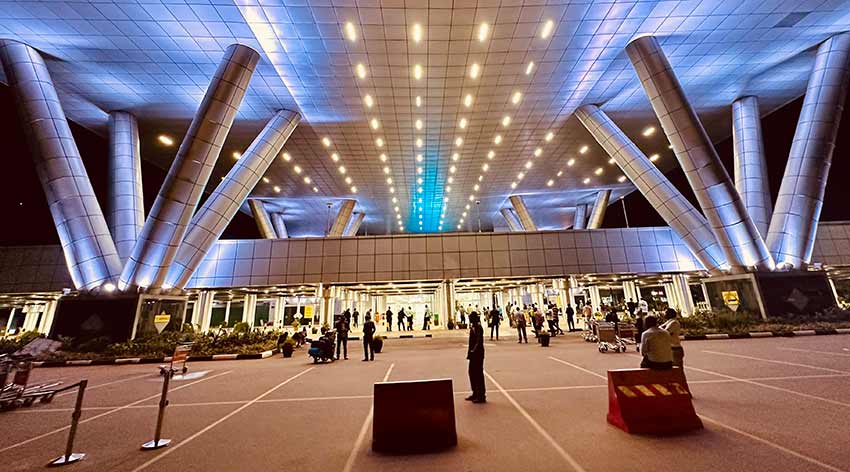
At Entebbe International Airport this difference sharpens. Time is less standardized, processes more porous, queues not the exception but part of the structure—shaped by infrastructure limits, staffing constraints, and informal procedures. To arrive early here is not simply caution—it is adaptation to an environment where predictability is limited. To arrive late is to import a different expectation: that systems will adjust, that margins exist. Two models of time collide—one that anticipates uncertainty, and one that underestimates it.
And yet it would be too easy to localize this logic. Even in Germany, where punctuality long functioned as a cultural self-description, time has become less reliable. In Munich, staff shortages and rising passenger volumes regularly produce bottlenecks at security. And in Berlin, the story of the new airport began with its own irony: the Flughafen Berlin Brandenburg was meant to open—and did so only nine years late. Today, even here, travel requires contingency. The difference lies less in geography than in expectation: a cultural narrative of reliability that often outlives the reality it once described.
The decisive error is not timing, but the point of reference. Those who anchor themselves to departure time miss the actual deadline. A flight “closes” long before it takes off—quietly, but definitively. Time is misaligned. And because this misalignment is invisible, it repeats itself.
It would be convenient to turn this into a personal moral. But the more interesting reading is political. Societies organize themselves along similar temporal logics. Some build buffers, prepare transitions, limit power before it hardens. Others ignore the visible endpoint, continue as if time were still available, until a structural closing point is reached—abruptly, without exit.
In Uganda this becomes visible in the duration of power. When transitions are not planned, when institutions are not opened early enough for change, the same illusion emerges as at the gate: that there is still time because departure has not visibly begun. But political systems, too, have invisible deadlines—constitutional limits, institutional thresholds, and moments of legitimacy that expire before the crisis becomes visible. They lie before the crisis, not within it.
Gorbachev’s sentence was not a threat. It was a description. At the airport, it can be observed every day. Some are already seated at the gate long before anything happens. Others run when it is too late. Both act rationally—within their model. But only one survives the moment when time ceases to be negotiable.
The well-known phrase is a journalistic condensation. What Mikhail Gorbachev actually said was:
“Dangers await only those who do not react to life.”
The question is not whether we know this—but when we act on it.
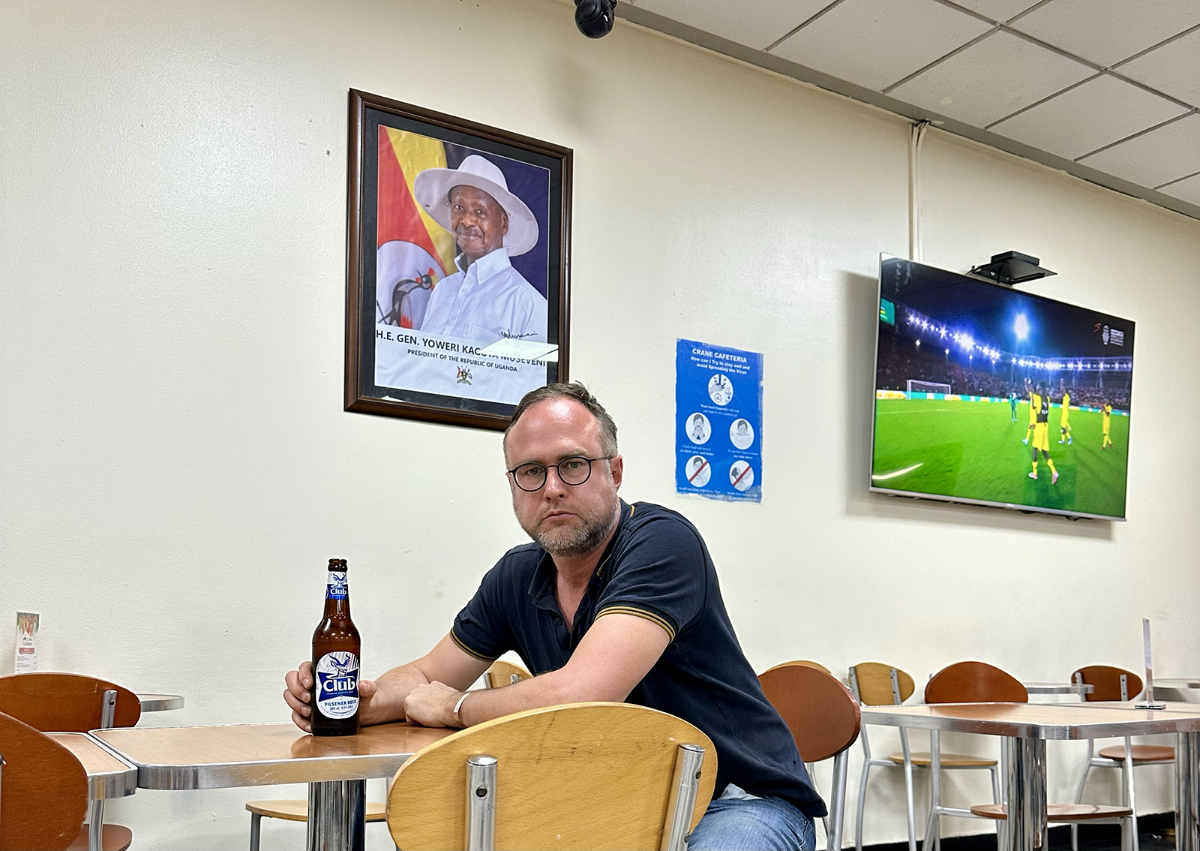
Cover photo: The author of this piece — once again far too early at Entebbe International Airport. Photo: Lookman Kampala
About the author
Konrad Hirsch is a filmmaker and journalist based in Berlin. He works across East Africa and Europe and writes about society, power and the fragile art of coexistence.