
While Museveni Eats the Country Away
Museveni is the pumpkin root that Ugandans should focus on uprooting, not Anita Among.
16 May, 2026
Share
Save
It is no longer surprising that we are easily swayed by triviality—things that barely matter to Uganda’s liberation struggle—and that we are hitched to the obvious while our motherland drifts towards Golgotha for its umpteenth crucifixion.
Uganda, indisputably, has been to Golgotha, not once or twice, and it has been crucified and suffocated to death. Uganda has died from autocracy—Museveni has ruled it for about forty-five years, with the help of the gun and by twisting the Constitution in his favour: scrapping the age and term limits, among other bills that would rather restrict him from ruling for eternity; the country has also died from kleptocracy—those in power have stolen Uganda’s resources without any iota of decorum, improvident of the country’s future.
For starters, corruption is not an abysmal vice in Uganda. In fact, all Ugandans are corrupt—regardless of how they publicly loathe it, they will always stick their hands into the public purse when no one is watching, as long as they have the chance.
For that matter, we lose nearly 44% of the country’s domestic revenue (approximately 10 trillion shillings) to corruption annually. Can we end this? We can. But that would collapse the regime since it is the only thing sustaining it.
President Museveni’s leadership has become so rusty that corruption is the only grease that keeps its wheels turning. In fact, corruption walks among us. It has ears. Corruption is a people, which is why, on several occasions, Museveni has admitted not going after the corrupt, even with empirical evidence, since they steal from and develop the country.
This is not accidental. Museveni is no longer popular among Ugandans—after he became the same monster he had once fought—and he knows it. So, the only way to prolong his reign is by giving people limited access to money in exchange for allegiance.
It is thus utter ignorance for one to think President Museveni detests corruption, especially as he portrays it in most of his speeches. Of course, in most cases, to prove to citizens that the law against corruption is sharp and relevant, he goes after petty thieves, ignoring looters on an industrial scale.
However, one admissible truth is that an undisciplined child is a reflection of his father, and it is unjust to vindicate the father while crucifying the child at the same time. When a child is a thief, then it is either that his father is a bigger thief or he is in support of the child’s stealing. Museveni is the father, and I doubt he is blind to the child’s stealing.
There has been concrete evidence against corrupt officials in almost all government entities, but instead, the law turned against the whistleblowers; they were either accused of public nuisance or blackmail. The corrupt have always been untouchable, and this has set such a grim precedent—those who embezzle are not the problem, but those who question those who embezzle are the real threat.
On July 23, 2024, Agora, a non-governmental organisation, under journalists Agatha Atuhaire, Godwin Toko, Dr Spire, the cartoonist and critic, and other concerned citizens, organised and took to the streets their frustration in the 11thParliament, chaired by Honourable Anita Among, who, according to reports, had turned the house into a marketplace for thieves. Honourable Among had used the parliament as a looting straw to drink from the country’s coffers.
Surprisingly, the security organs thwarted the peaceful demonstrations and arrested over 100 people. This farce was televised. Museveni watched it, and he concluded that these individuals were foreign-funded to destabilise Uganda’s peace. Anita Among, too, said these people were against her for passing the Anti-Homosexuality Bill, 2023. She further called the demonstrators bumshafters.
That way, corruption was protected while the whistleblowers were crushed, as Museveni often refers to clipping his enemies’ wings.
Fortunately, the plight of Ugandans who demonstrated against the parliament’s corruption attracted international attention, and later Anita Among was sanctioned by international entities and barred from travelling to certain countries. Even after that, Museveni had not reacted in any way. He maintained that the demonstrators were funded by foreigners to topple his government.
But do Ugandans need to be funded to stand up against injustice and corruption in their own country? Are Ugandans too blind to acknowledge their decaying country?
On January 15, Ugandans experienced yet another bloody election, where many opposition leaders and supporters disappeared, were beaten to a pulp, and some were murdered by security organs in cold blood; ballots were pre-ticked, and vote-bribery was the day’s anthem, and even children were arrested and thrown in jail to rot without charge or trial. However, these facts, as of today, remain a whisper in people’s ears. Ugandans have moved on. Victims of the situation, like Bobi Wine, who challenged Museveni in the past election and is now in exile, and numerous supporters of his who have lost their lives and futures, have been forgotten.
Since then, several bills, including the Protection of Sovereignty, have been passed by the parliament. Of course, all these bills, squarely, are a pretext for protecting the country’s sovereignty—but beneath them lies a scathing truth—insulating Museveni’s failed governance from criticism. Criticism weakens regimes. Critics lay bare the bones of tyrants.
For all the bills passed by the parliament, Museveni has been awarding parliamentarians with money. And this kind of corruption, because it is a normalcy, has been ignored. How sad.
For the 2025/2026 fiscal year, Museveni alone was allocated approximately 508.58 billion shillings under State House, and later, the 11th parliament passed for him a supplementary budget, Schedule No. 5 (May 2026), worth 1.1 trillion shillings, of which 410 billion was allocated to classified State House expenditures and 110 billion for other classified outlays.
In an economically struggling country like Uganda, with prevalent poverty levels, such a budget for an individual is obscene—it does not merely portray corruption of the highest order, but it also reflects a lack of morality. As of today, Museveni throws money at whoever excites him: TikTokers, bloggers, and individuals, among others.
For the whole of this week, with the parliament preparing for the 12th speakership elections, after the swearing-in of the president on May 12, the country’s already foul political atmosphere has intensified.
The whole country is hitched to Speaker Anita Among, whose corruption is more pertinent to our politics than before. It all started after the speaker unveiled a 3.5 billion Rolls-Royce. Museveni’s son and Chief of Defence Forces, General Muhoozi Kainerugaba, together with Museveni himself, seem to notice Anita’s corruption at the moment, which they had earlier ignored, even when there was evidence pinning her. It is now that even the anti-corruption bodies have taken an interest in investigating Among’s sources of funds and properties.
While Ugandans are excited about the whole farce, one with eyes can easily see that this case is not merely about corruption but about politics. Honourable Among had become a force to reckon with among the members of parliament and other political entities around the country. Anita has been so influential that she has paralysed the opposition and even admitted publicly to doing so. She has been so fierce that not even a single parliamentarian could dare test her wrath.
Honourable Anita Among and her accomplices are in the hot seat at the moment for wanting to eat off the same plate as President Museveni—she has shown so much power that the only healthy way for the National Resistance Movement party is to clip her wings. Uganda has had bigger thieves than Among, but they did not threaten power. Anita has threatened Museveni’s power by garnering so much influence. That is her only crime, especially since Museveni and his family now have a favourite candidate for the speakership seat in the forthcoming parliament.
For years, Museveni has used different individuals and later discarded them after their assignments were done. Honourable Anita’s assignments are done. She has passed critical bills. She has crippled the opposition. She has hurt Ugandans irreparably. And now someone else has to take over from her. In fact, Anita Among did not pull the trigger; she only held the gun for the hitman—Museveni—who pulled the trigger on all occasions. And to laugh at her tragedy is to ignore the bigger problem, which has affected the country for the past forty-five years.
Museveni’s power and autocracy remain unchecked. Ugandans are now caught up between Anita Among’s saga, which is merely a drop in the ocean, and the speakership race; freedom of expression is incessantly crushed while political prisoners rot in jail without charge or trial, and security brutality soars. Ugandans are wretched.
And now Museveni is a hero, just like his son, Muhoozi, even when they have stripped Uganda of its dignity. We celebrate them for handpicking Anita, while we forget the most pertinent subject—the transition of power—since Museveni has aged. Of course, while eliminating the corrupt fellows is relevant to the struggle, it should not excite us. A devil’s house does not fall when he eliminates his own for reasons well known to him, but it falls when the devil himself perishes. What Museveni is doing is power recycling. He will install another “Anita” who is less of a threat to his power.
It is a revered inference that Museveni’s government can never survive without corruption; thus, Ugandans should not be bamboozled by Anita’s saga, which is more about power balance than it is about the public moral perspective. To kill a pumpkin stem, you have to uproot it from its roots—Museveni is the pumpkin root that Ugandans should focus on uprooting; otherwise, nothing will change. Uganda’s problem is a leadership crisis, which is the mother of all corruption, injustice, and the country’s moral decay. Anita, in this case, is just the tip of the iceberg. And as long as we are lost in petty conversations, Museveni will continue to eat this country away.
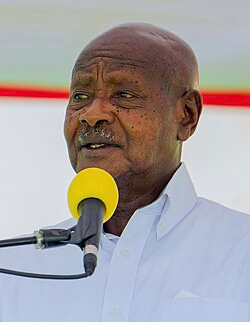
Photo Credit: Wikipedia
About the author
The Critique Magazine is an independent publication dedicated to critical thought, creative expression, and public debate. It serves as a platform where writers, journalists, and thinkers share perspectives on literature, politics, human rights, and social issues affecting society. The magazine encourages open dialogue and challenges conventional ideas through essays, commentary, and analysis.


.webp)