
Young Africans Are Merely Remnants
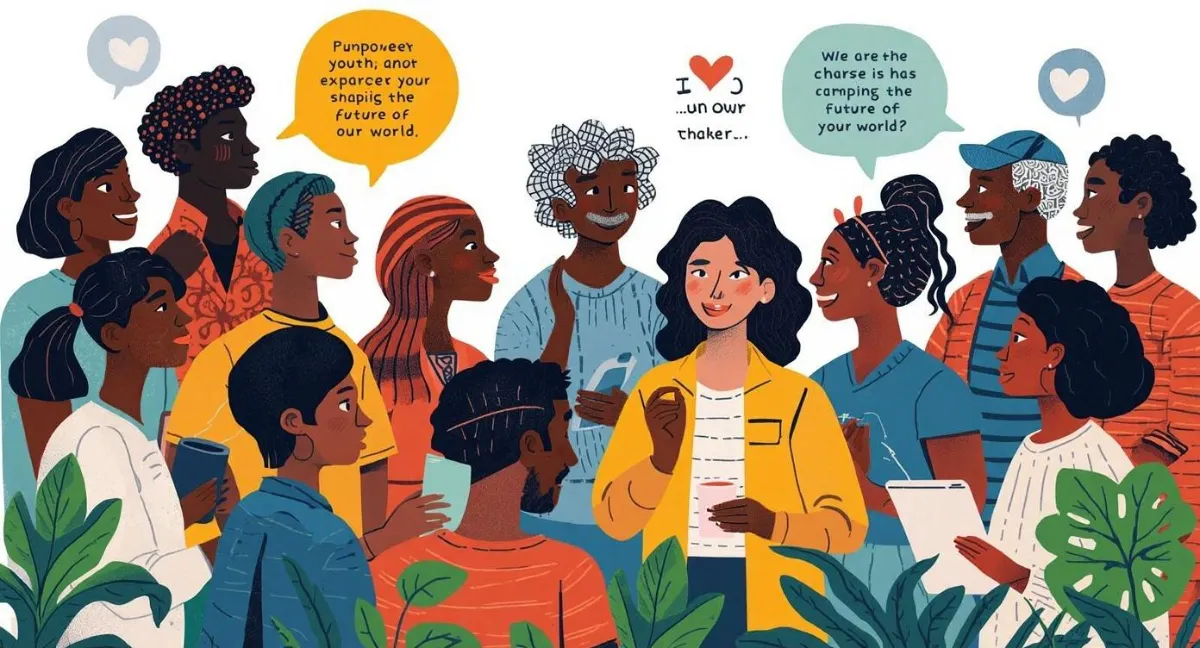
Inter-Generational Dialogue: Empowering Youth and the Need for Their Involvement in Shaping Our World.
14 Apr, 2026
Share
Save
“You are the young suckers that are to grow when the old bananas die.”
However, in today’s world—especially in Africa—young people are neglected, denied opportunities, and left to face an uncertain future. Thieves are canonised, while virtuous people are demonised.
To be courageous, honest, and determined is as dangerous as drinking acid. In today’s world, most people reap where they have not sown. The old bananas have deliberately refused to die.
This is a call to action: the older generation must engage in dialogue with the young, and the young must also engage the old. With the current status quo, it is the duty of the young to be angry—they have the right to be angry with the society of today.
One man once said, “We have given Africans the crown without jewellery; it is a toy to play with, and that is politics.” Indeed, the older generation has taken leadership as a toy, yet it is a badge of service, not a game.
We love being called "president", "member of Parliament", or "minister". We enjoy moving in cars, yet we own nothing and control nothing in the world.
History tells us that young people have always been the catalysts for change. Prophet Muhammad (peace be upon him) was 40 when he received revelation. Jesus was crucified at 33 but began reading at 12 and dialoguing with scholars. His disciples, who were all youths, performed tremendous works that changed the world.
Gandhi, the legendary leader, and Buddha were young men when they embarked on their remarkable journeys. Vasco da Gama explored the world at 37.
The acquisition of knowledge has no age limit. We only gain information and knowledge when we engage in reading, watching, and dialogue.
Jesus, at 12, was already reading and engaging scholars. What have you read? With whom have you dialogued?
We must break free from tribalism, nepotism, and favouritism. Our love for tribe has robbed us of balance and growth.
We are dominated both at home and abroad. If the creators of WhatsApp, TikTok, and Facebook took back their innovations, we would return to the Stone Age.
Young people, where are you? It is your energy and zeal that can change society. Do you have the zeal to get involved and accept being involved? Do you have the knowledge to support your zeal?
Today, youths use, participate in, and dine on food, yet they are excluded from real decision-making. This must change. Young people must rise, not in chaos, but in knowledge, purpose, and action.
Some say we belong to different religions, yet Gandhi rose after conflict between Muslims and Hindus, saying, “If we use religion to pay an eye for an eye, we make the world blind.”
We need intergenerational dialogue for our collective good.
Consider the colonisers who took over our continent; they were young men guided by their elders. What, then, should we dialogue about?
We need conversations through reading, watching, and sharing knowledge. As young Africans, what do we read, watch, and engage in?
The battle is the battle of the mind; knowledge is built upon knowledge. Let us rise to read both our own philosophies and those of others.
If we do not feed our minds through reading, how shall we compete with Americans, Arabs, Chinese, and Europeans who are reading and practising?
To acquire information, knowledge, and wisdom that will help us engage and participate, we must read widely—even religious texts regardless of affiliation: the Bible, the Quran, the Hindu Mahabharata, and Buddhist teachings.
History shows that young people transformed Europe by overthrowing monarchies and establishing constitutional governance. Napoleon Bonaparte, Benito Mussolini, George Washington, Modibo Keita, Solomon Mahlangu, and Obote are examples.
We need conversations on democracy, agriculture, engineering, industrialisation, technology, theology, and more. We must engage in discussions that bring change.
Today, Korea’s GDP stands at 1.2 trillion dollars, while Kenya’s is about 152 billion, yet in the 1990s, Kenya’s economy was five times larger than Korea’s.
Our universities have become certificate-issuing institutions rather than centres of learning and innovation. Instead of fostering engineering, research, and invention, many institutions focus on divisions such as tribal or cultural associations.
We must come together—young and old—to reason together. Otherwise, we will remain dominated. While other nations plan for the next 100 years, we remain divided by hatred and favouritism.
The Chinese say, “We learn from others and create our own.” They observed Western innovations and created platforms like TikTok and WeChat.
As Africans, what have we learned, and what have we created?
For African nations to grow and dominate, one African legend said:
“The tribe must die—not completely, but it must not be the basis for decision-making.”
Today, in China, conferences that generate innovation bring together people from across the country to learn, unlearn, practise, and actualise ideas. Meanwhile, we remain trapped in favouritism and segregation.
Dialogue must be based on knowledge. When you have knowledge, you lose fear. Knowledge gives you the courage to speak, to form opinions, and to challenge with evidence.
Sincerely, young people, you are the “young suckers” who will grow after the old bananas are gone.
There is also a saying: as long as the old goat does not die, the young one cannot fully thrive.
This means the older generation must mentor the young—those with the will and courage to bring change. Mentorship is reciprocal.
Ideas that transform society must be planted in courageous individuals—not those who seek to be politically correct, but those who are honest.
Therefore, for Africa to grow and dominate, tribes must not be the basis for decisions. Let decisions be guided by what is right and good.
Conclusion: A Call to Rise
Young people, do not wait to be engaged—get involved.
Elders mentor, empower, and work with the youth.
This partnership will transform Africa. And truly, if Africa rises, the world will become a better place for all.
“We want to catch a rat, but we are not concerned whether the cat that catches it is black or white.”
— Chinese Proverb
Let us learn from others, build friendships, and embrace inclusion, invention, and technological innovation.
About the author
My name is Abeson Alex, a student at St. Lawrence University, whose leadership journey reflects a deep commitment to service, integrity, and community transformation. I have held various leadership positions, including UNSA President of St. Charles Lwanga College Koboko, UNSA District Executive Council Speaker, UNSA Speaker for West Nile, and West Nile Representative to the UNSA National Executive Council. I also served as YCS Section Leader of St. Charles Lwanga College Koboko, YCS Federation Leader for Koboko District, and Koboko YCS Coordinator to the Diocese. In addition, I was a Peace Founder and Security Council Speaker for the peace agreement between St. Charles Lwanga College Koboko and Koboko Town College. I served as Debate Club Chairperson of St. Charles Lwanga College Koboko, District Debate Coordinator, and West Nile Debate Coordinator to the National Debate Council (NDC). All the above were in 2022-2023. My other leadership roles include Chairperson of the Writers and Readers Club, UNSA Representative in the District Youth Council, Students’ Advocate for Reproductive Health, and Students’ GBV Advocate for the District. Within the Church, I served as Chairperson of the Altarservers of Ombaci Chapel, Parish Altarservers Chairperson of Koboko Parish, and Speaker of the Altarservers Ministry in Arua Diocese. Current Positions: Currently, I serve as the Diocesan Altarservers Chairperson of Arua Catholic Diocese, Advisor of the Altarservers Ministry for both Ombaci Chapel and Koboko Parish, and Programs Coordinator of Destined Youth of Christ (DYC-UG). I am also a Finalist in the Global Unites Oratory Competition 2024, the current Debate Club Speaker and President of St. Lawrence University Koboko Students Association. Additionally, I am the Youth Chairperson of Lombe Village, Midia Parish, and Midia Sub-county in koboko district. I am one whose life has been revolving around ensuring that in our imperfections as humans, we can promote transparency, righteousness, and morality to attain perfection. I am inspired by the guiding words: Mobilization, Influence, Engagement, and Advocacy. I share my inspiration across the fields of Relationships, Career, Governance, Faith, Education, Spirituality, Anti-corruption, Environmental Conservation, Business & Self-Reliance, politics , Administration,Financial Literacy, Religion, and Human Rights. Thanks for the encounter.