Bridging Worlds: Konrad Hirsch at 50
German filmmaker, journalist, and cultural activist—honoured at 50 for championing art, expression, and dignity.
23 Mar, 2026
Share
Save
Konrad Hirsch turns 50. Half a century not defined by stations, but by movement: within Germany, between cities such as Dresden, Berlin and Munich; beyond continental boundaries, to places like the Seychelles and East Africa; between film and text, between art and political reality. It is the story of someone who encountered rupture early in life—and developed from it a way of thinking that connects.
.jpeg)
Konrad Hirsch with his mother Cornelia at the Dresden Zwinger, 1980.
Photo: Ernst Hirsch
Born in 1976 in Dresden, then part of the German Democratic Republic (East Germany)—a socialist dictatorship governed by an aging political leadership, marked by economic shortages, crumbling infrastructure, pothole-ridden streets, and repression enforced by the state security apparatus—Hirsch left the country with his family in the autumn of 1989, just weeks before the fall of the Berlin Wall. For many, this moment is a historical symbol; for him, it is a formative biographical experience. Growing up in reunified Germany—under conditions of freedom, stability and opportunity—he developed an early awareness that these circumstances are not self-evident. They are privileges. And for Hirsch, privileges imply responsibility.
.jpeg)
Father and son, Ernst and Konrad Hirsch, with historic film cameras.
This perspective is shaped as much by history as by proximity to film. His father, Ernst Hirsch, is a cameraman and documentary filmmaker—part of a profession grounded in observation, precision and patience. Konrad Hirsch grew up in this environment, learning early the language of images, the force of montage, perspective and light. It is no coincidence that he follows this path.
Photography shaped his visual sensibility early on. Working with analogue film—where developing images was still a chemical process—he spent countless hours in his father’s darkroom, learning not only technique but patience and precision. This formative experience deepened his understanding of images as crafted, material objects.
In Dresden-Wachwitz, he later pursued this passion further, running a photography gallery for several years. There, he gained curatorial experience that would inform his later work in organising and presenting exhibitions—extending his engagement with visual culture beyond filmmaking into the realm of curation and public presentation.
.jpeg)
Announcement of the cinema screenings of Konrad Hirsch’s Palucca film, 2002.
His first major works emerged in the early 2000s. He creates a striking portrait of the German expressionist dancer Palucca—an extraordinary artistic personality who maintained her place across very different political systems. The film captures not only the artist herself, but an attitude towards art shaped by independence and resilience. Hirsch takes on directing, cinematography and editing. This comprehensive approach already reveals his method: precise, close to his subjects, and deeply respectful of the material.
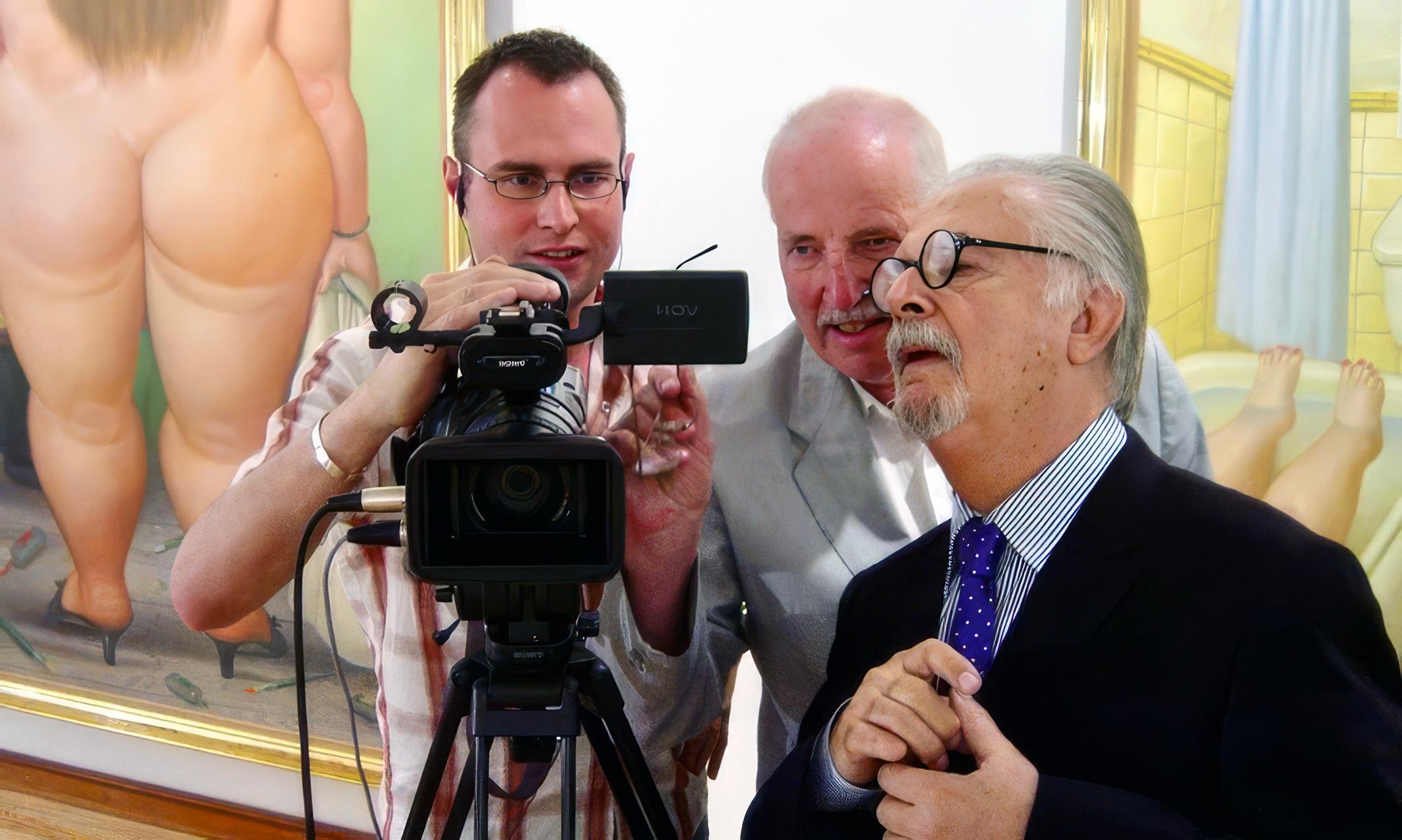
Konrad Hirsch during filming with Peter Schamoni and artist Fernando Botero in Colombia, 2005. Photo: Ernst Hirsch
Further projects follow within the cultural sphere. In “Botero – Born in Medellín”, Hirsch collaborates with filmmaker Peter Schamoni, contributing to script and camera, and is also involved in Schamoni’s documentaries on artists such as Max Ernst and Niki de Saint Phalle, as well as a feature-length portrait of Wilhelm II, the last German Emperor. He also realises widely noted documentary portraits of the Dresden painter Siegfried Klotz and the writer Wieland Förster—works that further underscore his sustained engagement with artistic biographies. These films reflect his interest in art and history beyond aesthetics—engaging with context, biography and the relationship between individual figures and their time.
At the same time, Hirsch’s work as a filmmaker spans a broader spectrum. He realises documentary films on subjects such as the art collections of the Principality of Liechtenstein and the German Watch Museum in Glashütte, while also producing commissioned films on themes like ecological agriculture. In parallel, he develops formats specifically designed for social media, adapting documentary storytelling to new modes of distribution and audience engagement. His experimental short film Erstschlag (2014), constructed from archival material, reflects his interest in reinterpreting historical images; the film was screened at international short film festivals, including Oberhausen.
.jpeg)
Archival work: Hirsch's film archive contains analogue film materials.
Shaped early on by Schamoni as a mentor, Hirsch deepens his cinematic approach through close collaboration on the director’s final films. After Schamoni died in 2011, he took over the production company, continuing its legacy while developing it further—preserving and re-presenting existing works and advancing new documentary projects between analogue tradition and the digital present.
His work is not confined to Germany. Screenings in Japan—where he presented films together with his father in 2024—international collaborations, and documentary projects with a global perspective are part of his professional reality.
Alongside filmmaking, journalism remains a second pillar of his work. Hirsch is a member of the German Journalists’ Association and contributes as a writer, commentator and observer. His focus is often political, with a clear attention to power structures and their consequences. In Hinterland Magazine, he writes about the lives of queer refugees—about arrival, uncertainty and hope.
Beyond these contributions, Hirsch maintains a steady presence as an author in established German media. He writes regularly for Berliner Zeitung and publishes in Die Weltbühne. His work often takes the form of portraits—of individuals, contexts and lived realities—and is shaped by a strong element of travel journalism, returning to places where political and social tensions become tangible.
.jpeg)
Exhibition at the Berlin Academy of Arts, 2026.
Photo: Derrick Kimera
As a guest contributor to The Critique Magazine, his writing turns to the fault lines of international politics: the tension between normative commitments and strategic interests, the role of Europe in dealing with authoritarian systems, particularly in Uganda, and the limits of external influence. His texts resist simplified moral narratives. Instead, they trace structures, expose contradictions, and examine shifting responsibilities. At the same time, they remain attentive to what may exist beyond confrontation: forms of dialogue, non-violent transformation, and the role of creative actors in processes of societal change. His writing combines careful observation with a restrained but unmistakable position—measured in tone, clear in implication.
His position is unambiguous: art and society cannot be separated. Artistic work is always political—whether consciously or not. Hirsch does not formulate this as a slogan, but as a conclusion drawn from lived experience.
That experience is not merely theoretical. In Dresden, Hirsch worked for several years as press spokesperson for the Palucca University of Dance, where he helped reshape the institution’s public image, giving it a more contemporary, international profile that was reflected in its communication and external presence.
.jpeg)
With Dr Lina Zedriga in front of the Embassy of Saxony in Berlin.
Photo: Lemi Frank Anguilla
In Berlin, he later worked for a period at the Representation of the Free State of Saxony to the Federal Government, in press and public relations. He organised events, moderated processes, and navigated institutional structures—work that required discipline, diplomacy and precision, and sharpened his understanding of political systems.
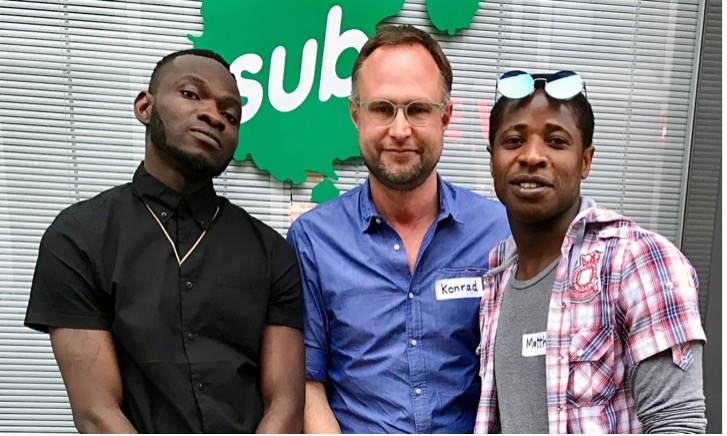
Volunteer work with refugees in Munich, 2016.
At the same time, his engagement remains grounded. In Munich, he volunteered in supporting refugees, accompanying them through the asylum process, assisting with bureaucracy and daily life. It is quiet, sustained work, carried out without publicity. Here, a defining aspect of his character becomes visible: a deeply rooted sense of solidarity and a humanist understanding of responsibility.
This commitment extends beyond individual cases. Hirsch consistently advocates for human rights as a universal principle—independent of religion, origin or sexual orientation. His work and engagement are guided by the conviction that dignity and freedom must apply equally to all, and that cultural and political practice cannot be separated from this ethical foundation.
This outlook is further shaped by his international experiences, particularly in East Africa. In Uganda, Hirsch encounters a political reality marked by repression, surveillance and restricted freedom of expression. The parallels to the East Germany he left as a child are tangible for him—not as an abstract comparison, but as a lived resonance.
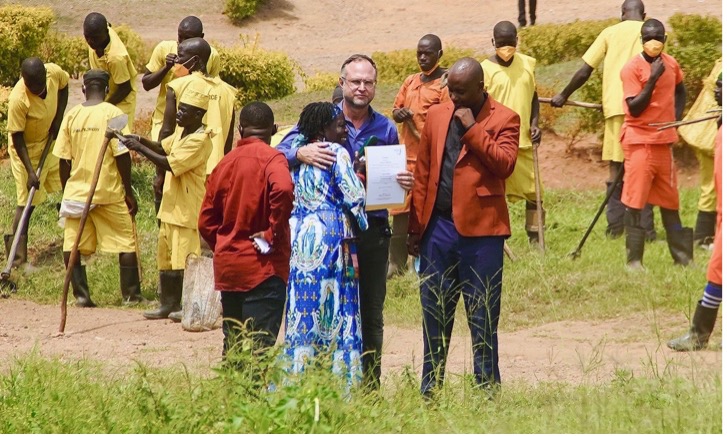
With the certificate of honorary membership of PEN Germany for writer Kakwenza Rukirabashaija in Kitalya, January 2022.
Photo: Lookman Kampala
He responds not only with analysis, but with action. He builds connections to opposition figures, supports activists, and brings cases of persecution into public view. In 2022, he visited Kitalya Prison near Kampala, where the imprisoned writer Kakwenza Rukirabashaija was being held, contributing to international visibility around the case.
.jpeg)
A summer day in Bonn with a musician and a writer from Uganda.
At the same time, his attention is drawn above all to the country’s creative voices: artists such as the musician and political leader Bobi Wine, the writer Kakwenza Rukirabashaija, the poets Stella Nyanzi and Sam Mugumya, and cartoonists like Ogon and Spire. For Hirsch, artistic expression carries a distinct political force. He believes that creativity does not merely reflect society—it can actively shape it.
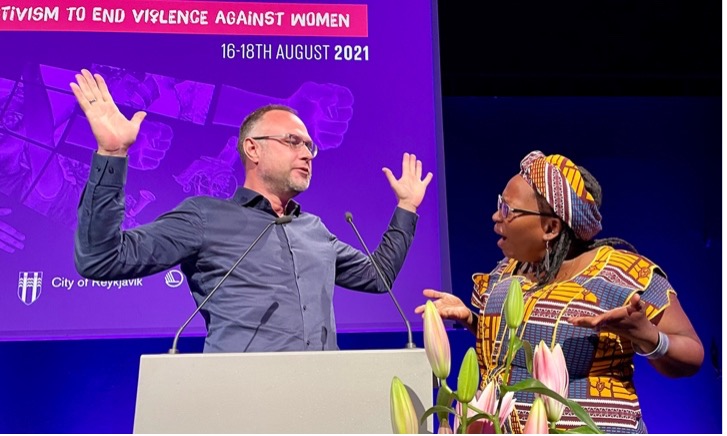
Debate with Dr Stella Nyanzi at a conference in Reykjavik.
Criticising the political situation directly or positioning himself as an activist is not how he defines his role. What drives him is something more nuanced: creating spaces in which these voices can be heard. Facilitating exchange, directing attention, enabling visibility—and thereby provoking reflection. It is a quiet but effective approach, grounded in respect and clarity.
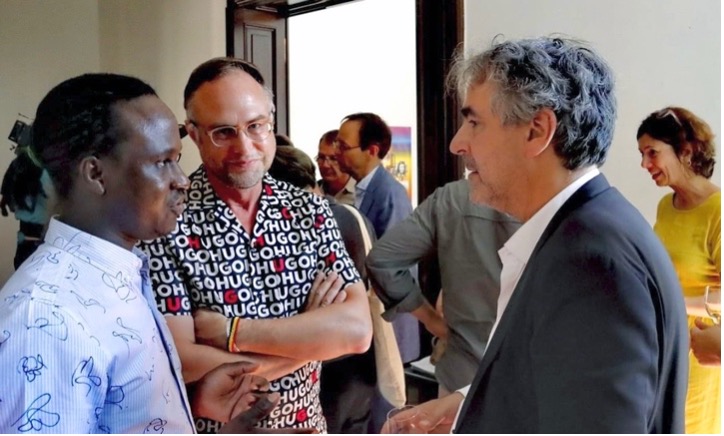
Founding day of PEN Berlin with founding member Edward Mutebi and PEN Berlin spokesperson Deniz Yücel.
As a co-founder of PEN Berlin, this commitment becomes institutionally anchored. The organisation advocates for persecuted writers and journalists, working to ensure that their voices are heard internationally.
Hirsch documents, connects, mediates. His projects give space to voices that would otherwise remain unheard. His work consistently operates at the intersection of journalism, film and activism. Notably, he shows a sustained interest in the lives and voices of women, less as a programmatic statement than as a natural extension of his perspective on society.
A key example is the film The Voices, created for International Women’s Day 2021. Here, Hirsch focuses on Ugandan women and their role in political and social transformation. The central idea is clear: “Women are a mighty force in Uganda’s liberation struggle.” Hirsch translates this into cinematic form, making visible experiences that are often marginalised, and offering an alternative narrative of resistance and agency.
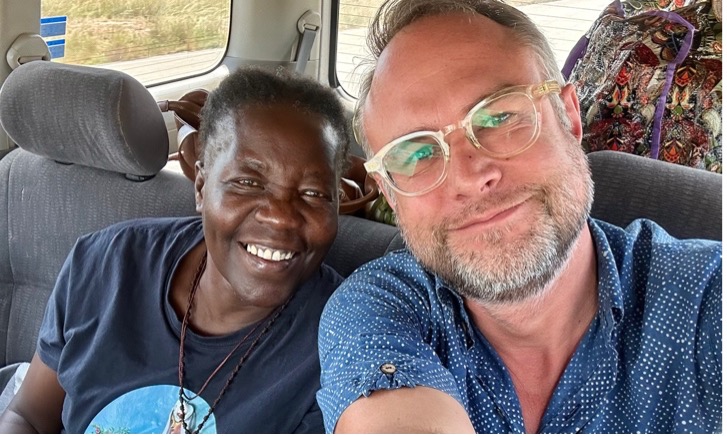
With Dr Lina Zedriga travelling in northern Uganda.
This approach continues in subsequent work. He adapts poems by Stella Nyanzi into film, bringing her radical and poetic language into a visual dimension. He documents the life of Dr Lina Zedriga, a prominent figure in Uganda’s civil society and political landscape—capturing her not only as a political actor, but as a complex individual whose biography reflects the tensions and aspirations of an entire society. He also portrays artists such as Gabriele Schnitzenbaumer, extending his focus to European cultural contexts.
Across these projects, a consistent intention emerges: visibility. To tell stories that might otherwise be overlooked. To observe with precision, to represent with respect, and to affirm that each of these voices carries social significance.
His engagement continues within Germany. Through the initiative Save the Dance, Hirsch advocates for transparency and accountability in the handling of the State Ballet School in Berlin. He raises questions, persists in demanding clarification, and remains committed beyond moments of resolution. For him, accountability is not an event, but a process.
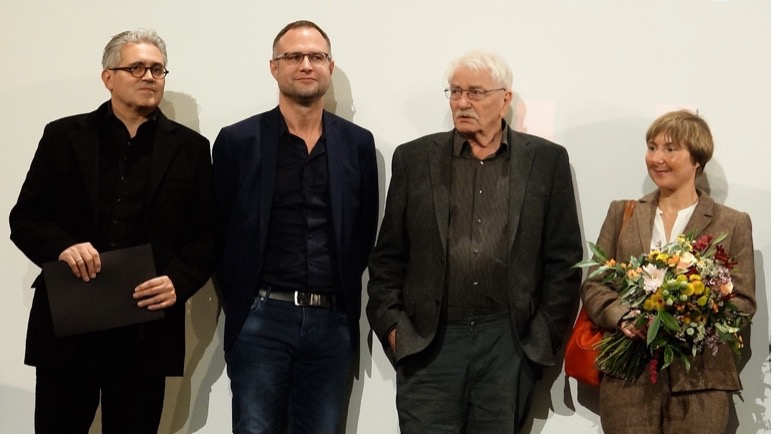
DEFA Foundation award for film retrospectives on the island of Hiddensee with Karl Huck, director Hermann Zschoche, and Wiebke Volksdorf.
Another field of his work is the Seebühne Hiddensee, a small, long-standing theatre project on a Baltic Sea island—an island where Hirsch has spent his summers since childhood. There, as chairman of the theatre’s supporting association, he curates and moderates film series, presenting works by the Schamoni brothers alongside the deeply moving DEFA films of director Herrmann Zschoche, creating a space where cinematic history and contemporary reflection meet.
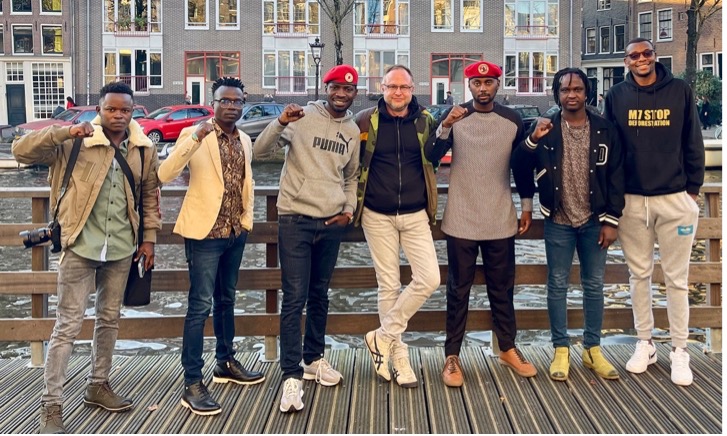
Delegation from Uganda in Amsterdam, 2022, on the occasion of the festival screening of the film Bobi Wine: The People’s President.
What runs through all these activities is a coherent conviction: that art, journalism and civic engagement are inseparable. That freedom, democracy and freedom of expression are not abstract values, but concrete conditions that must be actively defended.
Hirsch had the fortune of coming of age in a Germany that had become free and reunified. This experience continues to shape him. His travels—especially to East Africa—have made clear how fragile such conditions are. From this emerges a humanist orientation: to extend a hand where it is needed. With empathy, with ideas, with practical action.
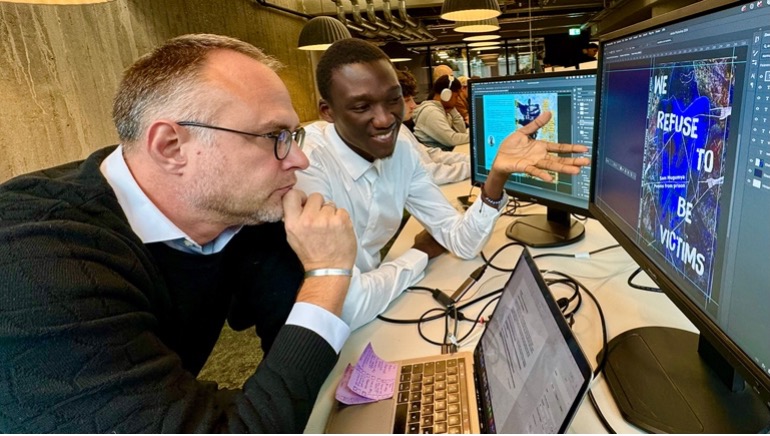
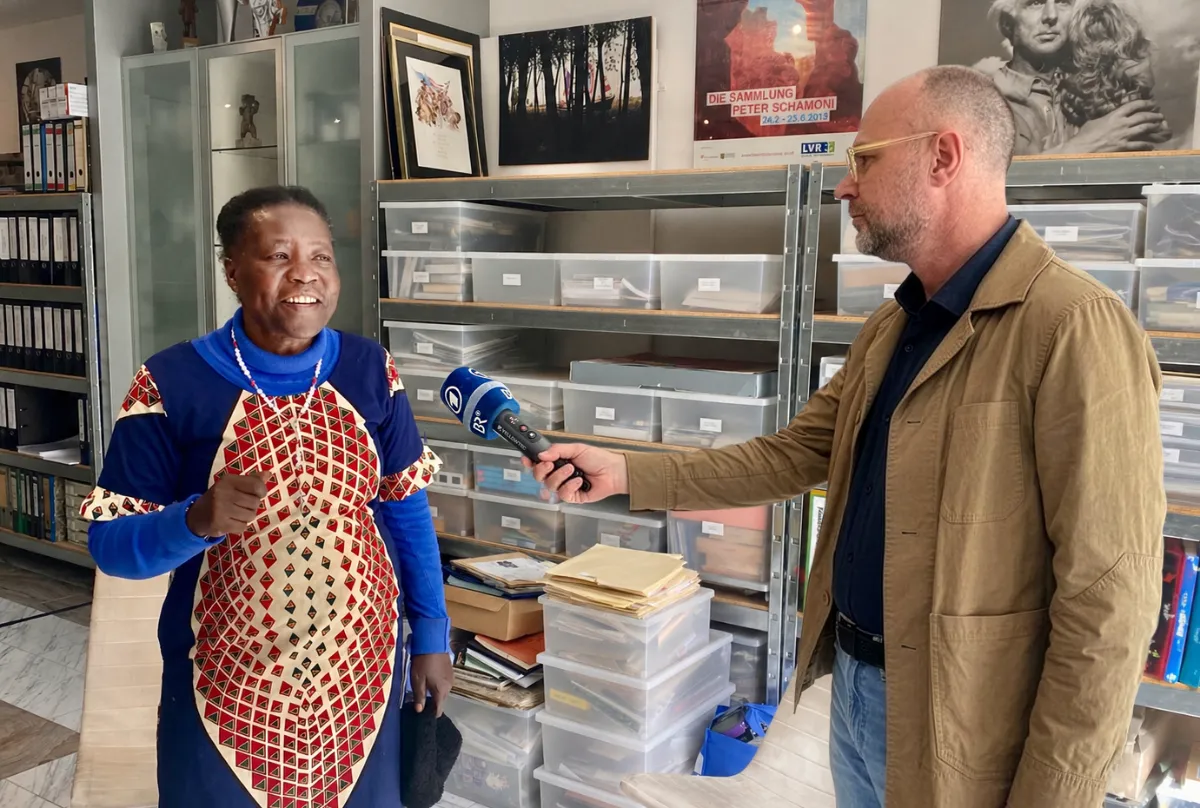
Konrad Hirsch and writer and journalist Godwin Muwanguzi discuss the layout of a poetry collection.
Photo: Tatenda Mudavanhu
In this sense, Konrad Hirsch is a bridge-builder. Between countries, disciplines and people. Someone who listens, who connects, who makes visible—without placing himself at the centre. His work is diverse, his paths are multiple. Yet at its core, it always returns to the same question: how a more just and freer society can be imagined—and what role each individual can play in shaping it.
At 50, this life cannot be concluded. It remains in motion. And perhaps that is precisely its greatest strength.
Feature Photo: Lookman Kampala
About the author
The author is a published novelist, and book editor at The World Is Watching, Berlin, Germany, columnist and human rights activist. He has written with The Observer Ug, The Ug Post, The Uganda Daily, Muwado, etc.