
Echoes in Matookeland: Why Political Writers Are The True Guardians of Our Conscience
Book Review: The Urgency of Godwin Muwanguzi's "A Nation of Chameleons, Crooks & Idiots".

30 Jun, 2026
Share
Save
“Let Them Wail. Uganda Belongs to Us.”
When the Commander of the Defence Forces (CDF) of Uganda dropped that phrase onto Twitter/X on the Saturday of 27th June 2026. It sent a cold through many of us. It was a succinct statement, but a deeply confusing one. In a country navigating the turbulent, twilight years of Mr Yoweri Kaguta Museveni’s four-decade rule, we are forced to ask a heavy question: Who exactly is "us," and who is "them"? The phrase triggered a memory of January 2017, when President Museveni bluntly declared, “I am nobody’s servant. I am a freedom fighter.” Reading the two statements side-by-side, a haunting pondering creeps in: Has our motherland been quietly relinquished to a select few?
It is in these precise moments of collective soul-searching that we begin to appreciate the terrifying, vital importance of our political writers. To speak uncomfortable truths in today’s climate is to bet your mental health, serenity, and your family's safety. Yet, a few courageous ones do it anyway. They hold up a mirror to the plight of the common citizenry. While a part of me desperately wants to believe the CDF meant Uganda belongs to all of us. The 56 tribes make up our vibrant 52.7 million people. The reality narrates a harsher story. True ownership of a country means the freedom to speak through the press and to shout down the corrupt officials plundering our national coffers. Therefore, to make sense of this modern political theatre, we have to look to the storytellers like the emerging voices of Godwin Muwanguzi, who are picking up a mantle passed down by literary giants.
In the footsteps of Orwell and Ngũgĩ
When we think of political mutiny in literature, George Orwell remains the gold standard. In 1984, Orwell explored the ultimate dystopian crisis: a world where an authoritarian regime uses draconian laws to stamp out dissent, mutilating the spirit of its citizenry through the stamp of the boot. It is a terrifyingly accurate mirror for contemporary Uganda, where the rule of law often feels like a malignancy to those in power. Orwell’s world perfectly captures what we might call the "tall poppy syndrome." In this environment, anyone who grows a little too tall, who speaks out too loudly against injustice, is promptly trimmed down either through arbitrary incarceration or extrajudicial silence.
It is this exact tension that Godwin Muwanguzi taps into in his brilliant political novel, A Nation of Chameleons, Crooks and Idiots. Set in a fictionalised, yet recognisable pseudo-country called Matookeland, Muwanguzi peels back the layers of governance to expose the raw nerves of religion, poverty, and institutional injustice. Reading Muwanguzi, it is clear he is a lifelong learner of Ngũgĩ wa Thiong'o. His narrative heavily echoes Ngũgĩ’s 1986 masterpiece, Matigari. In that novel, the protagonist returns home after the war for independence, only to realise with a broken heart that nothing has truly changed. The colonial masters wore new faces. The people remained destitute, and corruption became the new normal.
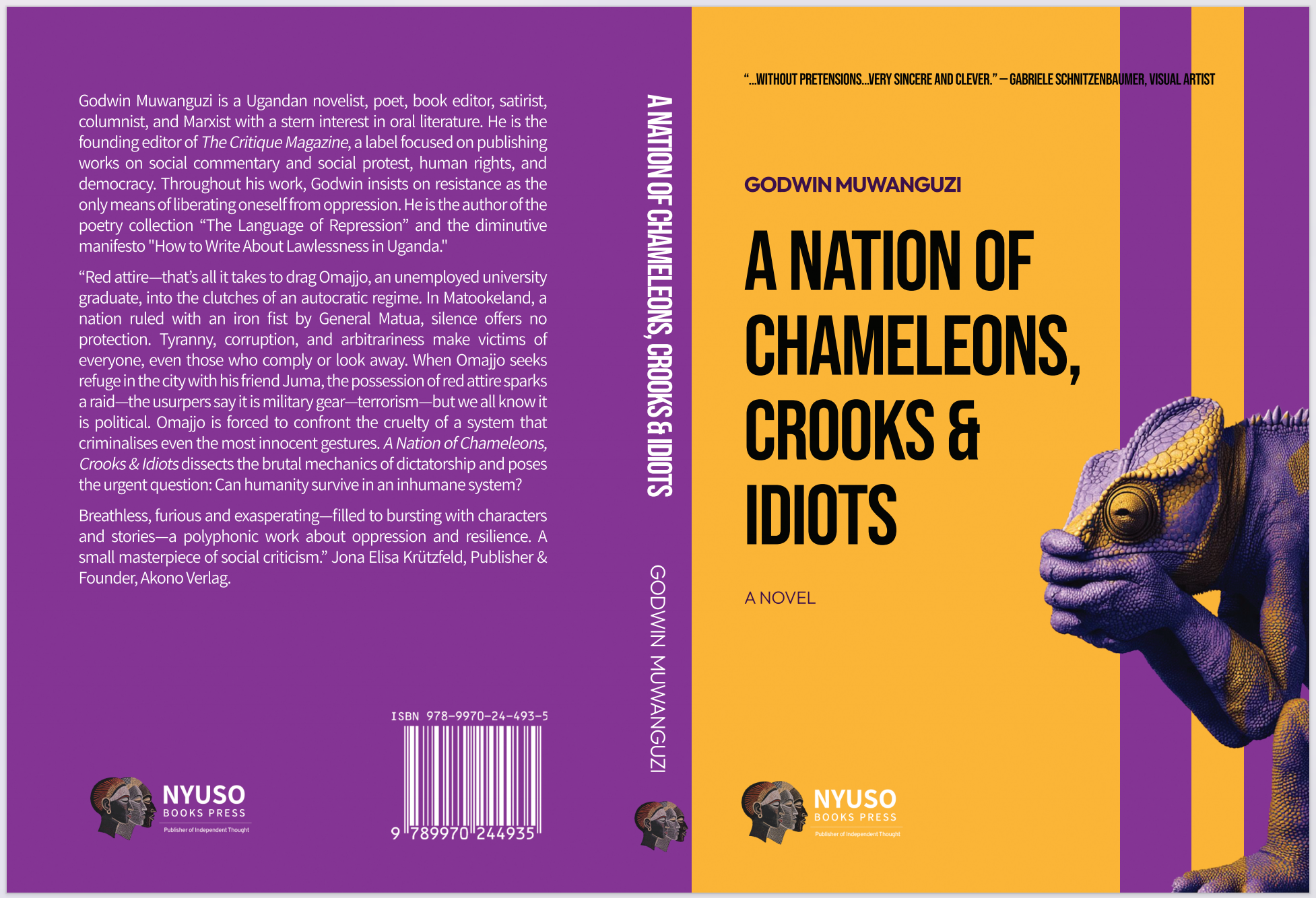
Muwanguzi channels this post-colonial disillusionment through his protagonist, Omajjo. Omajjo begins his journey as a reflective young man filled with prospective optimism. But as he walks through Matookeland, he is hit with one shattering revelation after another. Like many of us watching the news today, his optimism is forced to collide with a brutal, uncompromising reality. Ultimately, “Let Them Wail” is a reminder of why books like Muwanguzi’s matter. When the powerful draw lines between "Us" and "Them," it is the writers who remind us that the country belongs to everyone who weeps for it.
Order the book from: https://nuriakenya.com/product/a-nation-of-chameleons-crooks-idiots/
About the author
Born and raised in Uganda. Studied Science in Population Studies at Makerere University. He is a poet, playwright, and book reviewer. He has authored his first-ever commercial book called "The Muchwezi, The Flower & The Suitor" He is a shy person in real life; he fears looking people in the eyes. A broken person, unlucky in love and confused when he will find true Lover but passionate about People. He is an author of many unpublished poems, plays and novels due to financial constraints. When you see his books, please buy and support Him.