
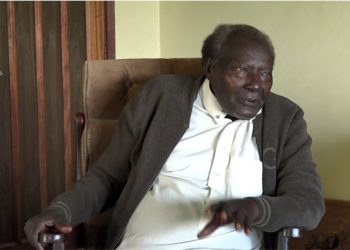
Eulogy and Tribute to Justice Prof. George W. Kanyeihamba
He didn’t teach law alone; he taught intellectual defiance, ethical resilience, and civic courage.
14 Jul, 2025
Share
Save
“The law is not a tool of rulers; it is the will of the people, tempered by justice, and sanctified by reason.”—Justice G.W. Kanyeihamba, From Justice to Judgement: A Jurist’s Journey (2023)
We are saddened as lawyers, judges, students, statesmen, and common citizens, not to mourn only, but to remember, revere, and relight the flame that Justice Professor George Wilson Kanyeihamba lit across the legal, intellectual, and civic spaces of our continent. Uganda did not merely lose a judge; Africa lost a jurist of Plato’s ideals—the philosopher-king whose robe bore not just the weight of legal fabric, but the truth of constitutional spirit.
He was more than a judge; he was a conscience in black robes, a man who stood at the very summit of judicial reasoning, yet remained anchored in the valley where rights are born and justice is most needed.
The law did not make Justice Kanyeihamba—he helped make the law. In the hallowed chambers of Uganda’s Constituent Assembly, his voice was a plumb line for constitutional clarity. As chair of the Legal and Drafting Committee, he helped craft the 1995 Constitution, a document he saw not as a political compromise but a sacred covenant:
A constitution is not a façade for rulers, but a fortress for the ruled."
He believed—deeply—that Uganda’s Constitution must never become a plaything in the hands of regimes. To him, a constitutional amendment without the pain of civic consensus was not reform but regression disguised as legality.
On the Supreme Court (1997–2009), he did not merely interpret laws—he interpreted power itself, and insisted that it must bow to justice. His brave dissent in the 2006 Presidential Election Petition was not just a legal note; it was a moral symphony:
The legitimacy of power lies not in numbers announced, but in procedures followed.
Even as others chose caution, he chose the higher danger of truth, declaring openly that irregularities in the re-election of President Museveni were so substantial that the result ought to be annulled. He redefined the role of a judge in Africa: not merely as a resolver of cases, but as a custodian of national destiny.
He was harassed, sidelined, even mocked—but never silenced. He once said:
The ugliest betrayal is not political—it is judicial silence when justice cries out.
Even in retirement, he remained a lion of civic virtue, challenging illegal rearrests of court-granted bail, suing the state over bail reforms, and defending public morality without fear or favour. Unlike many who drift into silence, he aged into activism grounded in scholarship.
As one of the privileged few to review some of his final manuscript, I witnessed a mind still sharp, still searching, still angry—but righteously so. His works are not just a legal thesis—they are a judicial gospel for Uganda, Nigeria, Kenya, and every other democracy at a crossroads.
He wrote with the precision of a surgeon and the conviction of a prophet. In one passage, he observed:
When the robe of justice becomes a costume for complicity, the court ceases to be a court—it becomes theatre. And bad theatre at that.
That sentence alone is enough to rattle the conscience of a continent. And yet, he was never nihilistic. He believed that law, when properly applied, could redeem even the worst regimes, because it channels our shared morality into enforceable standards.
Whether serving as Chancellor of Kampala International University or the African Court on Human and Peoples’ Rights, he planted legal seeds that are now trees bearing fruit across the region. Thousands of lawyers, judges, and scholars speak today with echoes of Kanyeihamba in their syllables—even when they don’t know it.
He didn’t teach law alone; he taught intellectual defiance, ethical resilience, and civic courage.
We shall not see his like again soon. Justice Kanyeihamba stood where others ducked. He fought where others negotiated. He reasoned where others kept quiet. His law was not lodged in codes alone, but in conscience, in clarity and courage.
"It is better to stand alone with truth than to sit in chambers crowded with compromise."—Kanyeihamba, Justice is Not for Sale (1999)
And now, the robe lies folded, the bench is silent, but the legacy speaks.
I declare that his words will outlive his breath. They now belong to the ages, to students unborn, and to judges yet untrained.
Feature Image Copyright: Gambuuze