
A Country That Buried Itself Alive
In Uganda, corruption has graduated from being a crime to becoming an unofficial administrative procedure.
13 Nov, 2026
Share
Save
Kiogora is dead, and none attended her funeral!
Not because the death was unexpected, but because everybody was too busy surviving to mourn. The priests were negotiating their allowances, the politicians were counting their money, the police were guarding the cemetery, and the citizens were arguing over who should provide the coffin. Even the gravedigger had demanded a facilitation fee before digging the grave.
Kiogora died quietly. There were no sirens, no national announcement, no three days of mourning, and certainly no presidential address. Her death was so ordinary that the country barely noticed. In fact, Uganda had been practising death for so long that another corpse did not seem newsworthy.
Welcome to Uganda, the country where the dead are expected to clap for the living, where the hungry are advised to appreciate economic growth, and where citizens are congratulated for surviving conditions that should never have existed in the first place.
Here, poverty is not a national emergency; it is a lifestyle. Unemployment is not a crisis; it is an opportunity to become an entrepreneur. A graduate who has spent five years looking for a job is simply told to think outside the box, preferably a box that contains no money, no connections and no hope.
Hospitals are breathing their last, but official reports insist the health sector is making tremendous progress. Patients arrive with diseases and leave with prescriptions, unpaid bills and prayers. Sometimes, the only thing that receives immediate attention in a hospital is the cashier's desk. After all, even death must clear its financial obligations.
Our schools are producing graduates faster than the economy can accommodate them. We celebrate examination results as though certificates were employment contracts. A young person graduates with a degree, a transcript, a recommendation letter and an impressive collection of unanswered job applications. Eventually, the graduate discovers that the most marketable qualification in the country is not academic excellence but knowing someone who knows someone.
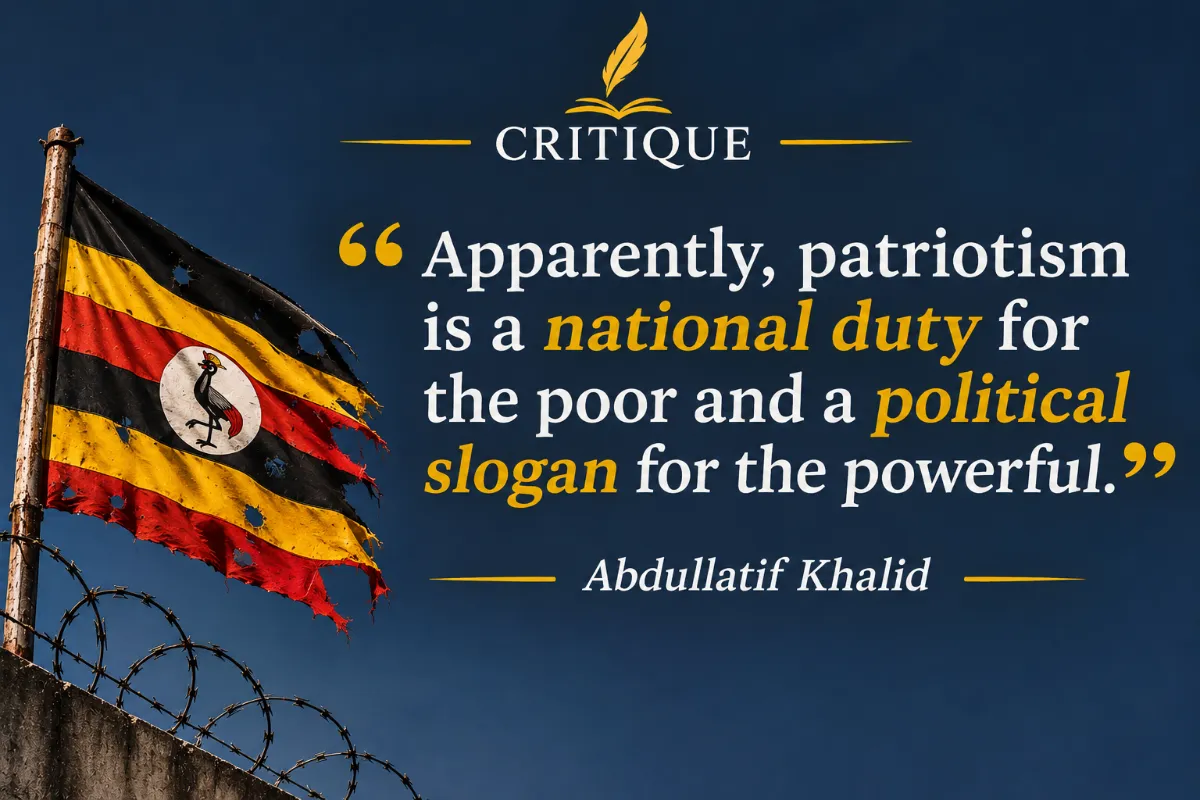
Meanwhile, Parliament remains alive and energetic. Honourable members debate, shout, suspend sessions and occasionally discover national problems during televised proceedings. They discuss the cost of living while enjoying allowances that ordinary citizens cannot earn in several months. They speak about sacrifice without ever explaining who should sacrifice what. Apparently, patriotism is a national duty for the poor and a political slogan for the powerful.
In Uganda, corruption has graduated from being a crime to becoming an unofficial administrative procedure. Money disappears from public projects with the mysterious efficiency of magic. Roads are commissioned before they are completed, projects are launched before they are funded, and investigations are announced before anyone remembers where the money went. We have become so accustomed to scandals that a clean public institution would probably be investigated for suspicious behaviour.
The roads tell their own stories. Some are designed for vehicles, others for swimming competitions during the rainy season. Potholes have become permanent geographical features, deserving names, historical recognition and perhaps parliamentary representation. A driver does not simply travel from one district to another; he negotiates with the landscape.
And then comes the question of leadership. Every few years, we are reminded that the country is progressing, that the economy is recovering and that the future is bright. Bright for whom, exactly? The businessman whose contract has been approved? The official whose salary has been increased? The politician whose children study abroad? Or the ordinary Ugandan who must choose between buying food, paying school fees and seeking medical attention?
The national anthem still plays, the flag still flies, and the speeches remain beautifully decorated with words such as development, transformation, patriotism and prosperity. But underneath the ceremonial language is a population increasingly exhausted by the distance between promises and reality.
Perhaps the greatest tragedy is not that Uganda is poor. It is that poverty has been normalised. It is not that corruption exists. It is that citizens have learned to expect it. It is not that public institutions are failing. Failure has become so familiar that demanding accountability is sometimes treated as an act of hostility.
We have buried our outrage, cremated our expectations and placed our dreams in a national museum. The young are looking for exits, the elderly are wondering what happened to the country they once imagined, and those who remain are learning to laugh because crying has become too expensive.
Kiogora is dead, and none attended her funeral. Perhaps they were all attending Uganda's.
But let us be careful: a dead nation is not necessarily one without a functioning government, a national anthem, a parliament or a presidential palace. A nation dies when its citizens lose faith in justice, when institutions serve individuals rather than the public, when the future becomes a privilege for the connected, and when the ordinary person begins to consider hopelessness a reasonable national policy.
Uganda may still be breathing. Its markets are open, its taxis are moving, its boda bodas are speeding, its politicians are campaigning, and its churches are praying. But somewhere beneath the noise of daily survival lies a country asking a very uncomfortable question:
Are we building a nation, or are we simply organising a funeral for generations that have not yet died?
And if Uganda is not dead, somebody should urgently explain why so many of her children are living as though they have already attended her burial.
About the author
Abdullatif Eberhard Khalid (The Sacred Poet) is a passionate, award-winning Ugandan poet, Author, educator, writer, word crosser, scriptwriter, essayist, content creator, storyteller, orator, mentor, public speaker, gender-based violence activist, hip-hop rapper, creative writing coach, editor, and a spoken word artist. He offers creative writing services and performs on projects focused on brand/ campaign awareness, luncheons, corporate dinners, date nights, product launches, advocacy events, and concerts, he is the founder of The Sacred Poetry Firm, which helps young creatives develop their talents and skills. He is the author of Confessions of a Sinner, Vol. 1, A Session in Therapy,A Nation in Mourning, and Confessions of a Sinner, Vol. 2. His poems have been featured in several poetry publications, anthologies, blogs, journals, and magazines. He is the editor of Whispering Verses, Kirabo Writes magazine issue 1, and edits at Poetica Africa.