
Museveni Fears Us
Consider Museveni’s final secret: he is afraid of us.
13 Nov, 2026
Share
Save
Museveni has mastered the art of speaking in opposites. He promises prosperity and delivers poverty; he vows peace and order, and the country gets chaos and force; he boasts of stability, and soldiers fill the streets, treating ordinary citizens as a threat to be managed rather than a public to be protected.
Psychologists have a name for what such a junta hopes to produce in its people. When an organism learns, through repeated experience, that nothing it does changes what happens to it, it stops trying. It is called learned helplessness. A republic of fear is learned helplessness at national scale, and its most efficient product is not the prisoner but the free citizen who has already concluded that resistance is pointless. That conclusion is manufactured, and it can be unlearned.
The preamble to Uganda’s 1995 Constitution opens by remembering our past: a history of political and constitutional instability, and our struggles against the forces of tyranny, oppression and exploitation. Article 1 then makes a promise: all power belongs to the people. But our history tells a harsher story. From Obote to Amin to the bush war that brought Museveni to power, power here has belonged not to the people but to whoever commanded the most guns. The Constitution remembers our bloodshed. Ugandans do not seem to have learned from it.
For a quarter of a century, Ugandans have walked to the polls believing the old civic gospel: that a voice unheard at the ballot box is a voice forfeited. But if voting truly had the power to change who rules us, would Museveni ever allow us to vote freely? What is the point of an election whose results are tallied by Byabakama in the dark? Here, the ballot can be silenced, and the petition that follows can be laughed out of court. The vote has become a ritual of consent, performed by the governed and wasted on the governor. A regime that must announce its popularity at gunpoint has already confessed the result.
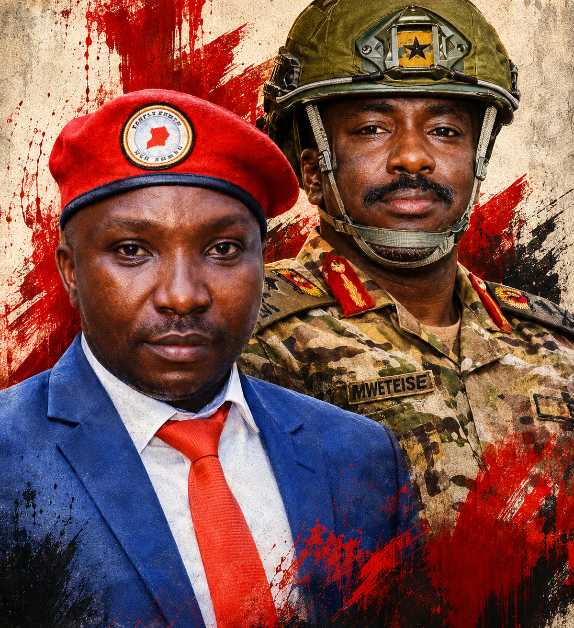
Look at what Museveni does to those who dare to oppose him. Kizza Besigye was seized in Nairobi in November 2024, hauled across the border and put on trial for treason, a case his lawyers say was born of an unlawful abduction and illegal military detention, and which many Ugandans see as the punishment for his politics rather than a pursuit of justice. Bobi Wine, who the official count says lost an election his supporters say was stolen, spent nearly two months hunted in his own country before slipping into exile. The army chief, Muhoozi Kainerugaba, has turned X into a stage for his menace: announcing that Eddie Mutwe was in his “basement,” promising to “behead” Bobi Wine, calling Besigye a “dead man walking.” And now, in October 2026, a Rwandan critic of Kagame, Robert Kabera, was found beheaded on the outskirts of Kampala, his head still missing. Whoever killed him, the message reaches every dissident, Ugandan or foreign: in this country, even exile is not safe, and neither is refuge.
Public punishment is rarely addressed to the victim. It is addressed to the audience. Behavioural psychology calls this vicarious conditioning: we learn what is dangerous by watching others pay for it.
The violence did not begin in 2026; it is the signature of a government four decades old. In 1989, 69 men were suffocated to death in a railway wagon at Mukura, and the President later apologised, though an apology is not justice. In 2016, soldiers and police stormed the palace of King Charles Wesley Mumbere in Kasese and killed more than 100 people, including children, in an assault no independent body has ever been allowed to investigate. In November 2020, at least 54 Ugandans were killed in Kampala when the arrest of Bobi Wine sent the youth into the streets. Torture chambers like Nalufenya, abductions of dissidents, and the removal of the age limit so that one man might rule for life complete a pattern. Each time, the state’s answer has been the same: bullets for the protester, silence for the grieving, and promotion for the commander.
In Museveni’s dictionary, “peace” is a verb for “to deploy.” From the late 1980s, Museveni backed the SPLM/A, the southern Sudanese rebel movement that, during the 1983 to 2005 civil war, was accused by rights groups of atrocities against civilians, including killings and the forced recruitment of child soldiers. Museveni armed and sheltered the Rwandan Patriotic Front, the force that marched out of Uganda into Rwanda in 1990, and whose troops UN investigators later accused of systematically killing Hutu civilians, a record the world has been slow to examine. Between 1998 and 2003, his army “kept the peace” in eastern Congo so thoroughly that the World Court ordered Uganda to pay Kinshasa $325 million for deaths, destroyed property and looted resources. Two decades later, the peacekeeper is accused again: a UN Group of Experts reported that Ugandan military and intelligence officials actively supported the M23 rebels who are now terrorising eastern Congo, and that M23’s leaders travelled to Uganda for meetings, while Kampala insists it is only cooperating with Congo’s government.
Even in Somalia, where Ugandan soldiers deployed under the African Union flag, Human Rights Watch documented allegations in 2014 of rape and sexual exploitation of Somali women and girls by Ugandan troops, and in August 2021 Ugandan soldiers killed seven civilians in Golweyn, a crime for which an African Union court-martial later convicted five of them. Kenyan activist Bob Njagi, freed in November 2025 after weeks in Ugandan military detention, said Ugandan soldiers told him they had been sent into Kenya in borrowed police uniforms to help crush the 2024 youth protests, during which, according to Kenya’s state human rights commission, at least 63 people were killed and 87 abducted between June and October. In Tanzania, after the October 2025 election massacre in which hundreds, perhaps thousands, were shot dead, reports surfaced of plainclothes Ugandan security officers among the shooters. The man who cannot keep peace at home is generous with the surplus abroad. At home, he calls it order; abroad, he calls it assistance. Everywhere, the word is the same, and so is the body count.
Stanley Milgram’s obedience experiments in the 1960s showed how readily ordinary people follow instructions from perceived authority, but also that obedience weakened sharply when others refused. Timur Kuran’s work on preference falsification explains why regimes appear stronger than they are: when everyone hides their private opposition, each person mistakes the silence of others for consent, a condition social psychologists call pluralistic ignorance. And Albert Bandura’s concept of collective efficacy names what breaks the spell: the shared belief that people acting together can produce change. Comparative research on resistance campaigns, notably by Erica Chenoweth and Maria Stephan, has found that nonviolent movements have historically succeeded more often than violent ones. None of this is a guarantee. All of it is an argument against despair.
Every tyrant’s season ends, and no regime outlives the consent of the governed. Power that rests on fear survives only while the fearful keep obeying. So the question is no longer what the opposition will do, but what each of us will refuse. Consent is not withdrawn by one leader in one square; it is withdrawn in a thousand ordinary places.
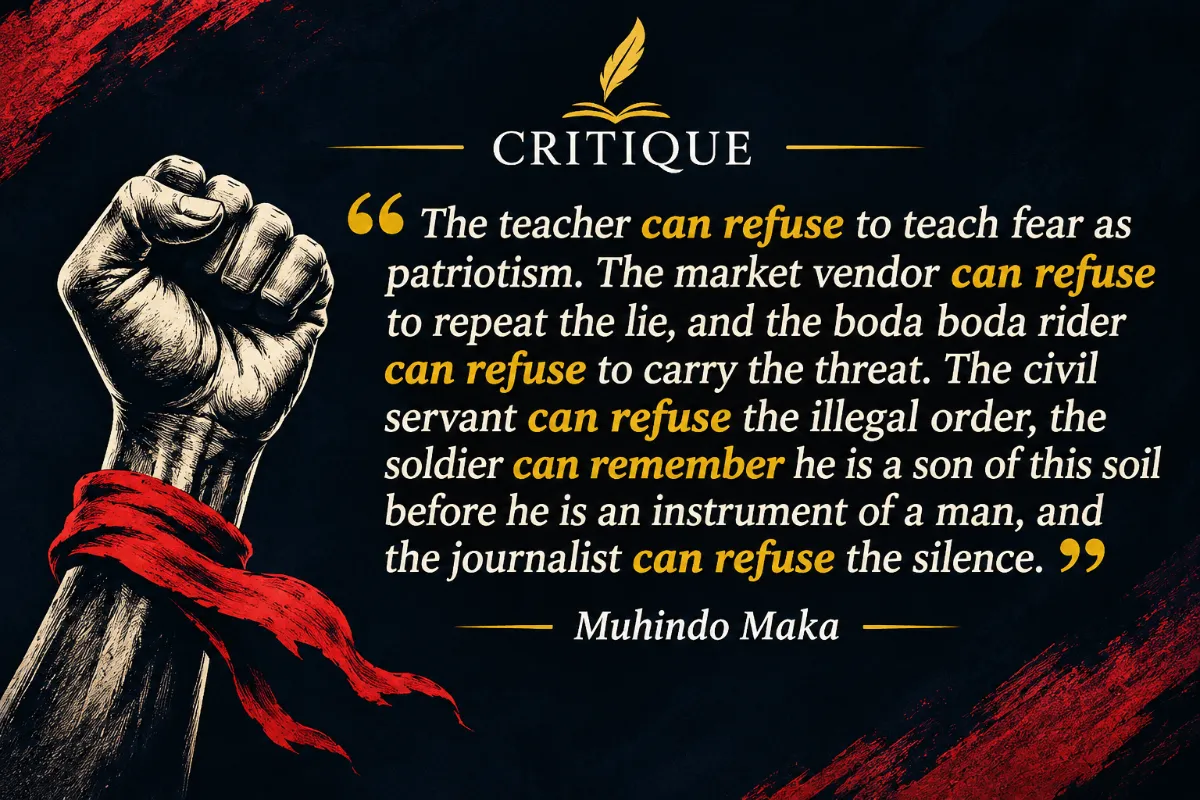
The teacher can refuse to teach fear as patriotism. The market vendor can refuse to repeat the lie, and the boda boda rider can refuse to carry the threat. The civil servant can refuse the illegal order, the soldier can remember he is a son of this soil before he is an instrument of a man, and the journalist can refuse the silence. Every Ugandan can record what they see, name the missing, stand with the family of the abducted, and share the truth that the state tries to bury. When enough of us do this, together and without violence, the machinery of fear stops, because it has always depended on us to run it.
The time has come to assemble, to refuse, and to claim the rights the Constitution promised on paper and the state denies in practice. No ballot or court has set us free. Our liberation will come from ourselves, through the collective, disciplined refusal to be ruled by fear.
We Ugandans must learn that freedom is not a fruit that waits to ripen and fall into our hands. Freedom has a price, paid in the currency of courage to challenge poor governance and the currency of solidarity to assemble and protest against atrocities. The ballot can be counted in the dark, but there are forms of power no commissioner can tally, and no soldier can seize: the strike that empties a workplace, the boycott that starves an unjust order, the refusal to obey an unlawful command, the camera that records what the state denies, the neighbour who stands with the family of the abducted. These cannot be rigged, because they do not pass through the hands of the regime. They live in the hands of the people.
We do not invent this right; we inherit it. Our Constitution’s own preamble recognises our struggles against the forces of tyranny, oppression and exploitation, and Article 3 declares that every citizen has the right and duty to defend this Constitution and resist those who would overthrow the constitutional order, and that doing so is no offence. When power rules by fear and the rules are bent to keep one family in State House, resistance is not rebellion against the Constitution. It is loyalty to it.
Fear is not a fact about the regime; it is a feeling inside us, and feelings change when we act against them. Anyone who has crossed the street they were warned to avoid, or told the truth aloud, knows how quickly the monster shrinks once it is looked in the eye. In 1933, Franklin Roosevelt told a frightened America that the only thing it had to fear was fear itself. He meant that terror, left unchallenged, does the oppressor's work for him. In Uganda, the regime has the guns, the files and the basements, but it has never had enough soldiers to stand in every kitchen, every classroom and every market. It has always relied on us to stand there for it.
So decide, today, what you will stop doing. Stop repeating what you know is false. Stop shrinking when the uniform passes. Stop mistaking the silence of your neighbours for their consent; ask them, and you will find they have been waiting for someone to speak first. Be that person. Learn the name of one of the missing and say it aloud. Tell one young person what you saw. Show up when a family needs a crowd.
I call on you all, young and old, to carry the torch through the darkened sky. No more silence in the struggle. Break free from Musevenism. Plant the seeds of liberation in the soil of our oppression, and let them grow. This fight against dynastic autocracy will not end in vain.
Consider Museveni’s final secret: he is afraid of us. Why else the internet blackouts, the basements, the soldiers on every corner? A ruler who is sure of his people does not need to threaten them. Fear is the currency of tyranny, and tyranny goes bankrupt the day we stop accepting it. So fear nothing but fear itself, and then, together, put an end to it.
About the author
Novelist. Poet. Political dramatist.