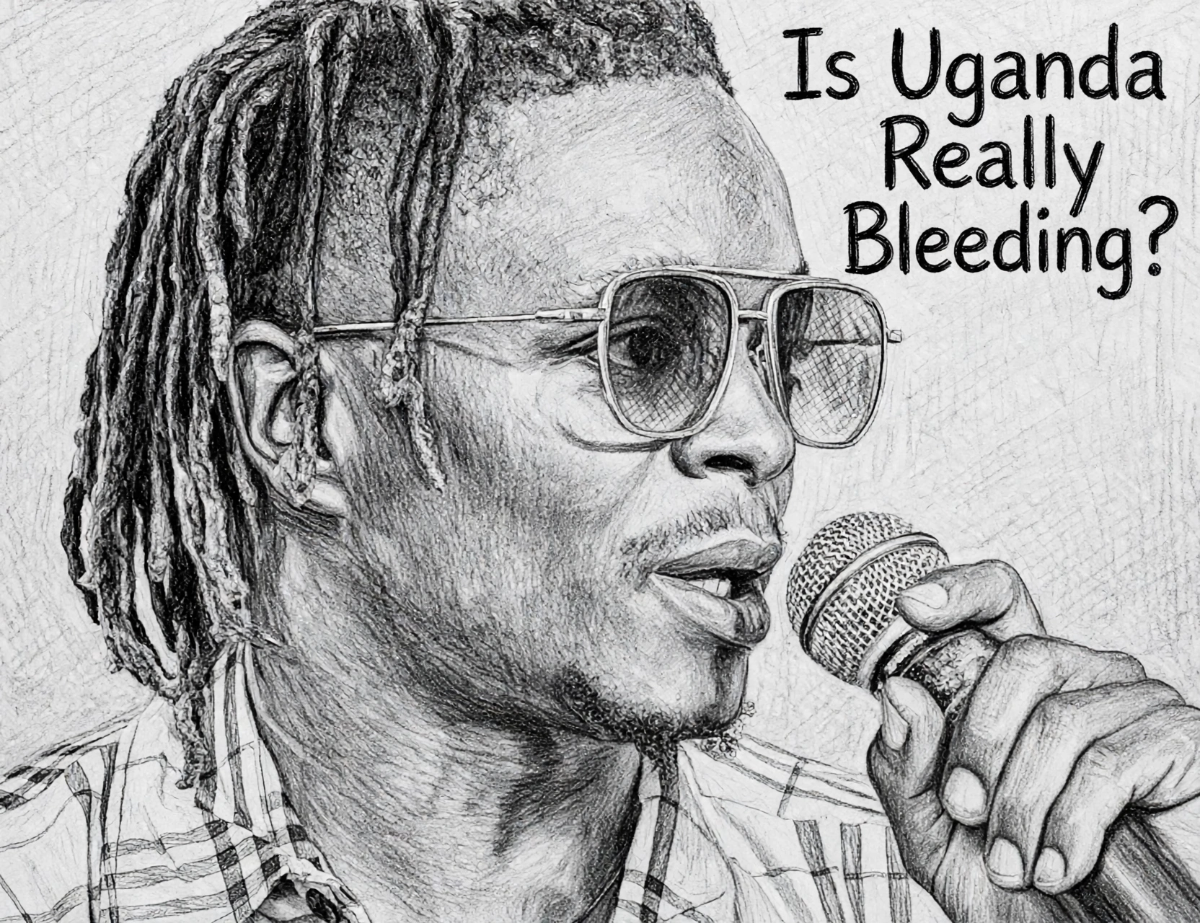

King Saha—Entertainment in Times of Political Crises: Is Uganda Really Bleeding?
Entertainment euphoria stifles a people’s ability to reflect. For an excited mind is a comfortable mind.
16 Aug, 2026
Share
Save
The opposition and critics have reiterated that Uganda is bleeding, that it is on the verge of collapsing, and that Museveni has become a headless arrow on the battlefield of restoring Uganda to at least its former self.
Of course, this is a substantiated fact: Uganda under Museveni has ceased to matter, as the focus has now shifted from building a sustainable and free country to ringfencing power for the Museveni family, thus replacing the ballot with the gun and justice with the first family’s political interests.
The crackdown on human rights is now a familiar song to which Ugandans dance restfully upon hearing. But the number of abductees soars, reports on the murdered flood newspapers and tabloids; political prisoners on trumped-up charges fill detention facilities; plain-clothed gunmen with incognito ‘drone’ cars incessantly terrorise common people, and hundreds of dissidents endlessly flee into exile—these are not exaggerated facts. Uganda soaks in human blood.
Suffice to say, Ugandans remain tolerant and happy—tolerant of the regime’s lawlessness and happy about the state of their wilting country—even with all their rotten politics; they dance and drink their problems momentarily into oblivion. What wretched people!
In Uganda, gossip, alcohol, sex, and European football dominate conversations. The populace is more excited about when and how much to drink, whom and when to shag, which football club is bigger in Europe and which is smaller, and who is most likely to win the English Premier League the following season. As a matter of fact, these conversations are a hit even among university professors.
We are hitched to trivialities. We know who a musician is sleeping with. We have nudes of celebrities in our phones. Alas, we know nothing about our country’s budget. We do not know how much money the president throws at flatterers, even when our health system is in shambles. We do not know how much has disappeared in the public service. We do not want to know about the nepotism that gnaws at the public offices. We even look away from the compromised justice system. We prefer entertainment to anything else.
Of course, this is not a coincidence. Entertainment is an important tool in controlling the masses. You let people dance off their indignation into oblivion while they forget the oppression they live in. You give them access to cheap alcohol and let them drink themselves away while you fortify your grip on power.
Entertainment euphoria stifles a people’s ability to reflect. For an excited mind is a comfortable mind. To question things, a mind must be perturbed.
Between 70 and 80 CE, the Roman Flavian dynasty constructed the Flavian Amphitheatre—the Colosseum—for entertainment purposes. The Colosseum was primarily a massive political tool. The emperors provided free food and entertainment to keep the restless lower classes happy and quiet. Because when people are entertained, when they are given crumbs of food, they stop thinking. They become unconscious. Yet, only with a conscious mind do a people rebel, and only on a hungry stomach do a people counter their masters for food.
Of course, entertainment in times of crises is not criminal. People ought to forget their suffering momentarily. But this is rather an acute irony in a Ugandan context; in a bleeding country, as we have cried out loud, concerts would be the last thing to ever think about. In a blood-soaked country, people do not dance; they mourn. They resist. They re-strategise.
On 14 August 2026, King Saha, a singer affiliated with the National Unity Platform—an opposition political party whose top leaders are in government detention facilities and some in exile at the moment, a political party whose supporters the regime has murdered in cold blood, abducted, and coerced into admission of treachery charges—held a live concert, drawing a mammoth crowd of fans to the Kololo Independence Grounds.
King Saha has posed as an acute critic of the Museveni regime. He has ridiculed the regime and its brownnosers in some of his songs. He has presented himself not just as an entertainer, but also as someone who cares about the suffering of common Ugandans. No one can ignore that explicit truth.
However, there remain several unanswered questions. For starters, the Kololo Independence Grounds are cleared for use by the Ministry of Defence and Veteran Affairs alongside the Uganda People’s Defence Forces, and the worst mistake would be giving access to the grounds to a government-astute critic, especially in times of a country’s political ambiguity, since the artist would easily mobilise and awaken the masses.
For instance, Bobi Wine was banned from holding any concerts in Uganda because the Museveni regime is aware of what armed art does to the minds of the enslaved people. It reminds them of their condition. And no one can stop a people who are conscious of their condition.
Music, throughout history, has been a counter-weapon against oppression. And regimes, throughout history, have banned songs that remind people of their suffering and thralldom. Regimes have arrested artists. They have murdered artists. Regimes have forced such artists into exile. Music does not just entertain, especially when a country is wilting away; music incites and awakens; it bruises.
And when King Saha successfully holds such a concert in the same country he claims is bleeding under the same regime that is oppressing his fans, then propositions are drawn: he is either wearing the struggle as a cocoon and the regime is aware of the big secret, or he is only using the situation to enrich himself. And when the NUP backs concerts like these, where people have to dance, then it is contradicting itself—perhaps the country is not bleeding. Because in a bleeding country, people do not go about dancing. They do not listen to flirty songs. In a bleeding country, people listen to revolutionary songs.
On this account, without contradicting oneself, one can easily conclude that the opposition, as long as it endorses entertainment in the face of injustice, is detached from the true struggle—a struggle that aims at mending the country’s political quagmire—and before teaching Ugandans how to resist the Museveni rule, it should first re-brief itself on the true state of the country. Otherwise, the opposition is equally irrelevant if entertainment is its priority.
About the author
The author is a published novelist, and book editor at The World Is Watching, Berlin, Germany, columnist and human rights activist. He has written with The Observer Ug, The Ug Post, The Uganda Daily, Muwado, etc.