The Hunter, the Lion, and the AI Death of Africa’s Knowledge
Colonialism silenced Africa with ink. Neo-colonialism muted it with economic policy.
09 Oct, 2025
Share
Save
The Proverb and Its Timeless Warning
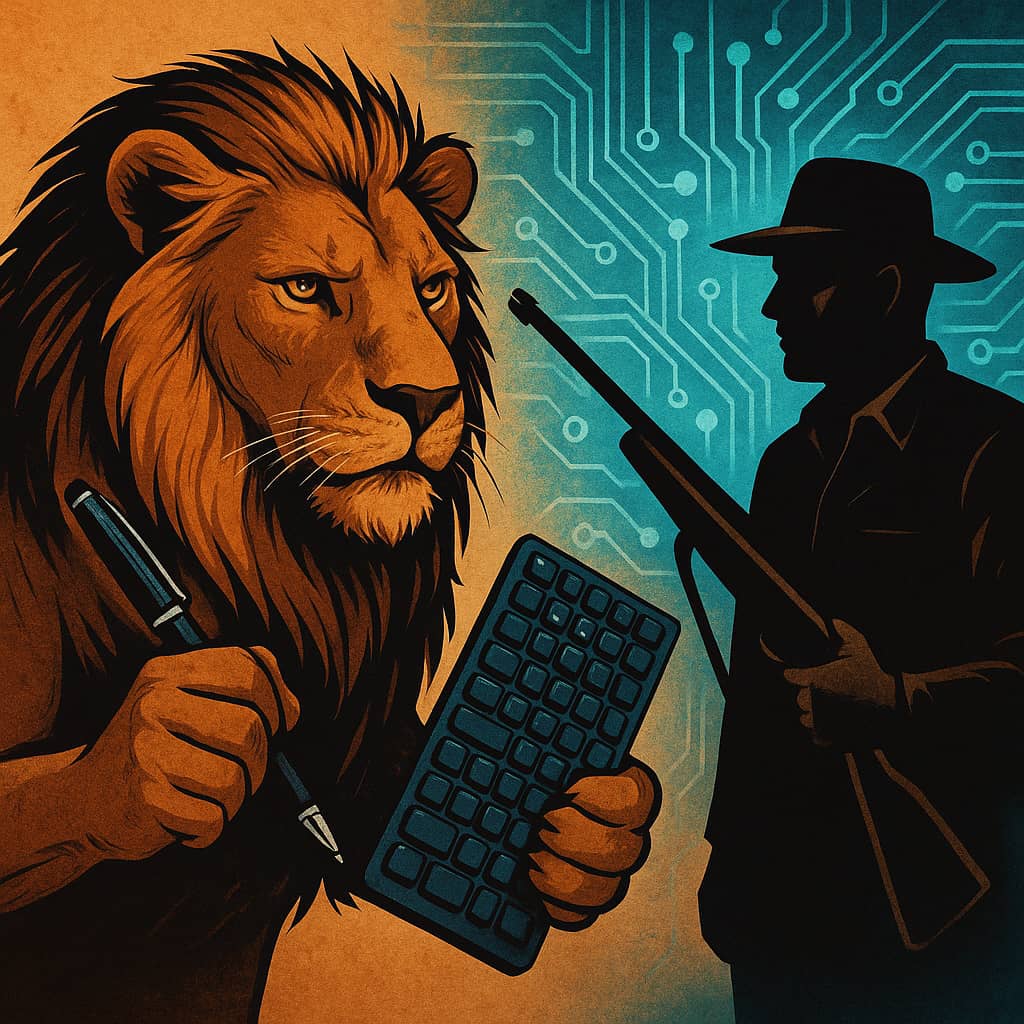
An old African proverb tells us: “Until the lion learns how to write, every story will glorify the hunter.”
It is a proverb about power and narrative, about who holds the pen and therefore who dictates truth. The hunter tells a tale of bravery, conquest, and dominion. The lion’s pain, resistance, and dignity are erased because the lion has no script, no parchment, no alphabet.
This proverb is not merely about hunters and lions. It is about Africa and its colonisers. It is about the tragedy of silence when knowledge is monopolised by another hand.
From Oral Tradition to Colonial Script
Africa was never voiceless. Our ancestors sang history in orature—songs, proverbs, riddles, and drumbeats. The hills and valleys echoed with memory. But then came the colonialist, who had mastered the written word. He codified law, mapped land, named rivers, and drew borders.
In that shift, Africa’s stories were no longer its own. To be "civilised" meant to read and write in alien tongues. Indigenous knowledge became "folklore," while colonial records became "history." The hunter’s ink subdued the lion’s roar.
And so Africa was colonised not only with guns and chains but also through grammar and script.
Neo-Colonialism: The Continuation of the Pen
Independence did not end this narrative captivity. The textbooks still bore the hunter’s ink. Economic policies, international treaties, and even development theories were imported, drafted elsewhere, and imposed here. Africa’s memory was distorted in its own classrooms, where a child could recite the kings of England but not the heroes of Buganda, Benin, or Mali.
This was the neo-colonialism of knowledge—the rewriting of Africa’s story in fonts it did not choose.
The Coming Threat: AI and the Death of African Knowledge
Now, another frontier emerges: artificial intelligence.
AI is not neutral. It is a library, a mirror, and a weapon. It feeds on data—language, stories, histories, and philosophies. But whose data does it consume? Whose truths does it reflect? If Africa does not build its own AI, coded with its own languages, infused with its own wisdom, then the continent faces a new death—the AI death of knowledge.
This is more dangerous than colonial script. While the hunter’s ink could be contested, AI creates a living archive that shapes thought, education, governance, and even memory itself. An AI built in California or Beijing, without Africa’s voice, will erase Africa more completely than any empire ever did.
The lion will not only fail to tell its story; its very image may be redrawn into extinction.
The Choice Before Africa
Africa stands at a crossroads:
To consume AI, as a user of imported tools, training machines with data that ignores its soul, becoming a silent consumer of another empire’s memory.
Or to create AI—rooted in Luganda, Kiswahili, Zulu, Amharic, Yoruba, and Shona; powered by African ethics of Ubuntu; designed to preserve African medicine, agriculture, law, and philosophy.
If we fail, our children will be educated by machines that know Shakespeare but not Okot p’Bitek, Aristotle but not Nyerere, Einstein but not Cheikh Anta Diop.
If we fail, the African lion will vanish from the digital savannah.
Toward an African AI Renaissance
The hunter has always written. But now, the lion must learn not only to write but also to code.
The new proverb must read: “Until the lion builds its own AI, every future will glorify the hunter.”
Africa must train engineers, invest in data sovereignty, digitise indigenous knowledge, and protect its languages from extinction. Language is not merely communication; it is a worldview. If Luganda dies, a whole universe of meaning dies. If Africa does not teach AI its own tongues, then AI will never think in African ways.
Conclusion
Colonialism silenced Africa with ink. Neo-colonialism muted it with economic policy.
AI, if unchallenged, will erase Africa with code.
But if Africa rises, writes its own AI, and inscribes its own memory into the digital age, then the lion will not only tell its story; it will roar across eternity.
Final Word:
The pen colonised Africa. The keyboard can liberate it.
About the author
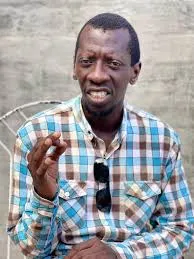
Arinaitwe Reagan is a Ugandan wordsmith, philosopher, and social activist. His existence is a testament to the transformative power of language, which he wields to challenge societal norms, spark meaningful conversations, and inspire positive change. A voracious reader and astute observer of human nature, Reagan's literary pursuits are informed by a deep-seated desire to understand the complexities of the human condition. His poetry and prose are infused with a sense of wonder, curiosity, and empathy, reflecting his commitment to exploring the intricacies of the human experience. As a passionate public speaker, Reagan has honed his ability to convey complex ideas with clarity, conviction, and charisma. His oratory skills are matched only by his capacity for active listening, which enables him to engage with diverse perspectives and foster inclusive dialogue. Through his writing, speaking, and activism, Reagan seeks to contribute to a more just, equitable, and compassionate world. His work is a testament to the enduring power of words to inspire, educate, and uplift humanity. He completed his primary level from St.Joseph's Preparartory School (2017)in greater Bushenyi in Western Uganda and later in 2018 he joined the most prestigious boys School in East Africa where he notably established himself as the class coucillor in 2019,moat informed student 2019,president Debate Club president Writer's Club,President Peace Club,as well as the school junior head prefect. He participated in Olympics Youth Camp in 2018 just as a young lad in form one,represented Uganda in Yale Young Africa's Scholar Program 2018,finalist in the Uganda World Bank Bank Debate Championship 2019,founding president Divine Mentorship Hub to train young breeds of leaders for Africa's next generation .He is a true Pan Africanist who participated in the Transformation Citizens Encyclopedia (TRACE),won National SESEMAT Science Competition 2022,awarded best studentt leader if the years 2019,2022 respectively, participated in the National Students Anti Corruption Challenge 2021,2022 respectively and Climate change dialogues as well as very many easy writing Competitions .He later joined CORNERSTONE LEADERSHIP ACADEMY-BOYS Ffor his A LEVEL Studies in 2023 where he was the school speaker ,president Debate Club,President Writer's club at school level and District level and was the president Executive Committee of Nakasongola District and National Level Secondary Scools Writers and Deabtors clubs respectively He served as the president of UGANDA NATIONAL STUDENTS ASSOCIATION (UNSA ) at District level as President DEC and national secretariat as 34th Secretary for Inter-School Affairs a role that mandated him to head all Secondary School students in the country. He featured in UNESCO documentary about literacy levels in Africa. Currently he volunters with Educate Uganda,Wananchi Youth Patriotic Forum, member of Africa Kwetu Studebts Association and agraduate of leadership and governance from KRUMBUKA LEADERSHIP SOLUTIONS in kigali Rwanda *land of a thousand hills*.Currently he is law scholar at ISLAMIC UNIVERSITY IN UGANDA. He believes it takes a revolution to create a solution