
My Father’s Radio Cassette: Memories, Nostalgia and Childhood
Some songs never leave us, just as some memories of our fathers never fade.
05 Nov, 2026
Share
Save
My first interaction with a radio was during Uganda's 2006 multiparty elections in my father’s 1996 Toyota Sprinter Carib Touring—Kibina. It was about evening: as memory recalls, electricity was chaotic back then during the era of UEB. My father started his car, switched on the radio, and listened to the vote count. It was a spectacle on my side; side-by-side, father and son listening to the most important thing in Uganda—ballot counting. I can’t recall who the electoral Chairman was back then, but I observed my father’s sad face. He was (and still is) a Democratic Party die-hard. His candidate, John Ssebaana Kizito, was losing. He was disappointed.
As a child back then, the only thing I wanted to play with was music. Why? In 2005, after the death of Pope John Paul II—now a saint—I told my father I wanted to be a priest; I had seen his requiem mass on UTV, now UBC; the singing was immaculate. So, I wanted to listen to anything involving music. I had observed on several occasions my father tossing one tape onto another in a cassette. He liked the Abato by Maddox Ssematimba, and savoured it on his lips whenever it played. Since I was the last-born back then in 2006, I candidly thought he was singing for me, and I often told him, “Taata nze nkwagala”.
I wanted to play the gimmick of “Taata nze nkwagala” so that he would play the Abato song. He was reluctant to my boyish wooing but quietly listened to the information that was read aloud on the family car radio. The “genius " in me thought, I am the golden boy of my father and invulnerable to a hot slap. I had observed his hands on several occasions. I decided to stop the FM radio and switch to the tape. Being young is associated with naivety and the inability to sense mood changes in people. My father was not my father at that moment; he was a politician who had lost faith in the Ugandan system—he was angry—and I was being silly and childish—the inability to read the room. He slapped me so hard on my face that my ear started “singing”. Indeed, as Maddox ruminated in his Abato song that “... Ngamba abaana abato ly’eriba egwaanga ly’omumaaso…,” I had understood one particular lesson that day: never play with your future. Although the message in the Abato song is quite different, I wanted to tell you all that a radio moment sent me crying to my mother’s lap that evening.
Ronald K. Ssekajja decided to write a special tribute to his father. A rare moment of father-son, especially when you grew up in a typical Ugandan homestead. Whilst growing up, we rarely saw our fathers smile. Affection was rare to witness in our fathers. The furthest I have been so close to my father was in 2017, when I topped my class during the UACE, and my father decided to give me a handshake—a rare moment for Mr Mulimira, but I know that man loves me, and all he ever wants is to see us win, his children. I have a theory that Mr Kasirivu, Ssekajja’s father, is not far away from mine, in character. In reflection of this soon-to-be publication, I will be mirroring my childhood, juxtaposing his life to mine.

Ronald K. Ssekajja, son of Clovis Kasirivu
To begin with, the evolution of radio and its idea came from different physics between the 1860s and 1890s. Great scientists like Nikola Tesla contributed tremendously to its growth, development, and improvement. A radio is the simplest way of communication to society; albeit with the different development in communication platforms, people of different generations embrace radios and keep interacting with them.
In Uganda, we have undergone three stages of radio development: The Post-Independence Era and State Monopoly (1960s–1980s), Media Liberalisation and the FM Explosion (1993–2000s), and Market Saturation and Digital Convergence (2010s–Present). All three eras of radio in Uganda have had different impacts on society and shaped narratives.
After independence in 1962, Uganda only had one radio station, which was state-owned and used for official communication. During the different civil wars in the country, especially during the turbulent times of Obote and Amin, the radio was used for state propaganda, policy dissemination, and entertainment. The 1986 guerrilla war victory of Mr Museveni saw a shift in the culture, where, from 1993 to the 2000s, there was diversity in communication and utilisation of radio. The liberalisation of radio sparked the onset of different radio stations, such as Sanyu FM, the first privately owned commercial FM station in Uganda, on December 18, 1993. Other radio stations in different regions were also established, all tailored to local languages as a form of communication.
The era of commercialisation of radio saw an influx of Congolese music in Uganda. Ssekajja admits that Kanda Bongo Man's "Man Billi," a radio sensation, was a darling at his homestead. The father loved the song to the core; he often played it for the family. Ssekajja narrates how powerful the song was, and he often entertained his father with his energetic dance moves. I can imagine the happiness—a bond between a father and his son.
Listening to Man Billi with an unbiased mind, I would confidently conclude that it is a high-pitched, quick Soukous and Kwassa Kwassa hit. The release of this song was around 1993; I was not yet born, so I have no memory of such a sensation, but whilst growing up, we heard stories of how powerful Congolese music was in Uganda. That all the cassettes in Uganda of “easy-goers” would play to the Congolese musicians, all thanks to the heavy state patronage under President Mobutu Sese Seko.
When we ruminate on where we have come from, and how far we have grown, we appreciate the role of memory in our childhood—and music was (and still is) fundamental in shaping our narrative and growth. All writers are informing us about their childhood trauma and the bigotry of society. Writers like Ssekajja remind us about the importance of appreciating the imperfect people in our lives.
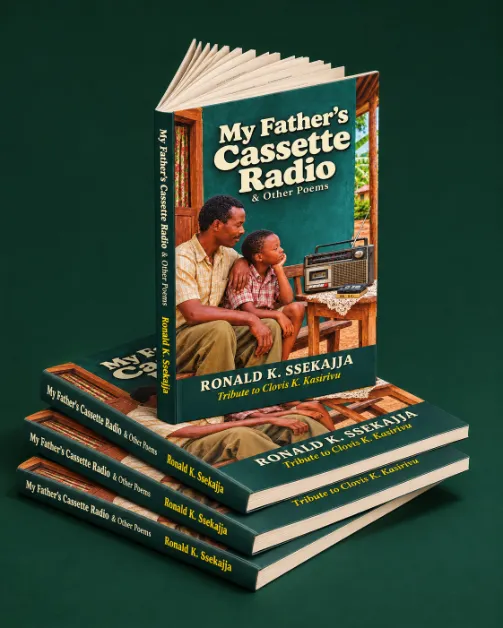
The writing “My Father’s Cassette, and Other Poems” is a nostalgia in its own right. Ssekajja navigates the many ways he wishes to honour his father, Mr Kasirivu, through writing. Recall the Christmas days with Phil Bongole Lutaya’s Tumusinze album of our time. We hunted and cut down the cypress trees, alias akakomera, and decorated our houses with the “Christmas Tree”. Mothers and daughters in the kitchen whilst fathers and sons busied themselves with the slaughter of chicken. My father recalls a vivid memory with Muzeeyi Kagege (my grandfather)—Ephraim Kizito Zziwa. Muzeeyi Kagege used to slaughter a whole cow and share it with all his relatives and children. He was a generous man. Similarly, I recall a time when we drank some soda that would pierce through our noses. The memories of the music of Zuukuka (wake up), Tumusinze (let us praise him), Ssekukkulu (I still fail to understand why the Baganda named Christmas Ssekukkulu)—all by Bongole Lutaaya played and rewound on our fathers’ cassette(s).
The dexterity to operate a radio cassette required personal wisdom and discernment; the most careful child in the family was sent for the radio. Since electricity was a luxury, the culture of “sun-drying” Tiger Head batteries was a ritual before the booming of Zuukuka on the cassette. The batteries had a way of rotting on one side; such chemistry of “sun-drying” was perfect to re-energise the strength of the radio batteries. I would swing back to memories of the Philly’s glorious voice in my mind; he would swing chords to the heights of the heavens, then roll them back to the earth to praise and worship God.
Ssekajja navigates this important text by reminding us that it is okay to stay young at heart. He says through his blurb, “This collection snapshots a son waking up to the heavy sky of unconstrained stars, who gathers the audacity to immortalise through ink the memories and the conversations of a dying father. He inks ankles deep in pain, praying that there is more time for a father-son dance before he crosses to the afterlife. The Poet refused to eulogise his father late, finding treasure in memories of childhood and all the moments with his father and his unending wish that he would stay longer.”
The reality of life is so hard to understand; we hope for a little bit of time with our heroes, pray they witness our victories, and drink from their cup of wisdom. However, while reading The Poppy War by R.F. Kuang, a contestation of gods erupts in the heavens: whether they should provide help to mankind. Erlang Shen, the Grand Marshal of the Heavenly Force, argues that mankind is selfish and petty because of their short lifespan on Earth. Although Shen sounds callous, we are naturally selfish as a people. We all hope for a long life and pray to the gods to grant us that gift, but the gods reserve this secret of immortality to themselves. However, writers like Brian Weiss theorise that death is not the end but the beginning of something we yet to know, that life begins after death and memories of loved ones continue with us in this world or the next. Furthermore, Weiss believes that through the theory of “soulmates”, it is one whole that is split into two, and that man/woman must strive to find the other half to feel each heartbeat of life. That it does not matter how many lives one half will live until they find that other half.
Understanding life, death, and loss is complex. It is only the gods and/or ancestors that understand what canvas we are on. The laments and supplications we make to them may not matter at certain moments. We all have had moments of reflection about life, loss, and the frailty of the human body; therefore, the blurb reflects the fears of a son losing his father and wishes he could stay a little bit longer to talk with him. However, the gods like Shen believe mankind should never know the secrets of immortality since we are naturally in a passage of growth. Our mortal bodies are only vessels, and we are immortal, born of the core of the universe. Tributes like these are immortal to our heroes; they reflect memories, childhood, and growth through the art.
“A Dawn, in My Father’s Eyes” is a reminder of how much we all are children at heart, but we can’t beat the race of time. The only thing we cling to is the memory of the past. Even in the eyes of Mr Kasirivu, he recalls his glory days of life whilst in Nairobi. The son (Ssekajja), as always, uses his vers libre style of writing to reflect on the life of his Father. The memory of the past—he himself can’t recall it, but the father does. Ssekajja worries that the cognitive ability and health of Mr Kasirivu are getting worse. Like all children, as we see our heroes get old, frail, and tired, we worry. He worries that he can’t dance for his father to his favourite Congolese song, Man Billi. That the dawn is nigh and there is nothing he can do to alter the wheels of time.

Clovis Kasirivu, Ronald K. Ssekajja's father
In Proverbs 16:31 and Job 12:12, the books equate old age with wisdom and righteous living. He who lives to old age is truly blessed and commands respect from the younger generations. Although Mr Kasirivu is frail and his memory fails him, the dawn in his eyes showcases the battles he has won and the fruits of his own labour: his children. And his son wishes to carry on his legacy and honour him through poetry.
In praise of Ronald K. Ssekajja and his writing journey, you must appreciate his continuous improvement in his craft, growth, and development of his niche. While all his readers might appreciate particular books, some find Echoes of Tired Men (2018) as their personal best collection because of its personal reflection on corporate lives—depression and fatigue. Others might disagree and claim that Wet Lips (2019) is their best text because of the romance and woos embedded. The sombre poetry of Dancing on Broken Lines (2019). The Footsteps of the Kakalabanda (2019) draws on tales of childhood at school and stories of Bukalabanda. The Olwendo Lw' Ebiyiye (2021) is a tribute to his mother language, and later his sui generis When Dreams Die (2021). All showcase his penmanship in writing. To me, I would summarise Ssekajja as a medley of many things. To top it off, he later released Needles & Hospital Bedsheets (2022).
Such a catalogue puts him in a class of his own; he is building a body of work that is hard to compete with. He has so much to tell us as a people. He has experiences, memories, and childhoods he yearns to share with his readers as a contribution to society and to immortalise his name. Ssekajja wishes to tell stories or inform his readers that writing is his calling, and there is a higher being beyond our realm that sends him to write the impartial art of his social development and in praise of our heroes.
About the author
Born and raised in Uganda. Studied Science in Population Studies at Makerere University. He is a poet, playwright, and book reviewer. He has authored his first-ever commercial book called "The Muchwezi, The Flower & The Suitor" He is a shy person in real life; he fears looking people in the eyes. A broken person, unlucky in love and confused when he will find true Lover but passionate about People. He is an author of many unpublished poems, plays and novels due to financial constraints. When you see his books, please buy and support Him.