
UNSA At a Crossroads
The Crisis of Purpose, Accountability and Student Leadership in Uganda
30 Oct, 2026
Share
Save
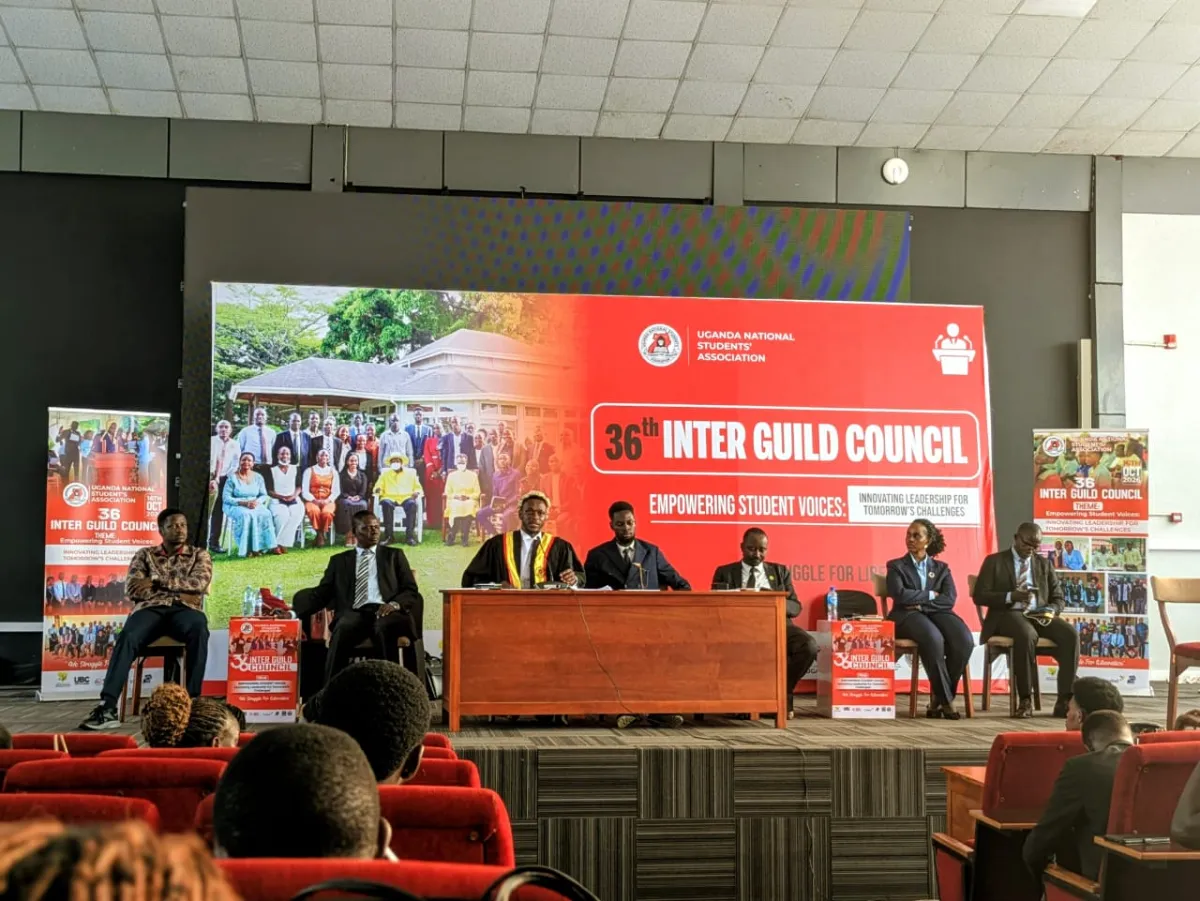
On 16 October 2026, guild leaders from universities and tertiary institutions across Uganda gathered at the Uganda Institute of Information and Communications Technology (UICT), Nakawa, for the Inter-guild Council of the Uganda National Students Association (UNSA). They came from different institutions, backgrounds, and corners of the country, carrying the aspirations, expectations, frustrations, and concerns of the students they represent.
They came as elected and entrusted representatives, believing that the Inter-guild Council was a democratic platform where student leaders could freely express themselves, exchange ideas, examine the challenges affecting their institutions, and collectively develop solutions to improve student welfare and strengthen national student representation.
They came with hope, determination, and a genuine desire to contribute to the development of their institutions and our beloved country, Uganda. However, what unfolded at Nakawa left many representatives disappointed and raised fundamental questions about the purpose, direction, and effectiveness of the institutions established to empower young people.
A Morning of Speeches, Patience and Expectations.
The morning programme began with guests, including Members of Parliament, ministers, and other government officials, addressing the gathering. From approximately 9:00 a.m. until 4:00 p.m., the programme was largely occupied by speeches.
Student leaders listened attentively and remained patient, waiting for the opportunity to engage in the business of the council. Many had travelled considerable distances, invested their time and resources, and temporarily set aside their academic responsibilities because they believed that their participation mattered.
As the hours passed, lunch was delayed until approximately 4:00 p.m. Despite the long wait, representatives remained hopeful that the council would eventually provide the opportunity to deliberate on the issues affecting students and the governance of UNSA.
During the morning programme, Brigadier General Charity Bainababo made a profound statement that deserves the attention of every young leader: "Responsibility without discipline is betrayal."
Her message emphasised patriotism, Pan-Africanism, socioeconomic transformation, and democracy. It reminded us that leadership is not merely about occupying an office or enjoying the privileges associated with it. Leadership requires discipline, responsibility, commitment, and the willingness to place the interests of the people above personal considerations.
Similarly, one of the founders of UNSA, now serving as a Permanent Secretary in the ministry responsible for Labour and Gender, emphasised the importance of student leadership as a platform for empowerment, productivity, public policy influence, and national development.
These messages were relevant and inspiring. However, they also presented a challenge to those of us gathered at Nakawa: how do we translate the values expressed in speeches into the actual conduct of our institutions?
It is not enough to speak about democracy if our representative forums struggle to facilitate meaningful democratic engagement. It is not enough to preach accountability if institutional processes do not provide sufficient opportunities for scrutiny and participation. And it is not enough to encourage young people to become responsible leaders if the spaces designed to prepare them for leadership fail to demonstrate the principles they are expected to practise.
The long morning programme and delayed lunch were not, by themselves, the greatest concern. The deeper concern was the growing expectation that, after the formal speeches, the council would finally turn to the substantive issues that had brought student leaders together.
The Council: What Was Expected and What Unfolded?
After lunch, the council resumed at approximately 5:00 p.m. Student leaders returned expecting meaningful deliberations on student welfare, institutional governance, accountability, and the future of UNSA.
Instead, the proceedings became dominated by disagreements concerning the order of business, the conduct of the council, and procedural matters. Representatives raised concerns about the handling of the meeting and the limited opportunity to engage in the substantive issues they had expected to discuss.
The unexpected turn of events created frustration and tension among participants. What should have been a constructive gathering became consumed by disagreements that threatened to overshadow the very purpose for which the council had been convened.
The proceedings eventually reached a point where confrontations threatened to turn the gathering into a battleground, and the council was adjourned without achieving the meaningful deliberations and resolutions many representatives had anticipated.
This was deeply disappointing.
Guild leaders did not travel to Nakawa merely to attend a ceremony, listen to speeches, take photographs, and return to their respective institutions. They came as representatives of students whose daily experiences are shaped by tuition challenges, accommodation, food shortages, academic administration, institutional governance, and the overall quality of their educational environment.
They came to exchange experiences, benchmark against one another, raise concerns, question administrative practices, and propose solutions. They came to strengthen the national student movement and explore how UNSA could become more responsive to its constituency.
When such an opportunity is lost to avoidable disagreements, the consequences extend beyond those who attended the meeting. Students across the country lose an opportunity to have their concerns discussed at a national platform.
What Is the Inter-guild Council Supposed to Be?
The Inter-guild Council should be one of the most important platforms for democratic engagement within UNSA. It should bring together guild presidents, guild speakers, and other student representatives to discuss issues affecting students across universities and tertiary institutions.
It should provide a forum for sharing institutional experiences, identifying common challenges, evaluating student representation, examining the performance of the Association, and developing practical recommendations for improving student welfare.
Above all, it should function as a school of democracy.
A democratic council must allow members to express their views, question decisions, disagree with proposals, and contribute to the development of resolutions. Disagreement should not be treated as a threat to leadership. Rather, it should be recognised as an essential feature of representative governance.
However, disagreement must also be managed responsibly. Student leaders have a duty to exercise restraint, respect one another, observe established procedures, and reject violence or intimidation. The authority of a council depends not only on the rights of its members but also on their willingness to protect the integrity of the institution through responsible conduct.
Likewise, those presiding over council proceedings must demonstrate impartiality, procedural competence, patience, and respect for the assembly. Their responsibility is to facilitate orderly deliberation, protect the participation rights of members, and guide the house towards legitimate decisions.
The chair should not become a source of division. It should be a point of order, fairness, and institutional stability.
The events at Nakawa should therefore prompt an honest assessment of how the Interguild Council is organised, how its agenda is communicated, how disagreements are handled, and how its proceedings can be made more productive.
Future councils should have clear programmes, adequate time for deliberation, early communication of substantive agenda items, and sufficient opportunities for representatives to contribute. The objective should be to ensure that every gathering produces tangible outcomes rather than ending with unresolved disagreements.
UNSA and the National Youth Council: Are We Fulfilling Our Mandates?
The experience at Nakawa should not be considered in isolation. It invites a broader reflection on the effectiveness of youth participation platforms in Uganda, particularly UNSA and the National Youth Council (NYC).
Earlier in 2026, disagreements and disorder reportedly disrupted proceedings at the National Youth Council's annual general meeting, resulting in an adjournment without the intended objectives being fully achieved.
Although the circumstances of the two meetings may differ, both experiences raise an important question: are the institutions established to empower young people providing the meaningful participation, accountability, and leadership development that they were created to promote?
UNSA and the National Youth Council serve important purposes in Uganda's democratic and developmental landscape. They should provide opportunities for young people to organise, articulate their concerns, develop leadership skills, engage public institutions, and contribute to policy discussions.
They should be spaces where emerging leaders learn to negotiate competing interests, respect institutional rules, appreciate diversity, and develop the capacity to solve problems collectively.
When meetings intended to empower young people become dominated by procedural disputes, prolonged disagreements, and adjournments, the institutions must examine their internal practices and identify the necessary reforms.
Youth participation cannot be reduced to ceremonial gatherings where young people listen to dignitaries and receive speeches about responsibility but have limited opportunities to deliberate on the issues affecting their constituencies.
There is a contradiction when young leaders are encouraged to practise democracy but their representative forums struggle to facilitate meaningful engagement; when they are instructed to embrace accountability but the institutional environment does not adequately accommodate scrutiny; and when they are expected to develop solutions for national transformation but their own meetings fail to produce the intended outcomes.
These contradictions deserve serious attention.
The credibility of youth institutions depends on their ability to translate their mandates into measurable results. Their success should be assessed not simply by the number of meetings held or the dignitaries invited, but by the quality of participation, the resolutions adopted, the problems addressed, and the improvements experienced by the young people they represent.
Benchmarking for Better Youth Leadership.
Uganda does not lack young people with ideas, energy, courage, and a desire to serve. What is required is a stronger institutional environment in which these qualities can be nurtured and translated into meaningful outcomes.
UNSA and the National Youth Council should deliberately benchmark against platforms that promote structured debate, public speaking, policy engagement, civic education, and constructive participation.
Institutions such as the National Youth Parliament and initiatives like Faraja Africa Uganda offer potential reference points for examining approaches to youth engagement, public dialogue, leadership development, and policy discussion. Their relevant practices should be studied critically to determine what can be adapted to strengthen UNSA and NYC.
Benchmarking should not mean blindly copying another organisation. It should involve identifying effective practices, examining how they work, learning from their successes and limitations, and adapting suitable approaches to the Ugandan context.
For UNSA, this could include strengthening the preparation of council agendas, introducing more structured debate sessions, ensuring that representatives receive relevant documents in advance, improving the management of meetings, and establishing clear mechanisms for following up on resolutions.
For the National Youth Council, it could involve strengthening civic education, improving consultation across its structures, building the capacity of youth representatives, and creating more effective mechanisms for communicating young people's concerns to relevant authorities.
Both institutions should also invest in leadership development that equips young people with practical skills in conflict resolution, public speaking, policy analysis, institutional accountability, and democratic governance.
A strong youth institution is not one in which every member agrees with the executive. It is one in which members can disagree without fear, question leadership without being treated as enemies, and contribute ideas without being denied a fair hearing.
It is an institution where criticism becomes an opportunity for improvement, reports are subjected to appropriate scrutiny, and decisions are reached through legitimate and transparent processes.
Lessons from African Leadership.
African history offers important lessons about leadership, national development, institutional responsibility, and the relationship between authority and service.
The experiences of Nelson Mandela, Julius Kambarage Nyerere, and Thabo Mbeki provide different perspectives on leadership, public service, political organisation, and institutional development. Their histories should be studied critically, not merely celebrated, so that young leaders can understand the responsibilities and challenges associated with building institutions that endure beyond individual officeholders.
Nelson Mandela's example highlights the importance of reconciliation, dialogue, and the pursuit of a political order in which differences can be managed without abandoning the broader interests of society.
Julius Nyerere's legacy offers lessons on public service, national unity, collective responsibility, and the importance of placing the development of society at the centre of leadership.
Thabo Mbeki's political experience provides further material for examining African renewal, continental cooperation, and the challenges of translating ambitious development ideas into effective institutions and policies.
These experiences are not identical, and no leader's record should be examined without acknowledging its complexities and limitations. Nevertheless, they remind us that leadership must be evaluated by more than speeches, titles, or personal influence. It must also be assessed by the institutions leaders build, the opportunities they create, and the capacity they leave behind.
For student leaders in Uganda, the lesson is straightforward: we must develop a culture of dialogue, accountability, discipline, and institutional responsibility.
Our universities and youth organisations are among the places where future public servants, political leaders, administrators, entrepreneurs, and community organisers learn how to lead. The conduct we demonstrate in these spaces can shape the standards we carry into national life.
If we cannot manage disagreement constructively in our own councils, we must ask how prepared we are to manage the more complex disagreements that characterise national governance.
If we expect accountability from public institutions, we must practise accountability within our own organisations.
And if we aspire to transform Uganda and Africa, we must begin by strengthening the institutions through which we already serve.
A Call to the Government of Uganda.
The government of Uganda must take youth institutional governance seriously.
UNSA and the National Youth Council are important platforms for youth participation and leadership development. Their effectiveness has implications for democratic participation, public accountability, civic education, and the preparation of future leaders.
The government should therefore support appropriate oversight, institutional capacity-building, and accountability mechanisms to ensure that these organisations fulfil their respective mandates.
This should begin with a constructive assessment of the challenges affecting the conduct of national youth and student gatherings. Relevant authorities should establish the facts surrounding reported disruptions, identify weaknesses in meeting management and institutional coordination, and work with the responsible leadership structures to develop practical corrective measures.
Such intervention must be guided by applicable laws, institutional constitutions, and the independence of student and youth organisations. It should not become an excuse for political interference, the suppression of criticism, or the imposition of external control over legitimate student affairs.
Rather, government engagement should strengthen institutional integrity, encourage constitutional compliance, improve administrative capacity, and protect the right of young people to participate meaningfully in decisions affecting them.
The government should also encourage regular dialogue between youth institutions, universities, tertiary institutions, and relevant ministries. This would help ensure that the concerns raised by students and young people are communicated to the appropriate authorities and considered in policy development.
Where institutional weaknesses are identified, the response should include leadership training, improved governance procedures, transparent reporting, and mechanisms for monitoring the implementation of agreed reforms.
The objective should not be to punish young people for disagreements. It should be to help build institutions capable of managing those disagreements constructively and delivering on their responsibilities.
Young people do not need institutions that merely gather them together. They need institutions that equip them to think, organise, debate, negotiate, and act responsibly.
Government has a responsibility to help create an environment in which such institutions can thrive.
A Call to Student and Youth Leaders.
To the leaders of UNSA and the National Youth Council, the events of 2026 should serve as an opportunity for reflection and institutional renewal.
Restore the focus on your mandates. Improve consultation. Communicate clearly. Plan meetings effectively. Respect established procedures. Give members sufficient opportunities to contribute, and ensure that disagreements do not prevent institutions from addressing the needs of their constituencies.
To guild leaders across Uganda, our responsibility extends beyond attending meetings and occupying leadership positions. We must represent our students faithfully, raise legitimate concerns, propose workable solutions, and defend democratic principles through responsible conduct.
We must recognise that the effectiveness of a council depends on everyone involved. Presiding officers must exercise fairness, executives must remain open to scrutiny, and members must participate constructively. No single officeholder or group can build a strong institution without the cooperation and commitment of others.
To the young people of Uganda, we must not abandon democratic participation simply because particular institutions fall short of our expectations. Instead, we must demand improvement, practise the values we advocate, and hold ourselves to the same standards we expect from others.
Our generation must reject the idea that leadership is about being heard at the expense of others. True leadership creates opportunities for others to speak, listens to opposing views, and pursues solutions that advance the common good.
Rediscovering the Purpose of Youth Leadership.
The Interguild Council at Nakawa should have been a defining moment for student leadership in Uganda. It should have provided an opportunity to discuss student welfare, strengthen national representation, share institutional experiences, and develop practical recommendations for the future.
Instead, the proceedings left many representatives disappointed and raised questions about the effectiveness of the processes through which student leaders engage with one another.
That experience should not be dismissed as a passing disagreement. It should become an opportunity for honest reflection, institutional correction, and renewed commitment to the purpose of youth representation.
We cannot continue establishing platforms for youth empowerment only to allow avoidable disagreements and inadequate planning to undermine their effectiveness. We cannot preach democracy while neglecting the practical discipline required to make it work. And we cannot prepare young people for national leadership without giving them opportunities to practise meaningful participation, accountability, and constructive dialogue.
Uganda needs young leaders who can think critically, debate intelligently, organise effectively, and lead with integrity. It needs institutions that nurture these qualities, encourage participation, and provide pathways through which young people can contribute to national development.
UNSA and the National Youth Council should be at the forefront of this transformation.
The time has come for these institutions to rediscover their purpose, strengthen their governance, improve the conduct of their meetings, and demonstrate through their actions that young people's voices matter.
The time has come for government to provide appropriate oversight and support, ensuring that youth institutions fulfil their mandates without compromising their legitimate independence.
And the time has come for student and youth leaders to demonstrate that democratic leadership is not simply about holding meetings or occupying positions. It is about listening, consulting, accounting for decisions, respecting institutions, and delivering results for the people we represent.
As Brigadier General Charity Bainababo reminded us, responsibility without discipline is betrayal. That principle must become more than a memorable statement from a public gathering. It must be reflected in how we plan, how we deliberate, how we disagree, and how we lead.
Leadership is service. Leadership is accountability. Leadership is discipline. Leadership is transformation.
Let us build institutions that outlive us, leadership that empowers others, and a student movement that does more than speak about change.
Let us become the change we demand.
About the author
My name is Abeson Alex, a student at St. Lawrence University, whose leadership journey reflects a deep commitment to service, integrity, and community transformation. I have held various leadership positions, including UNSA President of St. Charles Lwanga College Koboko, UNSA District Executive Council Speaker, UNSA Speaker for West Nile, and West Nile Representative to the UNSA National Executive Council. I also served as YCS Section Leader of St. Charles Lwanga College Koboko, YCS Federation Leader for Koboko District, and Koboko YCS Coordinator to the Diocese. In addition, I was a Peace Founder and Security Council Speaker for the peace agreement between St. Charles Lwanga College Koboko and Koboko Town College. I served as Debate Club Chairperson of St. Charles Lwanga College Koboko, District Debate Coordinator, and West Nile Debate Coordinator to the National Debate Council (NDC). All the above were in 2022-2023. My other leadership roles include Chairperson of the Writers and Readers Club, UNSA Representative in the District Youth Council, Students’ Advocate for Reproductive Health, and Students’ GBV Advocate for the District. Within the Church, I served as Chairperson of the Altarservers of Ombaci Chapel, Parish Altarservers Chairperson of Koboko Parish, and Speaker of the Altarservers Ministry in Arua Diocese. Current Positions: Currently, I serve as the Diocesan Altarservers Chairperson of Arua Catholic Diocese, Advisor of the Altarservers Ministry for both Ombaci Chapel and Koboko Parish, and Programs Coordinator of Destined Youth of Christ (DYC-UG). I am also a Finalist in the Global Unites Oratory Competition 2024, the current Debate Club Speaker and President of St. Lawrence University Koboko Students Association. Additionally, I am the Youth Chairperson of Lombe Village, Midia Parish, and Midia Sub-county in koboko district. I am one whose life has been revolving around ensuring that in our imperfections as humans, we can promote transparency, righteousness, and morality to attain perfection. I am inspired by the guiding words: Mobilization, Influence, Engagement, and Advocacy. I share my inspiration across the fields of Relationships, Career, Governance, Faith, Education, Spirituality, Anti-corruption, Environmental Conservation, Business & Self-Reliance, politics , Administration,Financial Literacy, Religion, and Human Rights. Thanks for the encounter.