
President Ruto's Nationwide Crackdown on Small Businesses Operating in Kenya Rattles Foreign Nationals
Is Xenophobia the new African Pan-Africanism?
09 Sept, 2026
Share
Save
NAIROBI, Kenya—On Monday, September 7, 2026, hundreds of Burundians, primarily small-scale traders in a hurry to get out of Kenya, flocked to their embassy on Dennis Pritt Road in Kilimani, Nairobi, in search of travel documents and help getting back home.
Following President William Ruto's directive to crack down on foreign small-scale traders operating in the country, they stayed at the facility late into the night as they hurried to organise their travel documents.
In response to the government's directive that targeted foreigners working, operating small businesses, or hawking without proper permissions, several carried their luggage while they looked for travel documents to return home.
Some arrived with suitcases and bundles of personal effects, while others brought along tuk-tuks and other possessions, signs of traders preparing to pack up their lives and leave Kenya.
On Sunday, thousands were also spotted across bus termini in the capital city, ready to depart the country and return home. Scenes from Nairobi's Machakos Country Bus Station showed massive crowds of foreign traders scrambling to book transport back to Burundi, Rwanda, and the DRC. In response, the government of Burundi announced plans to deploy buses to facilitate the repatriation of its citizens.
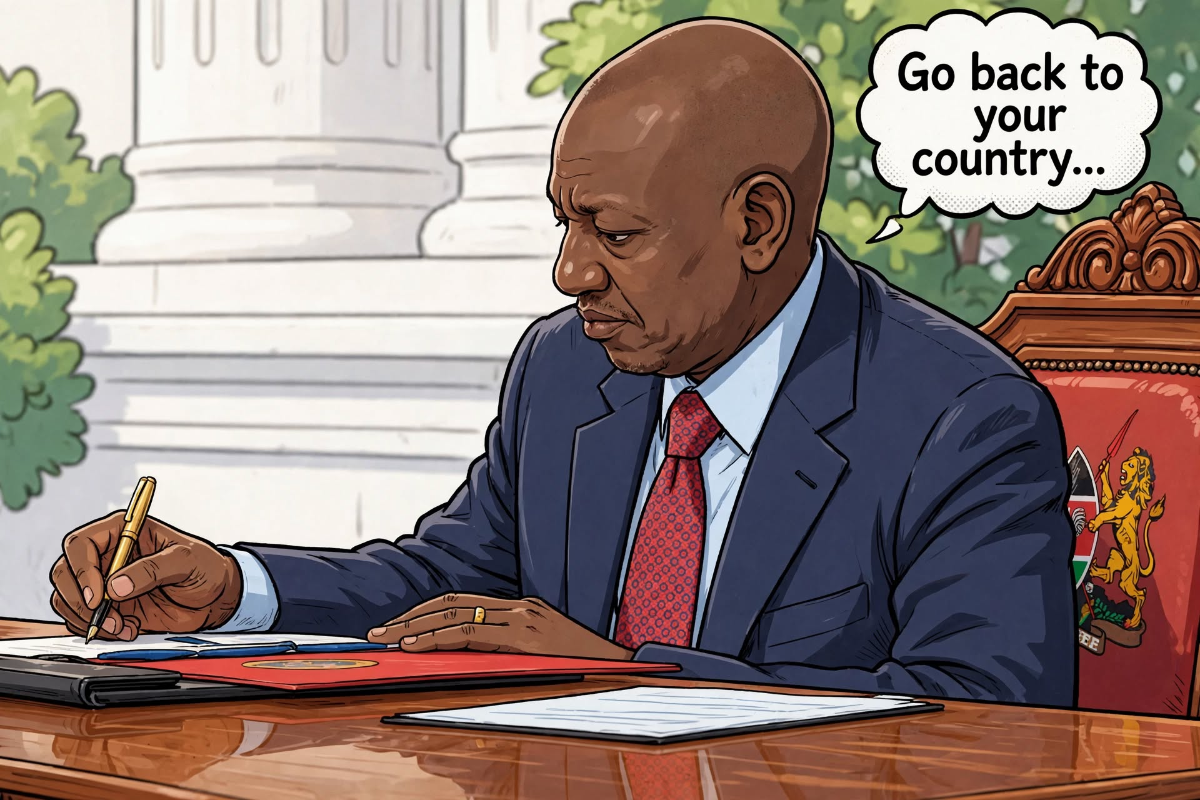
Last week, President Ruto ordered a nationwide crackdown on foreign nationals operating small-scale businesses and hawking in Kenya.
The directive, announced on September 2, 2026, during a meeting with local traders at State House, Nairobi, officially took effect on September 7, 2026. The policy mandates that petty trade and informal retail operations be strictly reserved for Kenyan citizens to protect local entrepreneurs from what the government calls unfair competition.
For many, the decision was not by choice. The nationals expressed frustration and sadness over the directive, saying they were being forced to abandon businesses and livelihoods that they had built in Kenya.
For some, the decision has left families facing an uncertain future. Several Burundian nationals have married Kenyans and raised children who acquired Kenyan citizenship by birth. They now face the painful prospect of leaving Kenya without their children or being forced to make difficult choices about keeping their families together.
Burundians react to the crisis
One of those caught up in the melee at the embassy is Osman Ibrahim, a Burundian national, who says there are so many people at the facility who have come with too much luggage because they can't go back to where they lived.
"We are getting discriminated against, attacked, and hurt. Some of us have passports, and some do not. Those with documents were left but were detained in Tanzania. We plead with the president to give us more time to sort ourselves out. He could announce more time to allow us to sort ourselves. The undocumented can seek documentation. Those with documents can then arrange their travels back to Burundi," lamented Osman.
In major urban residential hubs like Mowlem in Nairobi's Eastlands, tens of foreign-owned retail stores, salons, and street-vending stalls have preemptively closed. Many operators cite fear of targeted local hostility or aggressive enforcement.
Prominent figures, including former Chief Justice David Maraga and opposition leader Martha Karua, have criticised the directive. They argue that enforcing policy based on a State House announcement bypasses Parliament and potentially violates regional East African Community (EAC) free-movement protocols.
"We cannot profess to lead a regional Jumuiya while simultaneously subverting its foundational frameworks, and President Ruto cannot purport to credibly champion continental initiatives while simultaneously inciting domestic actions that subvert the tenets of Pan-Africanism," said Maraga.
Maraga, the United Green Movement Party leader, claimed that what killed Kenyan small businesses in 2026 was pending bills; he says the state refuses to pay county licence fees that rise without service, credit no trader can carry, and a revenue authority that pursues a mama mboga while fortunes leave the port undeclared.
"A government that is at the forefront of propagating xenophobia will not hesitate to turn those same divisive tactics against its own citizens along ethnic, religious, or other identity lines. Kenyans will not fall for these cheap, diversionary, and divisive tactics. We must be a country confident in our ability to solve our problems internally while looking abroad for the friends we need in forging global strength," explained Maraga.
As the issue continues to fuel a debate and divergent views, the government, through the Ministry of Investments, Trade and Industry, has clarified that a visa-free or exemption from Electronic Travel Authorisation (ETA) does not give foreigners the right to work, conduct business activities, or engage in hawking activities in the country.
Local traders are backing the government's crackdown on foreigners operating without valid permits, saying the move could help level the playing field in the already competitive small business sector.
PS Sing’oe’s response
They accuse unlicensed foreign traders of setting up businesses similar to theirs without meeting the same regulatory requirements, giving them an unfair advantage and squeezing Kenyan traders out of the market.
The overwhelming turnout at the embassy, however, quickly became a logistical challenge, with officials acknowledging that processing such a large number of applicants would be difficult.
The Burundian government had earlier issued a stern ultimatum to Nairobi, stating that the safety of its nationals lies entirely with the government of Kenya. Burundi warned that it reserves the right to take reciprocal measures, leading to concerns that Kenyan small business owners operating in Burundi, Tanzania, and Uganda could face retail bans in return.
Later on Monday evening, Foreign Affairs Principal Secretary Korir Singo'ei visited the Burundian nationals who were still gathered at the embassy in a bid to secure free emergency travel documents (laissez-passer) after many stated they received threats or faced discrimination from local communities following the order. PS Sing'oei assured them of government support to ensure they are properly documented or voluntarily repatriated.
President Ruto's directive is aimed at regulating small-scale retail and informal trade activities within our borders in line with the proposed Local Content Bill 2025.
Government Spokesperson Charles Owino told journalists during a press conference in Nairobi that the core intent of these measures is to protect vulnerable sectors of the domestic economy, safeguard local livelihoods, and maintain the integrity of our national identity systems.
"This is not unique to Kenya. It aligns with standard legislative practices across our region, such as the proposed Local Content Bill 2025, which balances economic patriotism with structured trade," said Owino.
According to Owino, the government recognises that due to historical circumstances and regional dynamics, several East African nationals, including several Burundians, reside and operate in Kenya without full documentation.
"In many instances, this lack of documentation leaves these individuals vulnerable to exploitation, health emergencies, and unnecessary harassment by law enforcement. We recognise and deeply appreciate the rich contributions made by East African nationals, particularly our Burundian brothers and sisters, to Kenyans' trade, culture, and socioeconomic fabric," added Owino.
Formal identity registration
Owino, a former National Police Service spokesperson, indicated that Kenya has a proud historic reputation as a haven and a land of hospitality and would not allow any sensationalist reporting to dilute this legacy.
To address this constructively, Owino said the government of Kenya is establishing a formal documentation and registration window.
"The call to register, we call upon all undocumented East African Community nationals and especially Burundian citizens currently residing in Kenya to immediately present themselves to their respective high commissions or embassies for formal identity registration. For intergovernmental collaboration during this process, the Ministry of Foreign Affairs will engage directly with the Embassy of Burundi and other regional partners to cooperatively manage and regularise these cases," he added.
For the duration of this designated registration period, Owino announced that all individuals undergoing registration will be presumed legally present in Kenya.
"This window is designed to bring our brothers and sisters out of the shadows, ensuring that they can access health, banking, and legal protections without fear. Subsequent diplomatic channels and all further administrative and operational details regarding the documentation process will be coordinated and communicated directly through the respective foreign missions," explained Owino.
The sudden policy shift has triggered significant tension and a rapid mass departure of foreign nationals, particularly impacting the local Burundian community.
However, Owino emphasised that Kenya is a country governed by the rule of law, and our national reputation is anchored on regional leadership and human dignity.
"The government of Kenya maintains a policy of absolute zero tolerance for any form of harassment, intimidation, or xenophobia. The directive to security agencies and the public is that we issue a strict directive to all national security agencies, local authorities, and the business community that no foreign national, documented or currently undergoing registration, is to be subjected to arbitrary harassment or discrimination," added Owino.
Kenya’s stand on the crisis
Owino cautioned that any element seeking to exploit recent directives to fuel xenophobic sentiments or mistreat foreign nationals will face the full force of the law.
In partnership with civil society networks and humanitarian organisations, Owino announced that the government is actively strengthening the monitoring of migrant safety in urban centres to ensure fair and dignified treatment for all.
This administrative regulation will be conducted in close coordination with regional partners.
"We thank our regional partners for their continued cooperation and reaffirm that Kenya remains an open, hospitable, and law-abiding home for all members of the East African family. Kenya's commitment to the East African Community Common Market Protocol remains absolute and unwavering. We view our East African neighbours not as foreigners, but as brothers and sisters of our shared Jumuiya," he further said.
While reacting to the directive, Ugandan-born businessman and industrialist Pan-Africanist George Michael Mukula observed that Uganda is home to over 1.2 million South Sudanese, alongside hundreds of Congolese, Burundians, Rwandans, Somalis, Eritreans, Ethiopians, Kenyans, Nigerians, and many other African nationalities.
"Our message is clear: no African nationality should be victimised simply because of where they come from. Never. Under President Yoweri Kaguta Museveni, Uganda has consistently championed African solidarity, regional integration, and peaceful coexistence. Pan-Africanism remains a central ideological principle of the NRM and an essential foundation of the East African integration project," Muklula posted on his official X account (formerly Twitter).
He said that Uganda believes in the free and orderly movement of people, goods, services, and capital within the framework of regional laws and protocols.
"As Pan-Africanists, we shall continue to stand for the dignity of our African brothers and sisters. Africa belongs to Africans. Our diversity must be our strength, not a reason for division. No to xenophobia, yes to Pan-Africanism. Yes to East African integration," he added.
PS Sing'oei, who sought to de-escalate the panic, further clarified that EAC nationals are free to work in Kenya as long as they hold valid work permits and licences. The trade ministry noted that the crackdown primarily targets those who exploited lenient visa rules to engage in informal retail without standard commercial documentation.
According to the United Nations, an estimated 16,000 Burundian refugees and asylum seekers reside in Kenya, many of whom rely entirely on the informal retail sector—such as hawking second-hand clothes and coffee—to survive. Their livelihood now remains deeply uncertain.
Original Photo Credit: State House, Kenya.
About the author
Dennis Lubanga has been a journalist for over 15 years. His interest in politics, climate change, the environment, and food security is deep and wide-ranging. He has worked for Nation Media Group, Y News Digital, TUKO.co.ke, and news9.africa. He is associated with reputable journalism initiatives like the Thomson Reuters Foundation, the African Uncensored Investigative Journalism Program, and The Nature Conservancy African Journalism Program. Among other platforms, the Annual Journalism Excellence Awards (AJEA) have recognised his work.