The Child Who Wondered Why Africa Was So Small
“How can the Africa I see in real life be so big, yet the Africa I see on the map be so small?”
07 Sept, 2026
Share
Save
There was once a child sitting in a classroom somewhere in Africa.
On the wall was a map of the world.
The child looked at it carefully.
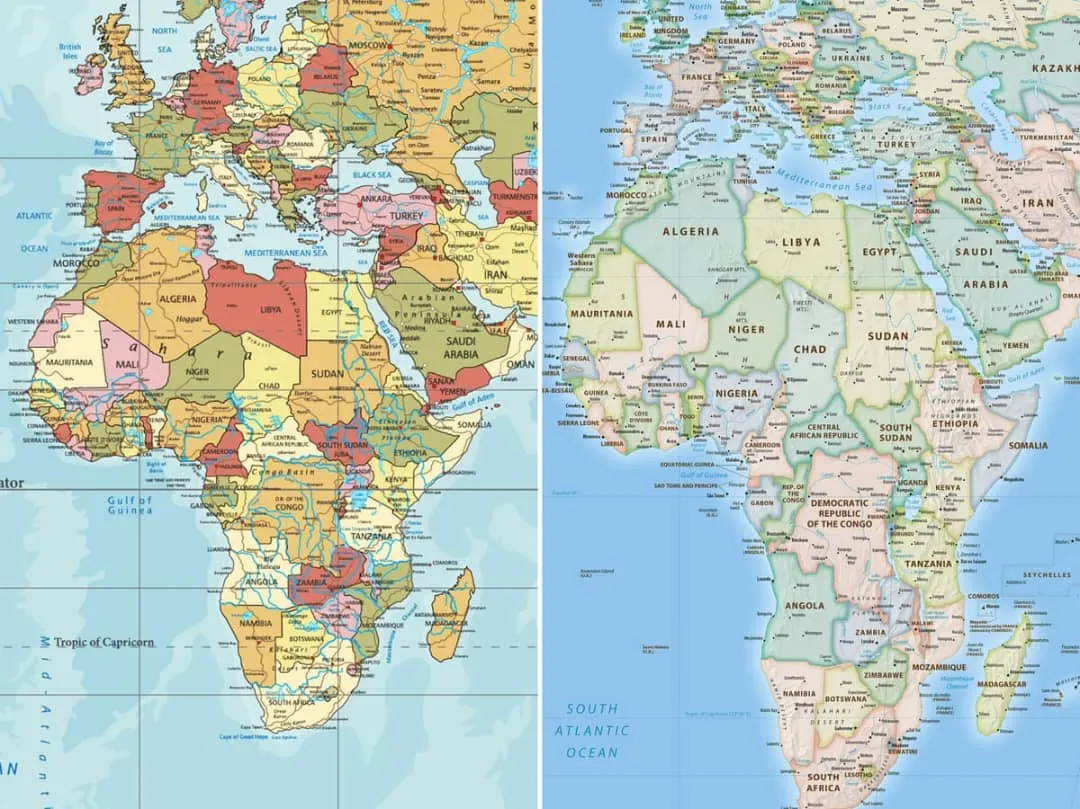
Europe looked large. North America looked enormous. Greenland appeared almost as big as Africa.
Then the child looked out of the classroom window.
They saw a continent filled with people, languages, nations, forests, deserts, rivers, mountains and cities. A continent of 54 countries. A continent stretching across more than 30 million square kilometres.
And the child wondered:
“How can the Africa I see in real life be so big, yet the Africa I see on the map be so small?”
Nobody had explained to the child that the map was distorting reality.
For generations, millions of children across Africa and the world grew up looking at the Mercator projection—a map originally designed in the sixteenth century to assist navigation. It served an important purpose for sailors, but when used as a representation of the relative size of countries and continents, it creates major distortions.
Africa, located largely around the equator, appears much smaller than it truly is, while regions closer to the poles appear disproportionately large.
The reality is astonishing.
Africa covers approximately 30.37 million square kilometres. It is the world's second-largest continent. Greenland, which can appear almost comparable to Africa on the Mercator map, is actually about fourteen times smaller. The entire United States, China, India and much of Europe can fit within Africa.
But for generations, the child did not see that Africa.
They saw a smaller Africa.
And perhaps that is where the deeper question begins.
WHEN A DISTORTION BECOMES A MINDSET
A map is not merely a picture.
A map teaches.
It tells a child what appears central and what appears peripheral. It can influence how societies imagine power, importance, distance and possibility.
When Africa is repeatedly presented as small, marginal or secondary, the distortion does not necessarily remain on the classroom wall.
It can enter the imagination.
The African Union has explicitly connected the correction of Africa's cartographic representation to a broader effort to challenge colonial legacies, describing accurate representation as part of restoring Africa's place in the global imagination and advancing what it calls cognitive justice.
That is why the question is bigger than geography.
The issue is not simply:
“How large is Africa?”
The deeper question is:
“What happens when generations are taught to see themselves smaller than they really are?”
A child who constantly sees Africa reduced on the map may one day encounter other forms of reduction.
They may hear that Africa is poor.
That Africa is behind.
That solutions must always come from somewhere else.
That knowledge must always be validated elsewhere.
That development must always be imported.
That leadership must always be copied.
Slowly, without anyone announcing it, a geographical distortion can exist alongside an intellectual one.
And that is why correcting the map matters.
But it is also why correcting the map alone will never be enough.
THE WORLD HAS CHANGED THE MAP. WILL AFRICA CHANGE THE MIND?
On September 4, 2026, the United Nations General Assembly overwhelmingly backed a resolution encouraging the use of map projections that represent the relative size of land masses more accurately, including the Equal Earth projection.
The initiative was spearheaded by Togo and supported by the African Union. The vote passed with 164 countries in favour, six abstentions and one vote against—the United States. The resolution is not legally binding, but it represents a significant international endorsement of more accurate cartographic representation.
For Africa, this is more than a cartographic moment.
It is a symbolic victory.
But symbols become powerful only when they produce action.
We can replace every Mercator map in every African classroom tomorrow and still remain colonized in our thinking.
A new map will not automatically create confident institutions.
It will not automatically reform education.
It will not automatically end corruption.
It will not automatically build industries, strengthen universities, empower young people or transform economies.
A larger Africa on paper means very little if Africans continue to imagine their possibilities through borrowed limitations.
The map can correct the geography.
But only Africans can correct the mindset.
DECOLONISATION MUST GO BEYOND POLITICAL INDEPENDENCE
Political independence was never supposed to be the final destination.
A flag can change.
A national anthem can change.
A colonial administration can leave.
But if the systems of thought remain untouched, independence can remain incomplete.
The next frontier of liberation must therefore include our minds, our education and our institutions.
We must ask difficult questions.
Why do some African students learn more about foreign histories than the intellectual traditions of their own continent?
Why do we sometimes treat imported knowledge as automatically superior to local knowledge?
Why do our institutions occasionally reproduce systems that were never designed around African realities?
Why do some of us believe progress must always look like somebody else's civilisation?
And perhaps most importantly:
Why should the generation that inherited a distorted map inherit a distorted imagination as well?
The African Union's Correct the Map initiative explicitly calls for the adoption of more accurate projections and their integration into education, media, digital platforms, and global institutions. But its broader message is equally important: how Africa is represented influences how Africa is perceived, engaged with, and invested in.
THE AFRICAN CHILD DESERVES A TRUE PICTURE
Imagine that child returning to the classroom.
This time, the map on the wall is different.
Africa is no longer visually reduced.
The child looks again.
And for the first time, the geography begins to resemble reality.
But the teacher must not stop there.
The teacher must tell that child:
“Yes, this is the true size of your continent. But your responsibility is to ensure that Africa's ideas, institutions, economies, and confidence begin to reflect the scale of its potential too.”
Because Africa's greatest problem is not that it was made to look small on a map.
Africa's greatest danger would be accepting smallness as an identity.
We must teach the African child that their continent is not a footnote to somebody else's history.
Africa is not merely a place where problems happen.
It is a place where solutions can be created.
It is not merely a market for the world's ideas.
It is a source of ideas.
It is not merely a continent waiting to be developed.
It is a continent capable of defining development on its own terms.
And Africa's young people must understand that reclaiming the narrative is not the same as denying the continent's challenges.
True confidence does not mean pretending that problems do not exist.
It means refusing to believe that our problems are proof of permanent incapacity.
A MAP CANNOT LIBERATE US. BUT IT CAN REMIND US.
The correction of the map should be understood as a beginning, not an ending.
Yes, Africa deserves to be represented accurately.
Yes, the world should see the continent as it truly is.
Yes, a child in Kampala, Kigali, Koboko, Lagos, Accra, Nairobi, Johannesburg, or Dakar deserves to look at a world map and not receive a distorted lesson about the size of their home.
But the work must continue.
We must decolonise our thoughts.
We must rethink our education.
We must strengthen institutions that serve African realities.
We must tell African stories with African voices.
We must study the world without losing ourselves in it.
We must innovate without assuming that every answer must come from elsewhere.
And we must build a generation that understands one fundamental truth:
Africa was never small.
Perhaps the map was.
Perhaps the imagination was.
Perhaps the systems that taught us to doubt ourselves were.
But Africa was never small.
The continent is massive.
Its population is vast and young.
Its cultures are countless.
Its history is deep.
Its resources are immense.
Its problems are real.
But so is its potential.
And now, as the world begins to correct the image of Africa on paper, the responsibility shifts to us.
We must correct the Africa we carry in our minds.
Because a new map hanging on a classroom wall will mean nothing if the child standing beneath it still believes that greatness belongs somewhere else.
The map has begun to catch up with the truth.
Now Africa must ensure that its mindset does too.
True liberation begins when we stop seeing ourselves through a distorted lens.
And perhaps, somewhere in an African classroom, a child will look at the new map and no longer ask:
“Why is Africa so small?”
Instead, that child may ask:
“If Africa is truly this big, why have we ever thought so small?”
That may be the question that changes everything.
#CorrectTheMap#DecoloniseTheMind#TransformAfrica'sProblems.
About the author
My name is Abeson Alex, a student at St. Lawrence University, whose leadership journey reflects a deep commitment to service, integrity, and community transformation. I have held various leadership positions, including UNSA President of St. Charles Lwanga College Koboko, UNSA District Executive Council Speaker, UNSA Speaker for West Nile, and West Nile Representative to the UNSA National Executive Council. I also served as YCS Section Leader of St. Charles Lwanga College Koboko, YCS Federation Leader for Koboko District, and Koboko YCS Coordinator to the Diocese. In addition, I was a Peace Founder and Security Council Speaker for the peace agreement between St. Charles Lwanga College Koboko and Koboko Town College. I served as Debate Club Chairperson of St. Charles Lwanga College Koboko, District Debate Coordinator, and West Nile Debate Coordinator to the National Debate Council (NDC). All the above were in 2022-2023. My other leadership roles include Chairperson of the Writers and Readers Club, UNSA Representative in the District Youth Council, Students’ Advocate for Reproductive Health, and Students’ GBV Advocate for the District. Within the Church, I served as Chairperson of the Altarservers of Ombaci Chapel, Parish Altarservers Chairperson of Koboko Parish, and Speaker of the Altarservers Ministry in Arua Diocese. Current Positions: Currently, I serve as the Diocesan Altarservers Chairperson of Arua Catholic Diocese, Advisor of the Altarservers Ministry for both Ombaci Chapel and Koboko Parish, and Programs Coordinator of Destined Youth of Christ (DYC-UG). I am also a Finalist in the Global Unites Oratory Competition 2024, the current Debate Club Speaker and President of St. Lawrence University Koboko Students Association. Additionally, I am the Youth Chairperson of Lombe Village, Midia Parish, and Midia Sub-county in koboko district. I am one whose life has been revolving around ensuring that in our imperfections as humans, we can promote transparency, righteousness, and morality to attain perfection. I am inspired by the guiding words: Mobilization, Influence, Engagement, and Advocacy. I share my inspiration across the fields of Relationships, Career, Governance, Faith, Education, Spirituality, Anti-corruption, Environmental Conservation, Business & Self-Reliance, politics , Administration,Financial Literacy, Religion, and Human Rights. Thanks for the encounter.