OpenAI, Closed Servers: What Zuckerberg's Manifesto Really Means for Africa
Africa and the AI Future: Open Access, Digital Sovereignty and the Zuckerberg Question
26 Aug, 2026
Share
Save
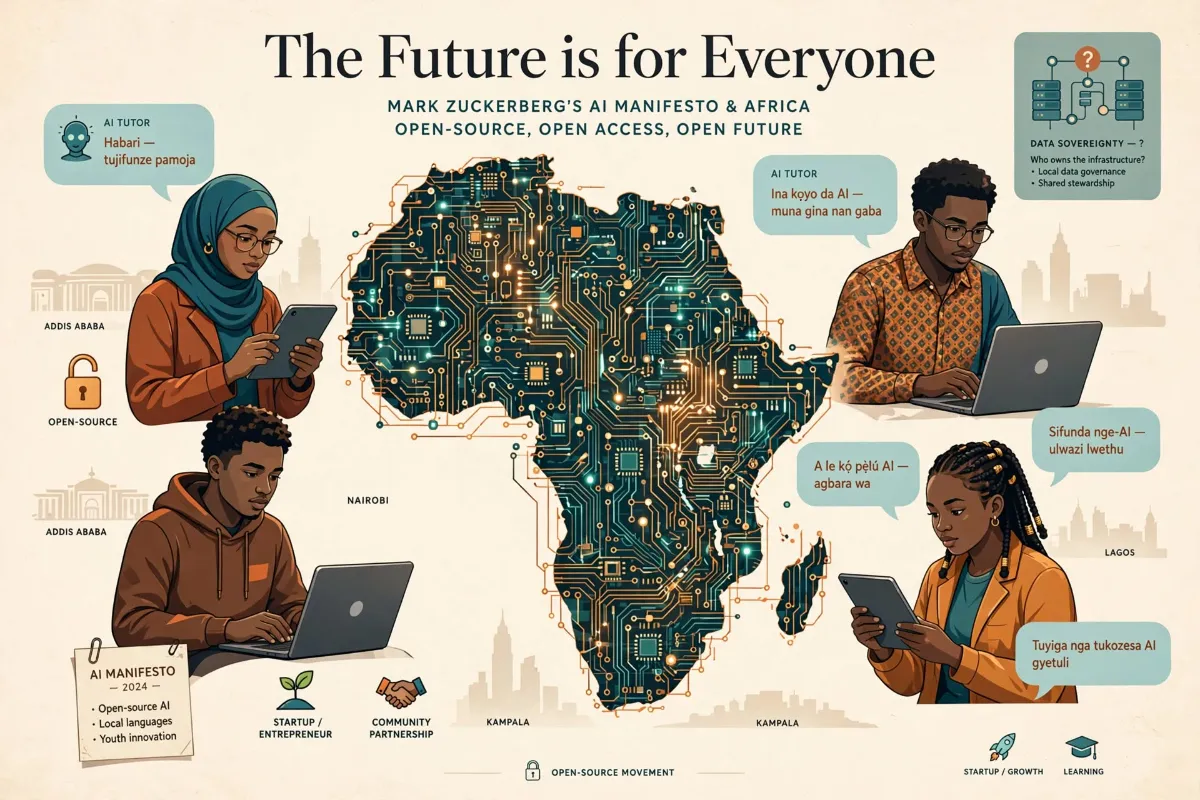
On August 10, 2026, Meta Chief Executive Officer Mark Zuckerberg released a lengthy letter titled "The Future is for Everyone," instantly picked up by outlets including Forbes under the headline "Mark Zuckerberg Outlines AI Vision in the New Manifesto" In it, he argued that artificial intelligence must remain open-source, accessible and empowering, not locked away by a handful of corporations or governments. His words have continued to stir debate worldwide, and nowhere is that debate more consequential than on a continent that has spent the last decade watching digital revolutions unfold at the pleasure of others.
Zuckerberg's letter landed on an already crowded continental calendar. Weeks earlier, the Ethiopian Cybersecurity Association and the UN Economic Commission for Africa had convened the inaugural continental conference on cybersecurity and artificial intelligence in Addis Ababa, under the theme "Risks, Resilience and Africa's Strategic Imperatives." The African Union's Peace and Security Council had, for the first time, placed AI governance formally on its agenda, while the Pan-African Parliament announced plans to draft a model law on cybersecurity and AI for member states to adapt, and that very week, still Uganda too had its first inaugural cybersecurity conference under the theme of "Securing Uganda's Digital Future, Collaboration, Resilience and Trust" . From Nairobi's Connected Africa Summit to Lagos, Kampala and Johannesburg's cyber-defence forums, the continent spent much of 2026 arguing, in different rooms, over the same question Zuckerberg's manifesto now forces into the open: on whose terms will Africa's AI future be built?
Zuckerberg's words carry particular weight for a continent grappling all at once with digital transformation, a yawning technology human-resources gap, uneven digital skills, and the unresolved question of sovereignty in the age of AI. His manifesto hinges on a simple thesis: AI should be a tool for all, not a privilege for the few. He warns that confining advanced models to closed systems risks concentrating power, stifling innovation, and widening inequality, an argument that resonates far beyond Menlo Park.
Africa's tech ecosystems are young but increasingly vibrant, from Lagos and Nairobi to Kigali and Cape Town, and Zuckerberg's insistence on open-source AI resonates for good reason: it lowers the barrier to entry, letting African innovators experiment with cutting-edge tools without paying the licensing fees that have long kept frontier technology out of reach.
On education, Zuckerberg envisions a world where everyone has a personalised tutor with the patience and depth of a PhD-level coach in every subject. He goes further, imagining adults gaining superintelligent learning assistants able to teach new job skills, new languages, or new hobbies on demand. This is a striking proposition for a continent that continues to grapple with chronic teacher shortages, especially in rural districts stretching from northern Nigeria to eastern DRC. AI of the kind Zuckerberg envisions could supplement overstretched classrooms, offering personalised learning in local languages such as Swahili, Hausa, Yoruba, Zulu, Luganda, Runyakore, Kinyarwanda and Amharic, rather than only in English, French or Arabic.
On entrepreneurship, Zuckerberg foresees an AI world in which everyone soon holds powerful tools to build new businesses, birthing ideas once too costly or difficult to attempt. He predicts this will drive not just greater economic growth but, over time, more employment rather than less, an assurance that speaks directly to one of humanity's deepest anxieties since generative AI models entered public use in late 2022, and one that lands with special urgency in economies where youth unemployment is already a governance crisis.
Flipping to the other side of the coin, this optimism must be met with stark realities. Regulation across the continent remains patchy: only a handful of countries, among them Nigeria, Rwanda and South Africa, have begun building AI-specific legal frameworks, and without stronger safeguards, open-source models could be misused for disinformation, fraud, or surveillance well before institutions catch up.
On dependency, there is a real risk that even with open access, African states remain tethered to Meta's infrastructure, raising sovereignty questions over who controls the servers, the model updates, and the flow of data. On this point, commentators have argued that in championing openness, Meta's CEO is not acting out of charity but playing geopolitics, positioning his company against rivals like OpenAI and Anthropic by embedding its models globally before others do. The timing lends the argument weight: the very day Zuckerberg published his letter was the same day Meta released its latest models, Muse Glimmer and Muse Spark 1.2.
Ideally, Africa's role should be neither uncritical cheerleading nor blanket dismissal of the manifesto. Instead, stakeholders across the continent- governments, innovators, and civil society alike- should seek out precisely where, in this "future for everyone," Africa's own leverage sits, and insist on holding it.
About the author
Musekura Kenedy is a lawyer, a tech and digital policy analyst.