

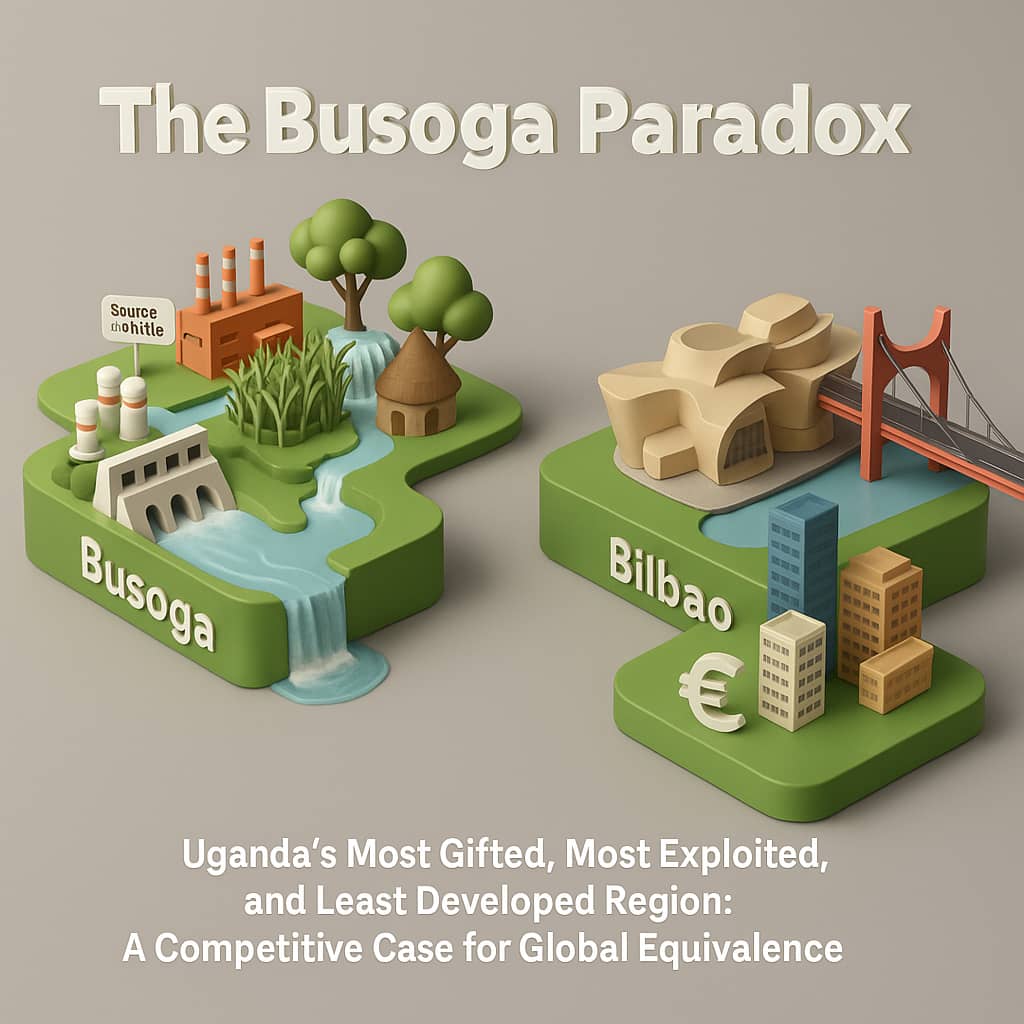
The Busoga Paradox—Uganda’s Most Gifted, Most Underutilised, and Disenchanfrised Region
A Competitive Case for Global Equivalence
02 Jun, 2025
Share
Save
I. A Land Chosen by Nature: The Origins of Abundance
Busoga stands as one of Uganda’s most paradoxical regions—immensely endowed by nature, yet historically impoverished by design. It is not an exaggeration to assert that Busoga is the most naturally gifted region in Uganda. Here, the mighty River Nile begins its journey to the Mediterranean, carrying with it the symbolic pulse of African resilience and abundance. This region is a hydrological treasure trove, possessing not just the Nile but also significant sections of Lake Victoria and Lake Kyoga, offering boundless potential for hydroelectric energy, fisheries, irrigation, aquaculture, water transport, and tourism. The Nalubaale, Kiira, and Bujagali dams sit squarely within its borders, powering the national grid—yet paradoxically, many Busoga homes remain in darkness, underserved by the very electricity they help produce.
II. The Agricultural Goldmine: Uganda’s Breadbasket with Broken Scales.
Busoga is agriculturally supreme. The fertile loamy soils that carpet Kamuli, Iganga, Bugiri, and Mayuge are ideal for cultivating Uganda’s staple and industrial crops. Sugarcane reigns supreme here, with Busoga accounting for over 60% of Uganda’s sugar production. Giant millers like Kakira, Mayuge, GM, and Kaliro Sugar dominate the region’s economy, though ownership and profit margins often lie outside the region. Rice, cassava, maize, cotton, bananas, and coffee thrive in Busoga’s rich soils. Yet the farmers—those who till the earth and grow the cane—remain some of the poorest Ugandans. The value chain is skewed; the wealth is extracted and exported while poverty is imported and institutionalized. While Buganda excels in coffee, Ankole in livestock, and Bunyoro in oil, Busoga stands as the only region combining agro-industrial crops, fishing, tourism potential, and renewable energy generation—making it the most versatile economic region in Uganda, if only properly harnessed.
III. Hidden Beneath Her Feet: Minerals, Wetlands, and Untapped Wealth
Busoga is not only fertile on the surface but rich beneath the soil. Salt deposits in the Kakira wetlands and Lake Nakuwa, sand along the shores of Lake Victoria, and phosphates on the edges of Kamuli and Buyende present vast opportunities for industrial processing and export. Historically, Jinja—the economic capital of Busoga—was Uganda’s industrial heartbeat, hosting copper smelters, textile mills, tannery plants, and grain processing factories. Nyanza Textiles and Nile Breweries stood as symbols of national pride. However, liberalization, poor planning, and neglect led to the collapse of this industrial base. Today, Jinja’s smokestacks are silent, its factories dormant, and its youth unemployed.
IV. The Statistics of Neglect: How Riches Became Ruin
Despite its immense contributions—sugar, electricity, fish, and agricultural exports—Busoga remains among Uganda’s least developed regions. Literacy rates remain dismal, school dropout rates are high, health systems are strained, and infrastructure is crumbling, especially in rural districts like Buyende and Namutumba. Electrification levels are shockingly low, even near major dams. The irony is painful: the region that powers Uganda remains largely in the dark. The roads are impassable during rainy seasons, the hospitals are under-equipped, and public education is on the verge of collapse. In essence, the engine that drives Uganda’s economy runs on a flat tyre—and that tyre is Busoga.
V. The Engine Without a Driver: Why Busoga Lags
The underlying causes are structural. Busoga has been reduced to a dependable political pawn—loyal at the polls but abandoned in the budget. Leadership has often revolved around politicking rather than regional vision. Farmers lack cooperative protection and fair pricing. The land tenure system is fragmented and riddled with absentee landlordism. Intellectuals and innovators flee to Kampala or abroad, leaving behind a vacuum of leadership and capacity. Busoga has not failed; it has been failed by the state—by its elites, and by a development model that favours extraction over empowerment.
VI. Recasting the Narrative: The Bilbao Comparison
To reframe Busoga’s potential, we turn to Bilbao, a mid-sized city in Spain’s Basque Country, once an industrial backwater, now a modern economic powerhouse. Bilbao’s population (~1 million) is dwarfed by Busoga’s (~6 million), and its landmass is tiny in comparison. Yet through deliberate investment in infrastructure, innovation, and industrial reinvention, Bilbao today boasts a GDP of over €35 billion (UGX 144 trillion). It achieved this by transforming its steel and shipbuilding roots into a diversified economy encompassing aerospace, tourism, design, and technology—supported by world-class urban planning and university-linked innovation hubs.
VII. Busoga’s Competitive Assets: Bigger, Richer, Yet Ignored
By comparison, Busoga possesses advantages that Bilbao never had: more land, more people, more water, more sun, and richer soil. It commands:
Three hydroelectric dams (Nalubaale, Kiira, Bujagali);
Agro-industrial dominance in sugar, rice, cassava, and fruits
Strategic transport corridors linking Uganda to Kenya
Mineral potential in salt, phosphates, and sand
Cultural and ecological tourism via the Source of the Nile and Kyabazinga Kingdom.
Yet, Busoga contributes less than UGX 4 trillion annually to Uganda’s GDP—mostly from sugar and fisheries—while Bilbao, with far fewer resources, produces over 30 times more.
VIII. Calculating Busoga’s GDP Potential
If Busoga’s resources were developed with Bilbao’s model in mind, its economic output could conservatively exceed UGX 12 trillion per year (approx. €3 billion). This would come from:
Agro-industrial processing: UGX 5 trillion
Tourism and culture: UGX 1.2 trillion
Fisheries and aquaculture: UGX 800 billion
Hydropower royalties: UGX 1.5 trillion
Industrial parks and SME hubs: UGX 3 trillion
Mineral extraction: UGX 600 billion
Such figures would rank Busoga above many East African cities and even compete with mid-tier European regions, like Porto (Portugal) or Kraków (Poland).
IX. Why the Gap Persists: A Political-Economic Dissection
Busoga’s stagnation is not due to a lack of potential but the absence of political will and planning autonomy. Unlike Bilbao, which benefited from Spain’s regional devolution and European structural funds, Busoga remains at the mercy of central directives. It has no power to allocate local revenues, zone its industrial corridors, or retain proceeds from power generation. Infrastructure is outdated, and wealth generated within the region is extracted to the centre without reinvestment. What Bilbao achieved through innovation and autonomy, Busoga has been denied by dependency and systemic marginalization.
X. A Competitive Policy Vision: How Busoga Can Rise
To transform Busoga, Uganda must adopt a competitive regional development model, including:
Regional Autonomy Lite: Establish a Busoga Economic Development Authority (BEDA) with the power to retain and reinvest a portion of revenues.
Agro-Industrial Clustering: Build regional value chains around Kamuli, Iganga, Jinja, and Bugiri.
Diaspora Investment Bonds: Harness Basoga living abroad to co-finance development.
Tourism Rebranding: Market the Source of the Nile and Kyabazinga monarchy globally.
Rail and Road Modernization: Upgrade the Jinja–Malaba corridor into a regional trade expressway.
Education and Innovation Zones: Establish centres of excellence in green energy, Agro-tech, and fishery science.
XI. Conclusion: Let the River Rise With Us
Busoga is not a poor region. It is a region rich in resources, people, and history—trapped in a system that does not allow it to thrive. Compared to Bilbao, its greater size and gifts make its stagnation all the more tragic. Where Bilbao turned its river into a stream of wealth, Busoga’s Nile flows past villages still in darkness, hospitals without drugs, and schools without roofs. But this need not be the end. The resurrection of Busoga is not merely a regional necessity—it is a national imperative. Uganda cannot rise without the region that waters and powers it.
Let the Nile not only begin here—let the transformation begin here too. Let Busoga rise—not in protest alone, but in policy, production, and pride. For in the veins of her people, and the current of her river, still flows the future Uganda must embrace.
Son of Busoga, Voice for Her Return to Glory

.webp)