.webp)

The Democratic Cost of Uganda’s Suspension of Military Ties with Germany
Diplomacy is the art of restraining power with reason. When reason is rejected, what remains is a theatre of force.
26 May, 2025
Share
Save
LEGAL AND INTELLECTUAL DISCLAIMER: This is a scholarly reflection written in the spirit of intellectual inquiry and academic freedom. It is not a call to action, rebellion, or any form of subversion. The opinions herein do not represent any political organization or institution, nor are they intended to defame, incite, or provoke hostility toward any state actor or organ. The analysis is made within the protection of Article 29(1)(a) of the Constitution of Uganda, which guarantees the right to freedom of speech and expression, especially in academic, philosophical, and journalistic contexts. It is published for educational and public policy discourse purposes.
"Diplomacy is the art of restraining power with reason. When reason is rejected, what remains is a theatre of force."
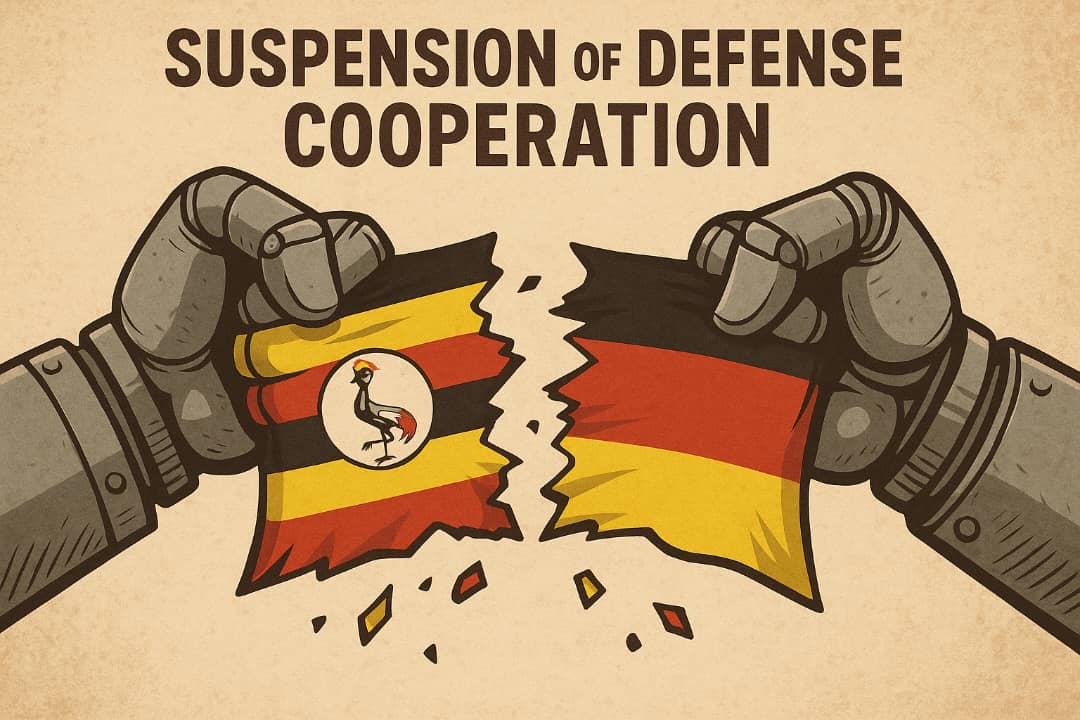
The Uganda People’s Defence Forces’ (UPDF) abrupt suspension of all military and defence cooperation with the Federal Republic of Germany—on grounds of "credible intelligence" linking Ambassador Matthias Schauer to subversive activity—may at first glance appear as a sovereign assertion of national security. But beneath the surface of this diplomatic rupture lies a deeper, potentially destabilizing unravelling of Uganda’s democratic ethos, rule-of-law commitments, and global legitimacy.
This is not just a military affair. It is a constitutional tremor.
The Danger of Politicized Intelligence: The Thin Line Between Security and Suppression
Intelligence, by its very nature, is a powerful but unverifiable currency in the public domain. It becomes perilous when weaponized without transparency or independent oversight. Uganda’s move to suspend bilateral defence ties based on “credible intelligence”—absent any presented evidence, judicial review, or multilateral consultation—raises fundamental questions:
Who judges the credibility of intelligence in a militarized environment?
What safeguards exist to ensure intelligence does not become a political tool?
In a mature democracy, intelligence must serve the public good, not regime preservation.
Militarizing Diplomacy: A Return to Garrison Politics
The statement was delivered not through the Ministry of Foreign Affairs, but by the UPDF’s Acting Director of Defence Public Information. This signals an unusual tilt: military authority shaping diplomatic narratives.
This reflects what political theorist David Easton would call a closed input-output system—where fear, rather than public participation, determines the political response. The result? Institutions tilt toward coercion rather than consensus.
The M.K Factor: Personality Politics and Democratic Erosion
The unfolding events occur alongside prominent public statements by General M.K., whose symbolic and actual proximity to the military and state power carries enormous implications. When public assertions about expelling ambassadors become political theatre, the risk is not merely diplomatic—it is structural.
Uganda has become a state where military voices eclipse civilian reasoning, and diplomacy becomes subordinate to ideological loyalty.
Consequences for Democratic Governance and Institutional Integrity
Collapse of Multilateralism: Germany is not just an ally; it has provided peacekeeping support, counter-terrorism cooperation, and institutional reform assistance. A breakdown in trust could have ripple effects on regional and global partnerships.
Marginalization of Civilian Institutions: Announcements of such magnitude bypassing conventional foreign affairs frameworks weaken institutional credibility and blur the lines between military and civilian governance.
Contraction of Civic Space: Allegations of foreign collusion could be used as a legal pretext to restrict opposition, journalists, and civil society actors, thereby silencing legitimate dissent.
Erosion of Soft Power: Uganda’s ability to lead or contribute meaningfully on the global stage depends on its adherence to democratic norms and transparency. The current trajectory risks substituting cooperation with confrontation.
The Broader Philosophical Crisis: From Consent to Coercion
As Frantz Fanon forewarned, postcolonial regimes often adopt the tools of their former oppressors—censorship, fear, and surveillance—under the guise of order. The bigger question is no longer about Germany, but about us:
Are we governing through public consent or institutional coercion?
Are we fostering dialogue, or enforcing silence?
If disagreement becomes tantamount to treason, democracy becomes a shell, and the soul of the Republic begins to wither.
The Iron Fist in the Velvet Glove
If this course is not corrected, Uganda risks diplomatic isolation, economic strain, and internal instability. What is being sold as patriotism could become the very scaffold of authoritarianism.
True power is measured not by how we suppress critics—but by how we engage dissent without fear.
Let Uganda beware:
In the name of security, we may be mortgaging our democratic inheritance. And in silencing envoys, we may be foreclosing our own voice on the global stage.
ENDNOTE: This work remains an intellectual contribution to the understanding of constitutionalism, democratic accountability, and international diplomacy. Any resemblance to state policy or future events is purely coincidental or speculative and intended solely for civic, legal, and philosophical reflection.