
Prayer, Power, and the Constitution: Can the State Forbid Intercessory Worship?
A Ugandan constitutional law discourse.
27 Feb, 2026
Share
Save
Disclaimer
This discourse is presented solely as a constitutional and academic analysis grounded in the Constitution of the Republic of Uganda, established principles of constitutional interpretation, and publicly known jurisprudence. It does not assert the factual accuracy of the reported claims concerning any alleged intervention by Yoweri Museveni in relation to prayer services at Lubaga Cathedral, nor does it purport to verify, confirm, or attribute intent, motive, or conduct to any individual or institution.
All references to named persons, religious institutions, or events are used strictly for analytical and illustrative purposes, to interrogate the constitutional implications that would arise if such conduct were to occur, whether by the Executive or any other arm of the state. The analysis is therefore hypothetical in posture but doctrinal in substance and should not be construed as a statement of fact, accusation, or allegation of wrongdoing.
This work does not seek to advance partisan, political, or sectarian positions. Its sole objective is to contribute to constitutional literacy, academic debate, and the rule-of-law discourse on the limits of executive power, the autonomy of religious institutions, and the protection of fundamental rights under the Constitution of Uganda.
Nothing herein should be interpreted as legal advice, judicial commentary, or an invitation to civil disobedience. Responsibility for factual verification of any underlying events rests with appropriate investigative, judicial, or journalistic processes.
Framing the Incident as a Constitutional Problem (Not a Rumour)
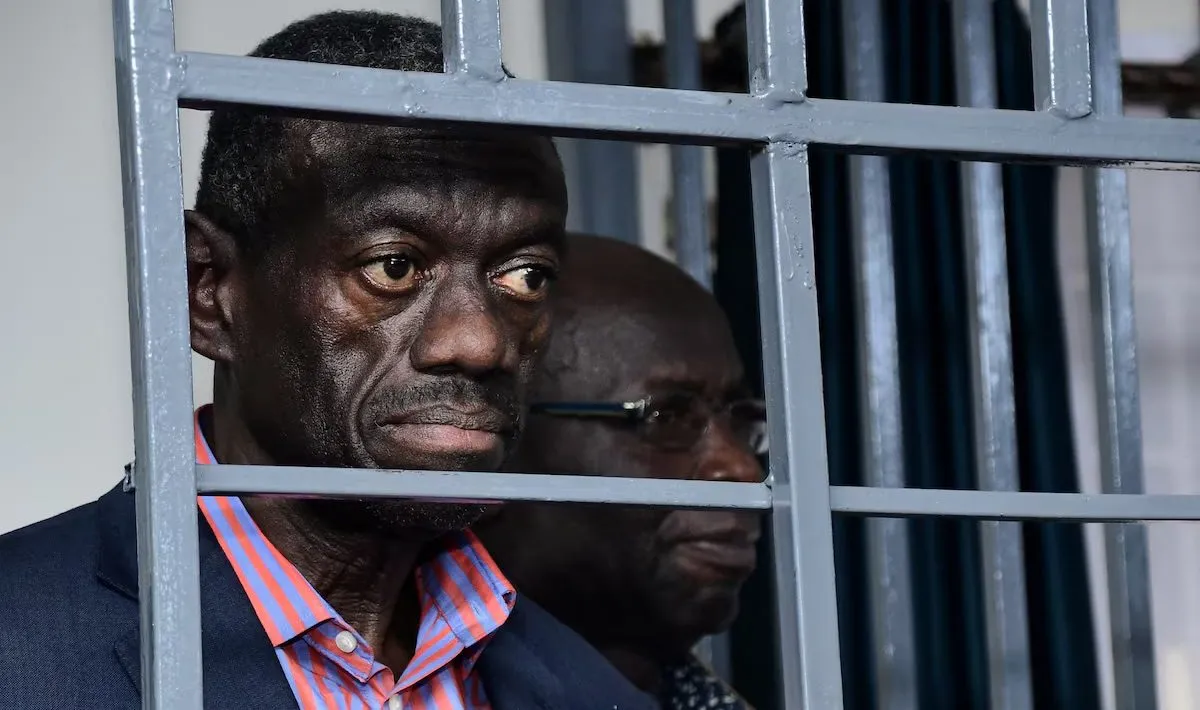
The reported claim that Yoweri Museveni personally intervened to prevent a scheduled prayer service at Lubaga Cathedral—allegedly intended for Kizza Besigye, the sick, and prisoners—must be approached with constitutional sobriety rather than political excitement. Even if the factual accuracy were disputed, the legal question remains intact and urgent:
Does the Executive possess constitutional authority to permit or prohibit prayers conducted within a church, particularly where those prayers are intercessory and include prisoners or politically sensitive detainees?
This is not a theological inquiry. It is a question of constitutional architecture, limits of executive power, and the resilience of civic freedoms under political stress. Constitutional law is not activated by proof alone; it is activated by plausibility. When an act is believable within a constitutional order, that order is already under strain.
Freedom of Religion: The Absolute Starting Point
Article 29(1)(c) of the Constitution of Uganda guarantees freedom of religion and the right to practise and manifest that religion. Ugandan constitutional interpretation has consistently treated this freedom as comprising three inseparable dimensions:
Freedom of belief (internal conscience),
Freedom of worship (public and private rituals),
Freedom of manifestation (prayers, services, intercessions, symbols).
A prayer service—especially one held in a consecrated religious space, led by ordained clergy, peaceful in character, and directed toward spiritual intentions—lies at the very core of this protection. It is not peripheral conduct capable of easy restriction; it is the essence of religious freedom itself.
Any state interference with such worship bears a heavy constitutional burden. The presumption is illegality, unless the state can demonstrate, cumulatively:
a legitimate constitutional objective (such as public safety),
necessity,
proportionality, and
use of the least restrictive means.
A targeted or blanket prohibition of prayer—especially by informal executive intervention—fails this test almost automatically.
Separation of Church and State: A One-Way Barrier
Uganda is constitutionally neither a theocracy nor an anti-clerical republic. The settlement is state neutrality, not state supervision. The Constitution requires the state to refrain from imposing religion, but equally to refrain from suppressing it.
Where the Executive allegedly telephones a cardinal or senior cleric to influence which prayers may or may not occur inside a cathedral, a dangerous inversion occurs:
The state intrudes into ecclesiastical governance, and
The church is reduced to an administrative extension of political authority.
This collapses the separation principle. The Constitution grants the President no supervisory jurisdiction over liturgy, intercession, pastoral priorities, or spiritual intention. To assume such authority is to govern by personal command rather than by law, a posture fundamentally hostile to constitutionalism.
Political Neutrality of Prayer: A False Constitutional Distinction
A recurring authoritarian argument is that prayers offered for a political prisoner are themselves “political acts.” Constitutionally, this argument is unsustainable.
Prayer does not become partisan speech merely because it names a political actor. Intercessory prayer for:
prisoners,
the sick,
the oppressed,
or named individuals,
is a time-honoured and cross-faith religious practice, recognised in Christian, Islamic, and African traditional religious systems alike.
If prayer for prisoners becomes unconstitutional because one prisoner is politically inconvenient, then all prison chaplaincy collapses. The Constitution cannot tolerate such selective logic without destroying its own coherence.
Rights of Prisoners: The Silent Constitutional Stakeholders
Ugandan constitutional jurisprudence is clear that incarceration does not extinguish humanity. Prisoners retain:
human dignity (Article 24),
freedom of religion (Article 29),
residual access to spiritual care.
Public intercessory prayer for prisoners affirms these values. Preventing such prayer indirectly violates prisoners’ residual rights by symbolically erasing them from the moral community. Constitutionally, this reflects a theory of punishment that is totalising and dehumanising, rather than rehabilitative—an approach Ugandan courts have consistently rejected.
Abuse of Executive Power: From Authority to Personal Rule
If a President may orally halt prayers without:
a court order,
a declared state of emergency, or
express statutory authority,
Then Uganda ceases to be governed by constitutional supremacy and slides into executive discretion. This is the textbook definition of arbitrariness.
The Constitution does not recognise presidential displeasure, anxiety, or political inconvenience as lawful grounds for suspending rights. Power exercised outside law—even when popular or well-intentioned—becomes raw power, not constitutional authority.
Chilling Effect and the Theology of Fear
The gravest constitutional injury may not be the cancelled prayer itself, but the chilling effect it produces:
clergy begin to self-censor,
churches avoid sensitive intercessions,
worship becomes cautious, sanitised, and politically deferential.
This produces a theology of fear, where faith survives only at the mercy of state tolerance. Historically, this is how religious institutions are domesticated into instruments of silence—without formal bans, arrests, or decrees.
Constitutional Reasoning Beyond Borders (Without Importing Regimes)
Across constitutional democracies—drawing on general common-law and constitutional reasoning rather than specific foreign regimes—three principles are settled:
The state may regulate public order, not religious intention.
Religious expression enjoys its highest protection within sacred spaces.
Executive instructions lacking legal form are constitutionally void.
Uganda’s constitutional text, history, and jurisprudential trajectory align squarely with these principles.
The Deeper Constitutional Question: Who Owns the Moral Space?
At its core, this incident raises a disturbing question:
Does the state merely govern bodies, or does it now claim jurisdiction over conscience and supplication?
When prayer requires political clearance, the Constitution has already been hollowed out—even if no court has yet spoken.
Conclusion: Prayer as a Constitutional Red Line
If the reported intervention is accurate, it constitutes:
a violation of freedom of religion,
an assault on church autonomy,
an abuse of executive power, and
a symbolic erasure of prisoners’ humanity.
Even if inaccurate, the mere plausibility of such interference reveals a constitutional culture under strain—one in which power feels entitled to enter the sanctuary and silence the altar.
In constitutional democracies, prayer is not a privilege granted by the President. It is a right shielded from him.

.webp)