President Ruto's Nationwide Crackdown on Small Businesses Operating in Kenya Rattles Foreign Nationals

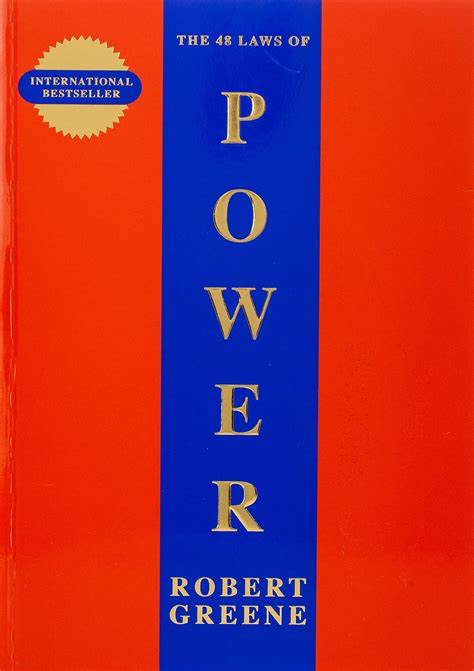
A Bold, Erudite, and Unrelenting Exposition of the Mechanics of Power in Human Affairs
09 May, 2025
And creed, offering a playbook for power that's equally at home in the boardroom and the break room, making it the ultimate guide for those who believe that knowledge is power—especially if that knowledge includes how to "Crush Your Enemy Totally" without losing your lunch break.
Reading The 48 Laws of Power is like attending a masterclass in manipulation taught by history’s most charming villains—with a syllabus approved by both Sun Tzu and your shady uncle.
Robert Greene’s The 48 Laws of Power is a bold, erudite, and unrelenting exposition of the mechanics of power in human affairs. Published in 2000, to me, the book has since established itself as a landmark work in modern self-help literature and strategic thinking. More than just a manual for ambition, it is a deeply historical, psychologically intricate, and philosophically provocative work that investigates how power is acquired, wielded, and protected in every sphere of life—from politics to business, from courts to personal relationships. Drawing inspiration from classical strategy, Renaissance court culture, Eastern philosophy, and modern case studies, Greene creates not merely a book but a tactical framework for navigating the often-treacherous waters of influence and authority.
The book is organized into forty-eight distinct laws, each revealing a key lesson on how to obtain and preserve power. Every law is presented with a commanding headline (e.g., “Never Outshine the Master,” “Court Attention at All Costs,” or “Crush Your Enemy Totally”), followed by historical anecdotes demonstrating the law in action, whether it be obeyed or violated. Greene skillfully weaves tales from a vast canvas of history, referencing figures such as Louis XIV, Queen Elizabeth I, Machiavelli, Bismarck, Julius Caesar, and even modern actors like Henry Kissinger and P.T. Barnum. These figures become case studies in power, exemplifying the triumphs and perils of political savvy, or lack thereof. Each law ends with a distilled summary of wisdom, reinforcing the central lesson in concise, practical terms.
What sets The 48 Laws of Power apart from other self-help or leadership manuals is its unapologetically realist—and some might argue, ruthlessly pragmatic—philosophy. Greene does not mask his message with idealism or sugar-coated optimism. Instead, he embraces a Machiavellian tone, making it clear that power is often achieved not through virtue but through perception, manipulation, control, and even strategic deceit. For instance, he advocates using selective honesty to disarm adversaries, exploiting enemies rather than trusting friends, and concealing intentions to outmaneuver opponents. These suggestions, while controversial, reflect what Greene sees as the real—and often brutal—rules of human conduct that a good deal of experience but few dare to articulate.
At the heart of the book is a profound psychological insight: that human beings, regardless of status, are governed by emotion, ego, fear, envy, and desire. Greene understands power not just as political dominance, but as psychological influence—the ability to affect how others see, think, and act. This is perhaps the book’s greatest strength: its acute understanding of the human psyche and its weaknesses. Laws such as “Play on People’s Need to Believe” or “Discover Each Man’s Thumbscrew” illuminate how deeply personal insecurities, aspirations, and fantasies can be used by the strategic mind. Greene makes the case that to control power, one must first master the terrain of human emotion and behavior.
Stylistically, the book is richly designed and intellectually layered. Greene writes with clarity, precision, and a certain theatrical flair that gives the text a sense of dramatic gravitas. The pages are bordered with historical quotations, aphorisms, and parables that add philosophical depth. His use of literary and historical references is not only decorative but functional—these stories elevate each law from abstract principle to lived reality. Readers are not simply told what to do; they are shown how others have done it and what the consequences were.
Despite its literary merit and analytical brilliance, The 48 Laws of Power is not without its critics. To me, the book promotes manipulation, narcissism, and an overly cynical view of the world. Indeed, some laws—such as “Pose as a Friend, Work as a Spy,” “Get Others to Do the Work, but Always Take the Credit,” and “Use the Surrender Tactic”—can be interpreted as endorsements of deceit and exploitation. Greene, however, contends that he is not encouraging readers to become tyrants, but rather equipping them with the tools to protect themselves in environments where power plays are unavoidable. He presents the world as it is, not as we might wish it to be. As such, the book is best understood not as a guide for becoming ruthless, but as a mirror reflecting the strategies others may use—knowingly or not—against us.
Another critique I would level at the book is its lack of moral direction. Greene seldom pauses to discuss ethics or the long-term implications of applying these laws in personal relationships or civic life. In a world where leadership increasingly demands transparency, empathy, and social responsibility, some may find The 48 Laws of Power too Machiavellian for contemporary sensibilities. Yet it is precisely this tension that makes the book compelling: it forces readers to confront the uncomfortable realities of ambition, rivalry, and survival in competitive settings.
In terms of cultural impact, The 48 Laws of Power has achieved something rare—it has transcended genre. It is as likely to be found on the shelves of Fortune 500 CEOs as it is on the desks of artists, activists, athletes, and even incarcerated individuals seeking personal reinvention. Its appeal spans class.
“Think of this book as the evil twin of your favorite leadership guide—same charisma, less conscience.”
Abdullatif Eberhard Khalid (The Sacred Poet) is a Ugandan passionate award-winning poet, Author, educator, writer, word crosser, scriptwriter, essayist, content creator, storyteller, orator, mentor, public speaker, gender-based violence activist, hip-hop rapper, creative writing coach, editor, and a spoken word artist. He offers creative writing services and performs on projects focused on brand/ campaign awareness, luncheons, corporate dinners, date nights, product launches, advocacy events, and concerts, he is the founder of The Sacred Poetry Firm, which helps young creatives develop their talents and skills. He is the author of Confessions of a Sinner, Vol. 1, A Session in Therapy, and Confessions of a Sinner, Vol. 2. His poems have been featured in several poetry publications, anthologies, blogs, journals, and magazines. He is the editor of Whispering Verses, Kirabo Writes magazine issue 1 and edits at Poetica Africa.