
Mukisa, a Calm Thinker and a Perfect Romantic: The Greatest Gift to Society
On Love, Imagism, and the Poetry of Bruno Mukisa Malbie
19 Aug, 2026
Share
Save
Among the various definitions of a poem, many define it in terms of lines, stanzas, and emotions. Methinks a poem can be an idea. An idea compressed in the little lines to address the problem at that particular moment. The problem could be heartbreak because many youths at large are often heartbroken—love gone sour or the impossibilities of loving genuinely.
Korgi in Imagism posits that Imagism represents a word through an image, and such poetry was meant to counter lengthy twentieth-century poetry. This enhances the appeal of poetry to the common people and short attention spans. Different writers (like Rupi Kaur), especially in the Global North, have been writing short poems, drawing inspiration from Ezra Pound and Hilda Doolittle. However, I first interacted with this kind of writing in Uganda in 2022, when Zenah Nakanwagi wrote I am A Woman, I am Love. A text that highlights a woman’s story and how society treats them – the stereotypes and, above all, the dismantling of patriarchy.
Dismantling patriarchy and its entrenchment begins with understanding who we are as a people and how best we can coexist. For patriarchy is engraved deeply even in the holy writs we belong to. For instance, Timothy 2:12 says: "I do not permit a woman to teach or to assume authority over a man; she must be quiet." Whilst Surah An-Nisa 4:11 says, "to the male, a portion equal to that of two females." This exhibits a series of controversies over the dismantling of patriarchy, per the many feminist poets.
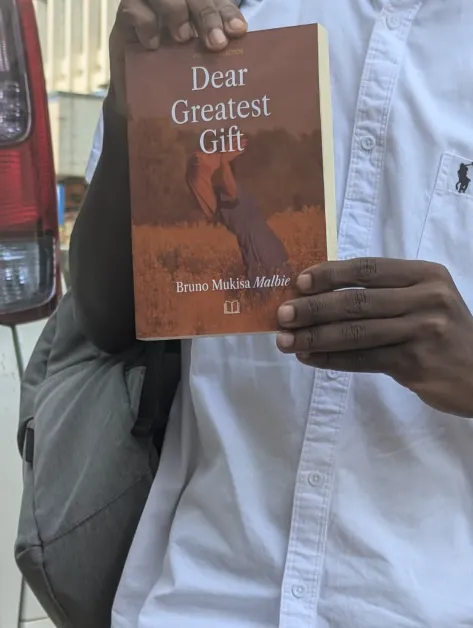
The purpose of this text is simply to discuss the contemporary writer of our time, Bruno Mukisa Malbie, and his imagistic poetry collection, “Dear Greatest Gift.” Mukisa, as a Luganda noun, implies blessings, grace, luck, or perhaps good fortune. It is a popular unisex name among born-again churches. Why do I say so? I buy books without bias, with an open heart to learn from people. Mukisa belongs to the Pentecostal church or denomination, and he proudly acknowledges his spiritual father, “Prophet” Elvis Mbonye, in his book. I revere individuals who are unashamed of their religious faiths. I respect such commitment.
Deeply entrenched in the “medley” of prophecy, I have watched many videos of “Prophet” Elvis Mbonye on YouTube; some have come to pass, others have not. Should we conclude that his pastor is a prophet? Should we not? That is entirely personal to the reader. My own prophecy is that Mukisa is a magician at the pen, and one day people shall see how important his work is and will respect his ingenuity.
His collection consists of over 300 short and powerful poems that you must read several times deeply and respect his coinage of words, articulation, and diction. Each poem requires the reader to enjoy it at least three times before proceeding to another one. Why? A short poem is like relishing a delicious bulb of jackfruit. For you to appreciate the sweetness, you must eat several of them to satisfaction. That means each poem of Mukisa’s deserves the relish to appreciate his talent.
The major theme in his collection is romance, as he employs both female and male persona(e) in his work. He enjoys matters of the heart, and he addresses them with passion and commitment. To understand him better, begin with the title of the poetry collection, “Dear Greatest Gift”.
To break down the title, “Dear” is a term of highest value in different lexical semantics. Many historical standards attribute it to something scarce or expensive. To comprehend the weight of the word “Dear,” the reader must devote time to read Franz Kafka’s Letters to Milena and Letters to Felice. To him, the word, in its sense, was heavy and clipped, a strong emotional and intimate bond he was afraid to address as an individual. Kafka apologised in his letters to his recipients like Milena and Felice. In certain letters to Felice, we see him apologise to her for how loving him might cost her own peace of mind. Whilst with the "Greatest," understanding the semantics around the entire word completes the reverence I have for this (new) contemporary writer. For instance, the greatest blessing this author can receive is often tied back to his name, Mukisa, which carries the highest wishes for luck and favour from God or ancestors. To Bruno, this collection seems to be his greatest fortune to his God—since he is a Christian per se. On the concern of “Gift,” I find Mukisa a gifted writer. Something important to note. In other words, how you relate to the title totally depends on you as a reader.
I have read several perfect poems in his collection, but the one I relished so much was “Stare Into My Heart." A very candid image of a woman disrobed, her legs ajar—east to west. Her papilla poetic and perfect to savour. Her pudendum, fresh and wet. That was how I envisioned reading the poem. It reminds me of John Donne’s “The Good-Morrow,” where Donne’s links intimacy to spirituality, and man and woman conjoin in harmony in their bed to witness God and the universe. Their bed becomes the whole and bliss for tomorrow.
Furthermore, in digging into the poem, the persona in the poem “comments,” "For a time, I felt him peer into my soul; I was laid bare, with nothing to conceal before him. I desired love." If you have read Anais Nin’s “Delta of Venus,” you would conclude that, truly, Nin is incarnate indeed. The line focuses on the mind of a woman and how she enjoyed the desire of her man. With a mere gaze at her, her emotional walls are stripped apart, and she is ready to surrender her entire being to him. She goes on: “He got a hold of my coat and drew me closer. His grip was too firm for me to flee, but stronger was the stare of his eyes.” This line addresses the depth of psychological submission by a woman. Many times, for a woman to love, there has to be an emotional bond. The poem explores this to a T.
In a nutshell, to enjoy Bruno’s text, you must appreciate many writers, especially poets of romance who existed before. You must understand that this is a young man writing art from within, something raw and appealing to the contemporary—relatable, to be exact. Each poem needs time, and each syllable is powerful and must be savoured with caution. I would sentimentally bias myself, and to you, dear reader, Malbie presents an important philosophy—deep and standard. Excellente contende
About the author
Born and raised in Uganda. Studied Science in Population Studies at Makerere University. He is a poet, playwright, and book reviewer. He has authored his first-ever commercial book called "The Muchwezi, The Flower & The Suitor" He is a shy person in real life; he fears looking people in the eyes. A broken person, unlucky in love and confused when he will find true Lover but passionate about People. He is an author of many unpublished poems, plays and novels due to financial constraints. When you see his books, please buy and support Him.