

The Washington AI Accord: Africa's Wake-Up Call
Africa Must Not Be a Bystander in the Global AI Race
17 Oct, 2026
Share
Save
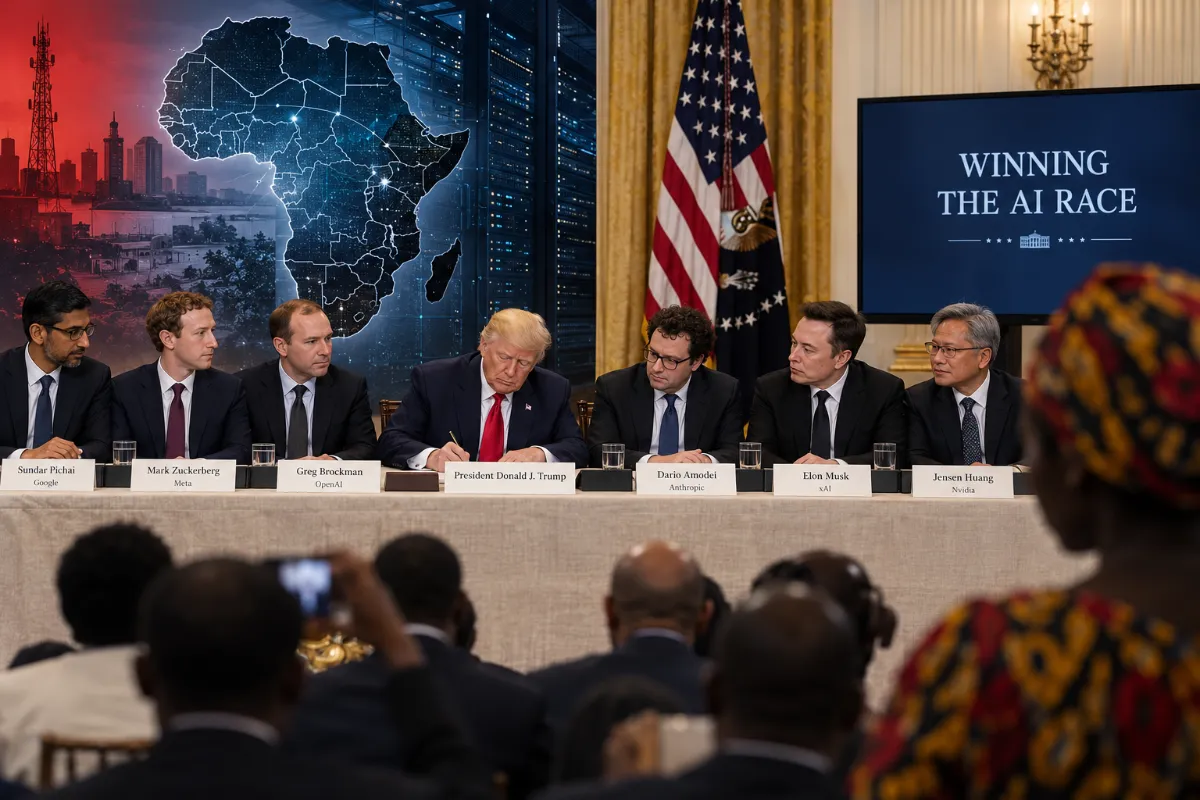
Recently, the White House became the stage for a historical gathering. The titans of Artificial Intelligence (AI)—Sundar Pichai of Google, Mark Zuckerberg of Meta, Greg Brockman of OpenAI, Dario Amodei of Anthropic, Elon Musk of xAI, and Jensen Huang of Nvidia—sat alongside President Donald Trump to sign an accord on superintelligence. The accord commits Frontier AI companies to strict safety accountability and oversight measures. From an African policy perspective, four major issues caught my attention most from the Washington Accord:
First, the Illusion of self-policing versus sovereign enforcement: At its core, the White House Accord rests on voluntary commitments rather than legally binding statutory obligations. It asks multinational tech conglomerates to establish internal monitoring teams, contract third-party evaluators, and brief internal board committees regarding systemic hazards. From a policy standpoint, this reliance on corporate goodwill overlooks the structural conflict between shareholders' quest for profits and public safety. From an African perspective, where nations are exponentially relying on these technology platforms across public health, judiciaries, financial systems, and main public service infrastructure, relying on a Silicon Valley-based internal board to oversee AI frontiers presents a dilemma, particularly regarding the continental voice on regulatory leverage. Another challenge that I see likely to arise is enforcement and accountability through these foreign corporate boards once they come into play. From the strategic angle, rather than waiting for Western self-policing to protect domestic markets, policymakers across the continent must build independent, enforceable national and regional governance frameworks to govern AI deployments locally.
Secondly, infrastructure dominance and data sovereignty: The signature page of the accord sends an unmistakable signal to the African continent; it will serve as a reminder of the centralisation of compute power and model development within a handful of US corporations. By standardising safety processes around these specific frontier companies, the accord implicitly consolidates their positions as default global providers. Either way, African governments remain vulnerable, and the mercy of AI titans for relying entirely on proprietary foreign foundations exposes African economies to digital dependencies and foreign cloud architecture. To safeguard data sovereignty and long-term economic autonomy, policymakers must champion sovereign AI initiatives. This includes enacting data residency guidelines, incentivising regional compute infrastructure, and supporting open-source developer ecosystems so that local innovators are not locked into foreign-owned, closed-source ecosystems.
Third, turning third-party audits into Local compliance mechanisms: Clause 3 of the accord highlights the need for independent external auditors or evaluators to assess model safety. However, the agreement leaves the definition of these evaluators completely unspecified, opening the door for US-centric compliance firms to set universal benchmarks. The question is whether African regulatory bodies can claim this space in this operational vacuum by defining what constitutes an authorised independent auditor within their own sovereign jurisdictions. My suggestion is that any multinational technology provider deploying frontier AI within sensitive domestic sectors should be required to undergo auditing by recognised local or regional African evaluators. These assessments must verify not only technical cybersecurity, but also context-specific safety, linguistic accuracy, and adherence to local data privacy laws.
Fourth is strategic leverage through regional blocs: The White House summit demonstrates how the US government and its dominant tech firms present a unified national front to secure technological leadership globally. Isolated negotiations between individual African nations and trillion-dollar technology monopolies will inevitably lead to asymmetrical outcomes. To bargain effectively for equitable access, or a semblance of equitable access to technology transfer and localised infrastructure investments, African leaders must act collectively. Utilising frameworks like the African Continental Free Trade Area (AfCFTA) digital trade protocols or regional economic communities allows policymakers to present a unified diplomatic front. By speaking with a singular voice, African nations will strategically position themselves to demand global AI agreements to address the developmental and economic realities of the continent.
Last, AI geopolitics is likely to loom large on the continent. For instance, aligning with a US-led accord could strain relations with China, which is also advancing its own AI governance frameworks. The rhetorical question I wish to leave with continental policymakers to ponder is: should the African continent craft a continental policy that balances partnerships with multiple blocs? Or should it align with one of the AI frontier blocs?
About the author
Musekura Kenedy is a lawyer, a tech and digital policy analyst.