
When Ants Vote for Insecticide: A Political Parable for Uganda’s Moment
The ants do not vote for life, for reform, or for balance. They vote against the cockroach.
11 Jan, 2026
Share
Save
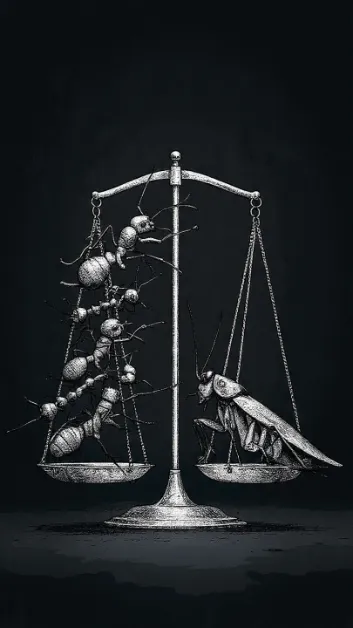
Out of hatred for the cockroach, the ants voted for insecticide—and they all died, including the housefly that did not vote. - " unknown"
DISCLAIMER
This piece is a political parable and philosophical commentary written in a sui-generis style. The characters, metaphors, and illustrations employed herein—including references to insects, voting, and extermination—are purely allegorical, intended solely to provoke reflection on patterns of political behaviour, civic responsibility, and the unintended consequences of collective decision-making.
This work does not endorse, incite, or promote violence, hatred, or harm against any individual, group, political party, institution, or state actor. It does not name or target any specific person, candidate, or political organisation, and any perceived resemblance to real-world actors or events is interpretative, not declarative.
The views expressed are those of the author and are presented for academic, philosophical, and civic discourse purposes only, in exercise of freedom of thought, conscience, and expression. The essay neither instructs nor directs electoral choices but invites readers to think critically, vote responsibly, and reflect deeply on the long-term implications of political decisions, especially in moments of heightened emotion.
Readers are encouraged to engage with the text intellectually, not literally, and to appreciate it as a work of reflective political philosophy rather than partisan advocacy.
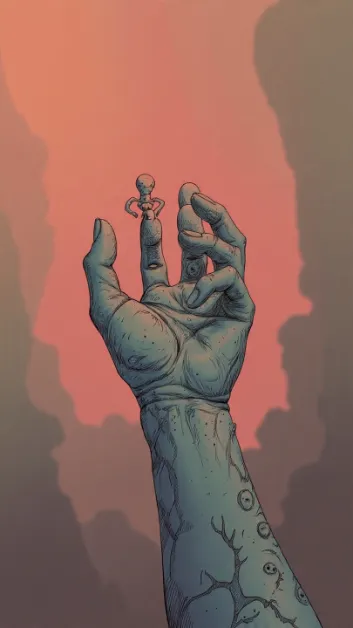
Out of hatred for the cockroach, the ants voted for insecticide—and they all died, including the housefly that did not vote.
This parable is comic on the surface, tragic at the core, and brutally instructive for our political moment. It is the kind of wisdom that laughs first, then lingers like a moral hangover. As Uganda stands on the threshold of presidential elections next Thursday, the parable deserves not just repetition, but deep excavation.
The Allegory Unpacked: Why the Joke Hurts
In the parable, three actors appear:
The Cockroach—annoying, resilient, and deeply unpopular.
The Ants—numerous, emotional, mobilisable, and convinced of their collective power.
The Insecticide—a blunt instrument: efficient, indiscriminate, and irreversible.
The ants do not vote for life, for reform, or for balance. They vote against the cockroach. And therein lies the first tragedy of politics: When hatred becomes the ballot, wisdom vacates the polling station.
The insecticide does not ask:
Who voted?
Who abstained?
Who is innocent?
Who merely needed reform?
It kills by category, not by culpability.
This is how political disasters are born.
Uganda’s Political Terrain: Familiar Insects, Familiar Errors
Uganda today is thick with political metaphors that walk, crawl, and occasionally sting.
Voting Against vs Voting For
Many Ugandans are not voting for a clear vision of governance; they are voting against:
a face,
a surname,
a party colour,
a memory,
a grievance inherited rather than examined.
This is negative politics, where the voter asks:
“Who do I hate more?” instead of “What survives after the cheering stops?”
History teaches us—painfully—that regimes born purely out of resentment often arrive with loud promises and quiet coffins.
The Illusion of Selective Punishment
The ants believed insecticide would:
kill the cockroach,
spare the ants,
maybe inconvenience the housefly.
This belief mirrors a dangerous Ugandan assumption: The collapse will only affect them, not us. But economic shock does not ask for party cards. Instability does not recognise tribe. Institutional breakdown does not read campaign posters.
When:
courts weaken,
currency shivers,
security fractures,
international confidence retreats,
everyone pays—supporter, opponent, neutral, and the apolitical housefly who “doesn’t do politics.”
The Housefly Fallacy: “I Didn’t Vote”
The housefly abstained. It still died. This is the most uncomfortable truth in the parable.
In Uganda, many say:
“I don’t vote.”
“Politics is dirty.”
“Let them fight; I’ll mind my business.”
But politics never minds its business.
Fuel prices do not ask whether you voted.
Hospital shortages do not ask about your ideology.
Youth unemployment does not check your neutrality.
Silence is not insulation; it is merely delayed exposure.
Classical and Contemporary Echoes
The French Revolution
The people hated the aristocracy—understandably. They voted for the guillotine. The guillotine did not stop at kings. It ate revolutionaries, moderates, and eventually its own architects.
The insecticide became the ruler.
Libya After Gaddafi
The hatred was unanimous. The solution was explosive.
Today, Libya has:
no unified state,
multiple governments,
endless militias.
The cockroach is gone. The house is uninhabitable.
Uganda’s Own Memory
Uganda has seen moments when:
institutions were burned to punish individuals,
armies replaced constitutions,
cheers drowned out caution.
We know—perhaps better than most African nations—that regime change without institutional continuity is merely chaos with new slogans.
Humour as Truth Serum
Let us be honest, with a smile:
The ant thinks it is safe because it is “many.” The insecticide thinks in millilitres, not morals. The cockroach survives most things anyway.
Ironically, cockroaches are famous for surviving insecticides.
So the ants may die first.
The housefly dies quietly.
And the cockroach… adapts.
History is cruel like that.
The Rhetorical Question Uganda Must Answer
As elections approach, Uganda must ask—not emotionally, but existentially:
Are we voting to destroy, or to build?
Are we punishing personalities, or strengthening systems?
Are we thinking beyond next Thursday to the next decade?
Because the state is not a cockroach. The constitution is not an insect. And the economy is not immune to poison.
The Conclusion
Democracy is not about who you hate most. It is about what you are willing to preserve even when angry.
Vote, yes. Criticise, absolutely. Demand change, courageously. But never vote for insecticide when you live in the same house because history records this without mercy:
Nations rarely die from lack of passion.
They die from passion without thought.
And the graves, as always, are bipartisan.


.webp)