
When the Ringtone Becomes the Only Voice That Cares
A Confession from Retired Prof. Wasswa
24 Jun, 2025
Share
Save
I. How I Met Prof. Wasswa: The Day Silence Spoke
I met Prof. Wasswa not in a crisis, but in a quiet too loud to ignore. He was seated beneath a neem tree, outside a dusty café near Wandegeya. His phone lay on his lap—screen dark, as if it were mourning its abandonment.
He didn’t greet me. He didn’t smile. He simply said: “Isaac… I know my phone works. But it hasn’t rung in days. Maybe weeks.”
Something in the way he said Isaac, not as a name, but as a cry, froze me mid-step.
He wasn’t looking for pity. He was looking for proof that he still existed.
II. A Graveyard of Contacts
He handed me his phone. There were over 500 contacts—names like:
Mama Gundi
Tata Gundi
Pastor Bukenya
Sister Doreen
But not a single recent call.
No “Good morning.”
No “Happy birthday.”
No “Happy Father’s Day.”
No “We miss you.”
He whispered, “Even wrong numbers have stopped calling me.”
He once thought the phone was broken. So he took it to a technician. The verdict? “Simu eno telina buzibu, Ssebo. Naye abantu bomanyi tebakulowoozako.”
(Your phone isn’t faulty, sir. It’s just that the people you know… no longer think about you.)
III. The Only Calls That Come—The Loan Wolves
He turned the screen toward me again. Unread messages. Missed calls. All from loan apps—predators with MBs and no mercy: Quick Cash. MoMo Money. Mangu Cash. Kagwirawo. Quick Sente. Kasente. FairMoney Loans. OK Loan.
He chuckled—but it was the sound of someone dying quietly.
“They don’t even greet. They just abuse me.”
Then, he mimicked their venomous Luganda: “Mwewola zaaki nga mukimanyi nti muli baavu bakunkumpe?” (Why do you borrow when you know you’re poorer than a church mouse?)
“Tukooye okwegomba kw’abaavu!”
(We’re tired of the greed of the poor!)
“Omwavu oyo ayagala okweyisa nga Ssebo! Simanyi oba ono atya Katonda.”
(That pauper wants to act like a boss! I wonder if he even fears God.)
I looked into his eyes, not wet with tears, but bloodshot from the long-term inflammation of invisibility.
IV. The Midnight Plea: My Phone, Your Ring
Then, he did something I never expected. He reached for my hand and said: “Isaac… I beg you—don’t send me money. Don’t even reply to this pain. Just… call me. Once every Wednesday. At midnight. Don’t speak. Don’t wait. Just let it ring.”
He added:
“I’ll know my phone still works. I’ll know I’m not completely erased.”
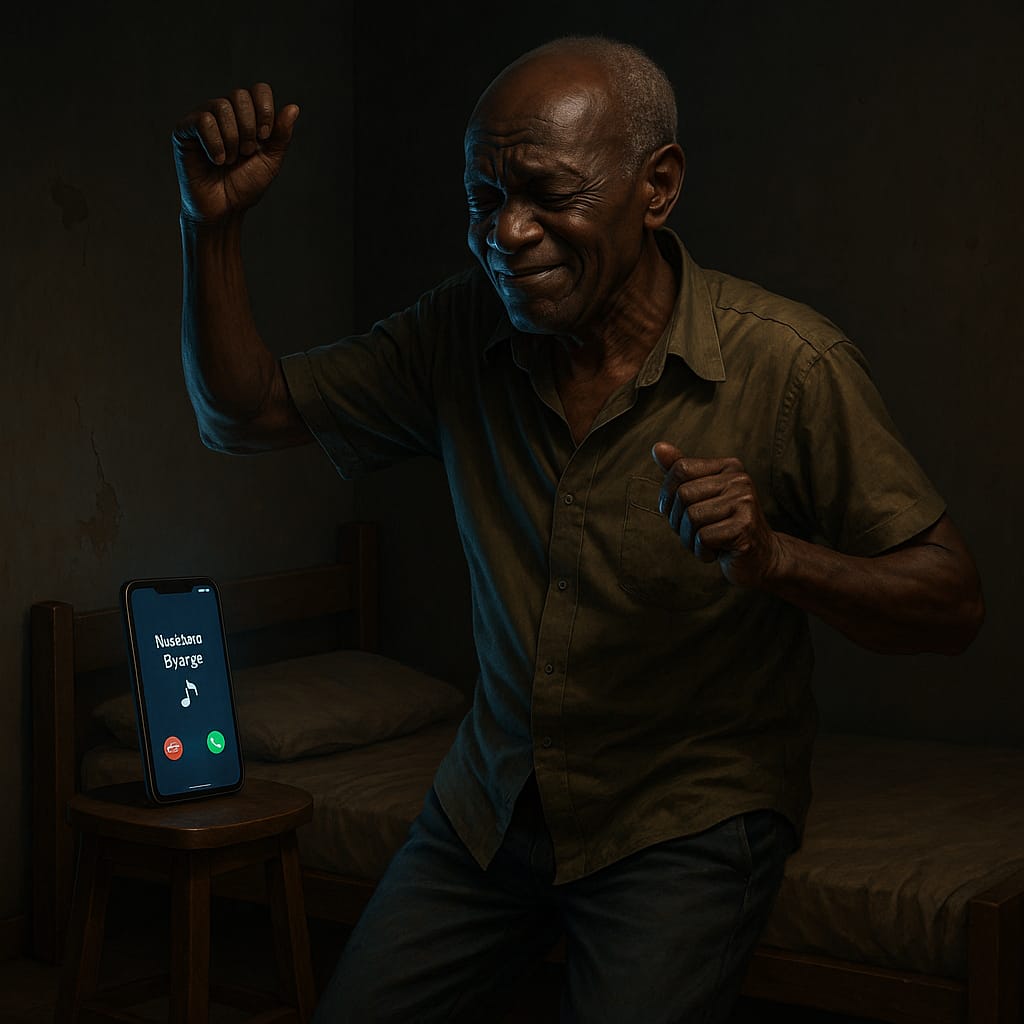
“I set my ringtone to Nekolela Byange by Chameleone—so even in the silence, the tune reminds me: ‘I work for myself… let the talkers talk.’”
That request pierced me. He didn’t need a conversation—he needed a heartbeat. A ringtone. A pulse. A resurrection.
V. The Portrait of a Forgotten Man
Imagine him:
Alone in a one-room bedsitter.
Walls with peeling paint.
A bed without a pillow.
A phone with no light, except on Wednesday, at midnight.
Then it glows.
And the ringtone plays:
“Nekolela byange… abogela bogere…”
He doesn’t answer.
He doesn’t speak.
He dances.
In the dark.
Alone.
But for those three minutes, he is no longer invisible.
“When I hear that ringtone,” he said, “I feel hugged. I feel noticed. Even if it’s you… just calling… and hanging up—I feel alive.”
VI. The Philosophy of Dwindling Relevance
He told me:
“I used to think love was loud. But now I know love is the ring of a phone at midnight, not the crowd during Christmas.”
“People love you until you have no airtime. They only check on you when your WhatsApp status sounds suicidal—not to help, but to ensure you don’t die before repaying them.”
“I’ve been most alone…When I had the most contacts.”
VII. What Prof. Wasswa Taught Me
I came to meet a lonely man.
I walked away, having met a sage in solitude.
He taught me:
Deleting numbers isn’t bitterness—it’s self-respect.
Measuring your worth by how many people call is a trap.
If you don’t have a Kato, find an Isaac.
And if even Isaac forgets—be your ringtone.
“The only love I can afford,” he said, “Is the one that costs me nothing… Just the ring.”
VIII. To Everyone Like Wasswa
Maybe you’re Wasswa too.
Maybe your phone hasn’t rung in a month.
Maybe even your birthday passed like fog.
Maybe you’ve become so quiet to avoid being a burden.
Let this be your declaration:
Your phone is not broken.
Your heart is not useless.
You are not irrelevant.
You are simply in a world that has monetised affection.
But you can reclaim your rhythm:
Delete those who treat you like a backup battery.
Dance to your ringtone.
Let that tune remind you: You still matter. Even if no one else says it.
IX. The Last Thing He Said
As I stood to leave, he looked at me—one final time—and said: “Isaac… don’t forget my number. And if ever I seem to fade…just call me. No words. Just the song.”
Then he smiled. His eyes—heavy. But his soul—lit. And as I walked away, I heard the soft echo in my heart: “Sometimes, all a man needs to stay alive…is a ringtone at midnight.”