

Africa at the Crossroads of Crypto Legislation
A Continental Response to the GENIUS Act
25 Jul, 2025
Share
Save
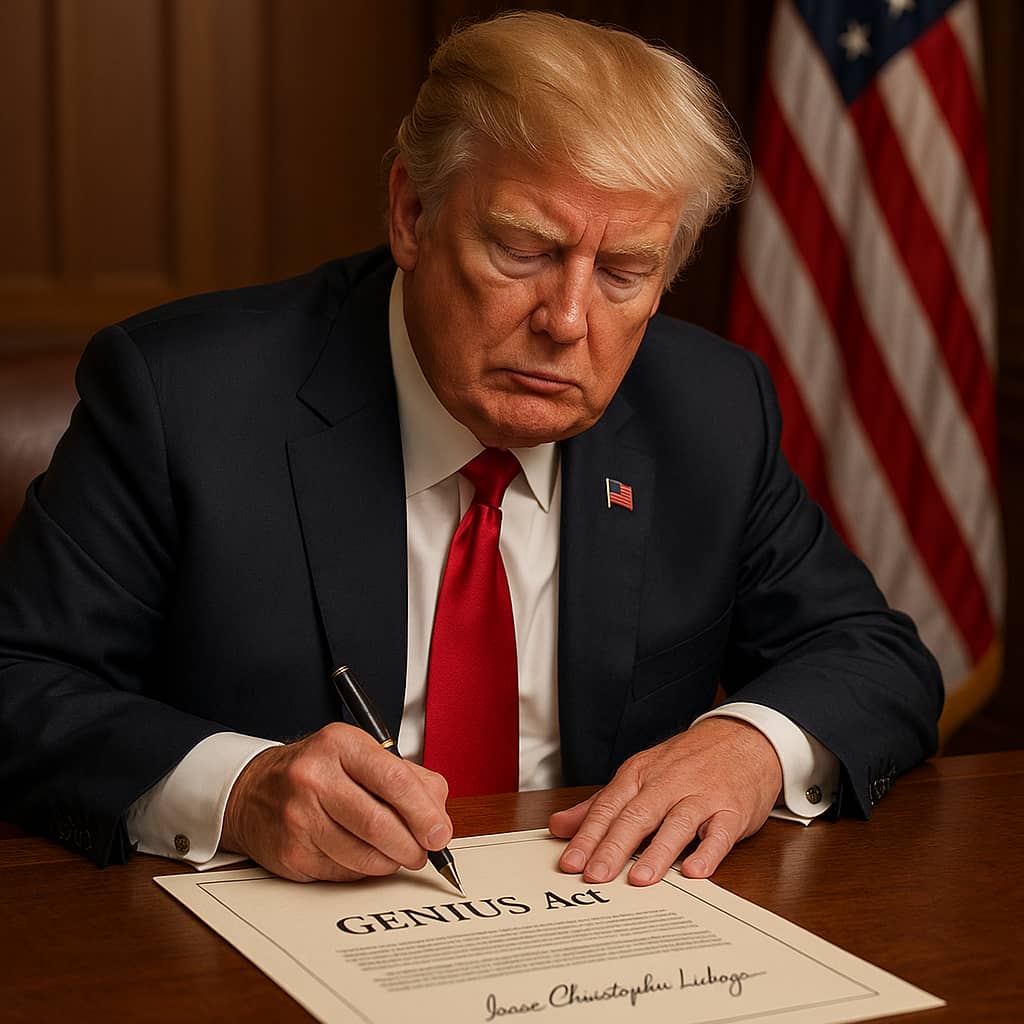
On July 18, 2025, President Donald J. Trump signed into law the GENIUS Act (Guaranteed Electronic Nationally Issued United States Stablecoins), marking a watershed moment in the evolving landscape of global digital finance. The act—hailed as the United States’ first comprehensive federal framework for regulating stablecoins—seeks to establish America as the epicentre of regulated digital assets and to mainstream stablecoin adoption through institutional trust and legal clarity.
For Africa, this is more than a U.S. domestic policy. It is a tectonic shift in the digital monetary order—one that could either galvanise African nations to compete through regional innovation or expose the continent to deeper economic dependency and marginalisation. This discourse interrogates the socio-economic, legal, and strategic implications of the GENIUS Act on Africa and evaluates whether the continent can forge a sovereign, competitive path in the digital currency age.
The GENIUS Act lays out a pioneering framework for stablecoin regulation, emphasising:
Licensing of issuers (banks and non-bank financial entities);
Mandatory reserve backing with U.S. Treasury bills or U.S. dollars;
Independent audits, disclosures, and strict AML/KYC compliance;
A categorical ban on a U.S. retail Central Bank Digital Currency (CBDC), preserving room for private innovation.
With this framework, the U.S. sets a global precedent. Analysts forecast the U.S. stablecoin market could surpass $2 trillion by 2028 (Reuters, 2025), anchoring a new era of digital-dollar dominance.
The Socio-Economic Implications for Africa
Financial Inclusion vs. Digital Sovereignty
Africa is home to over 57% of the world’s unbanked adults (World Bank Global Findex, 2022). Stablecoins, especially those pegged to the U.S. dollar, could offer an inclusive alternative to traditional banking by enabling digital wallets for the poor and unbanked. Platforms such as Binance P2P and Yellow Card are already facilitating crypto transactions in local African currencies.
However, unchecked adoption of U.S.-denominated stablecoins may undermine local currencies, weaken central bank authority, and obstruct nascent sovereign CBDC efforts like Nigeria’s eNaira or the Central African Republic’s Sango Coin. What begins as financial liberation could soon morph into monetary neocolonialism if policy foresight is absent.
Remittances and the Diaspora Dividend
Remittances are the lifeblood of many African economies. In 2023, Africa received over $53 billion in remittances, with Nigeria alone receiving $20 billion (World Bank, 2023). Stablecoins can lower transfer costs from the current 7–10% (Global Remittance Price Database, 2024) to less than 1%, revolutionising cross-border family support.
But herein lies the paradox: If such transfers bypass domestic banking systems, taxation, anti-money laundering enforcement, and foreign exchange management become difficult, eroding national revenue and oversight capacity.
Digital Entrepreneurship and Innovation Hubs
Africa’s vibrant tech ecosystems—Silicon Savannah (Kenya), Flutterwave (Nigeria), and Yoco (South Africa)—stand to gain from programmable stablecoins that support smart contracts, tokenised capital raising, and cross-border trade.
Yet these gains remain tenuous without a coherent legal framework. Regulatory hostility—like Nigeria’s now-lifted 2021 crypto ban—suffocates innovation and deters institutional investors. Clear, localised, and future-oriented digital asset laws are urgently needed.
Legal Takeaways: Africa Must Draft, Not Copy
The GENIUS Act offers a regulatory blueprint but not a one-size-fits-all solution. African countries must tailor their principles to regional realities:
Reserve Requirements: Africa should consider multi-asset backing models, including gold, commodities, and basket-pegged stablecoins, to reduce overreliance on the U.S. dollar.
Licensing Regimes: A tiered structure is necessary—differentiating between banks, FinTech, startups, and cooperatives—to promote inclusivity and innovation.
Audit & Disclosure Mechanisms: Mandate independent reserve verification, consumer redress systems, and mandatory whitepapers for public issuers.
Consumer Protection & AML/KYC: Fraud and crypto scams are rising. A continental regulatory sandbox under the AfCFTA could harmonise protections across African jurisdictions.
South Africa’s Financial Sector Conduct Authority (FSCA, 2023) already offers a promising model, demonstrating the feasibility of progressive crypto oversight in Africa.
Can Africa Compete? Yes—but strategy is key.
Africa has the human capital, entrepreneurial drive, and mobile-first infrastructure to compete, but several barriers must be addressed:
Regulatory Coherence
Africa’s crypto landscape is fragmented. While Kenya and Ghana have welcomed innovation, Zimbabwe and Algeria enforce crypto bans. The AfCFTA Secretariat, in coordination with the African Union, must spearhead a continental digital assets policy akin to Europe’s MiCA Regulation.
Infrastructure and Digital ID
Without widespread broadband and digital identification systems, stablecoin adoption will deepen inequality. As of 2024, only 28% of sub-Saharan Africans have mobile internet access (GSMA, 2024). Investments in rural connectivity and identity verification are vital.
CBDC and Stablecoin Co-existence
Rather than compete, CBDCs and stablecoins can be complementary. African CBDCs can serve domestic retail use, while stablecoins enable diaspora payments, commodity trade, and investment flows—if clearly defined by law.
Legal and Financial Literacy
Law schools and financial institutions must rapidly adopt digital asset curricula. Judges, regulators, and lawyers must be trained in blockchain jurisprudence, smart contract enforcement, and tokenised finance regulation.
Strategic Recommendations
Domain Recommended Action
Pan-African Regulation: Establish a Digital Assets Commission under the AfCFTA or the African Union
Stablecoin Issuance: Promote Afro-pegged stablecoins (e.g., backed by gold, oil, or commodity indices)
Remittance channels: Create Afro-remit corridors using licensed stablecoins to reduce fees
Education & Research: Launch Crypto Law & Policy modules in African law faculties
Infrastructure Partnerships: Leverage public-private coalitions to scale blockchain infrastructure, especially in fintech and telecom sectors
The GENIUS Act is more than a piece of U.S. legislation—it is a declaration of monetary innovation, legal clarity, and geopolitical ambition. Africa cannot afford to watch idly. The choice is between digitally sovereign futures or externally coded dependencies.
Let us not awaken to a continent where our money is programmed in Washington, our reserves sit in Silicon Valley, and our laws hold no relevance in the wallets of our people.
Africa’s response to the GENIUS Act must be bold, African-led, and future-facing.
References
Reuters. (2025, July 18). Trump signs stablecoin law as crypto industry aims for mainstream adoption.
AP News. (2025, July 18). Trump signs landmark crypto bill into law.
Atlantic Council. (2025). Understanding the GENIUS Act and its implications.
World Bank. (2023). Migration and Remittances Factbook.
GSMA. (2024). Mobile Connectivity Index—Africa.
South African FSCA. (2023). Crypto Asset Regulatory Framework Report.
World Bank Global Findex. (2022). Financial Inclusion Data Highlights.
Economic Times India. (2025). What the GENIUS Act means for global crypto regulation.