
Book Review: Kampala Nga Gagwiire
Exploring Nalongo Ruth Namusobya's poetry: a celebration of African culture, language & identity.
14 Feb, 2025
Share
Save
It is nearly impossible for anyone to discuss African literature without recognising African languages; however, people do it. They undermine the role of indigenous languages in telling African stories. Many African writers and readers focus on the story, not the language in which it is told.
Whereas it is satisfactory that the language of the colonists is the only tool of effective communication among Africans—the continent being a habitat for many ethnic races, thus speakers of different languages, we have utterly suppressed African languages while elevating the foreign ones.
We now tell stories in strange languages for fear of our message dying entirely if it were written in our native tongues—sadly, we still refer to it as African literature.
One admissible fact is that language and culture are intertwined, and none of the two can survive without the other—language is the heartbeat of our identity, while culture is the mirror in which we see ourselves.
Thus, we cannot reclaim African independence from the imperialist without linguistic decolonisation; without the pride of telling our stories our way, in our languages—without liberating the African culture and its major components.
The continuity of glorifying the colonists’ languages only undermines the defiance of the oppressed people; it distorts our culture, names, beliefs, self-esteem and heritage—it mitigates our past and history; it trivialises the African race.
In Decolonising the Mind, Ngugi Wa Thiong’o, the author, argues that any literature written in a foreign language about Africa and Africans is not African literature, but Afro-European literature. He argues that such literature only portrays the mental control of the sphere of the black people by the imperialist. It shows dominance—control of African culture, politics, wealth—it is a tool of oppression.
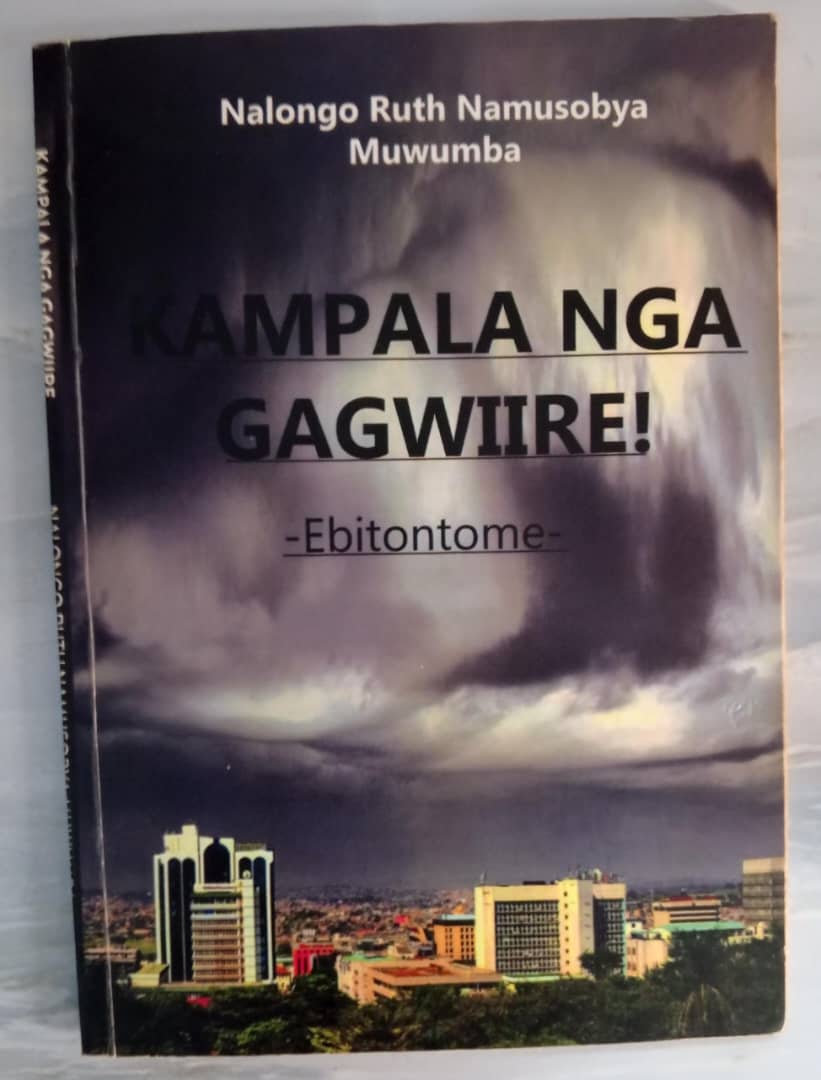
Perhaps it is on this basis that Nalongo Ruth Namusobya Muwumba, the author of “Kampala Nga Gagwiire”, comes up with a book in her mother tongue. She decolonises literature when everyone is colonising it either by writing in foreign languages or writing just like the colonists, ignoring the typicality of an African narrative.
Nalongo understands the freedom that comes with writing in Lusoga, one of the Ugandan languages—and by doing so, she sets a precedent that it is not just about the story all the time, but about the language in which a story is told. She barely cares about the audience, otherwise, she would have written in English, a foreign language for her book to capture every reader’s attention across the globe, but she rather chooses to retrieve her heritage by exploring Lusoga, which is read by a few people.
"Kampala Nga Gagwiire" is a poetry collection of 13 poems, written orally, and specifically for those who recognise themselves—those who have survived the cultural bomb of imperialism. From a reader’s perspective, this is not just a book, but a rebellion. The writer prioritizes her language above all else, and in doing so, she unveils the oral power of the African narrative and its aesthetics.
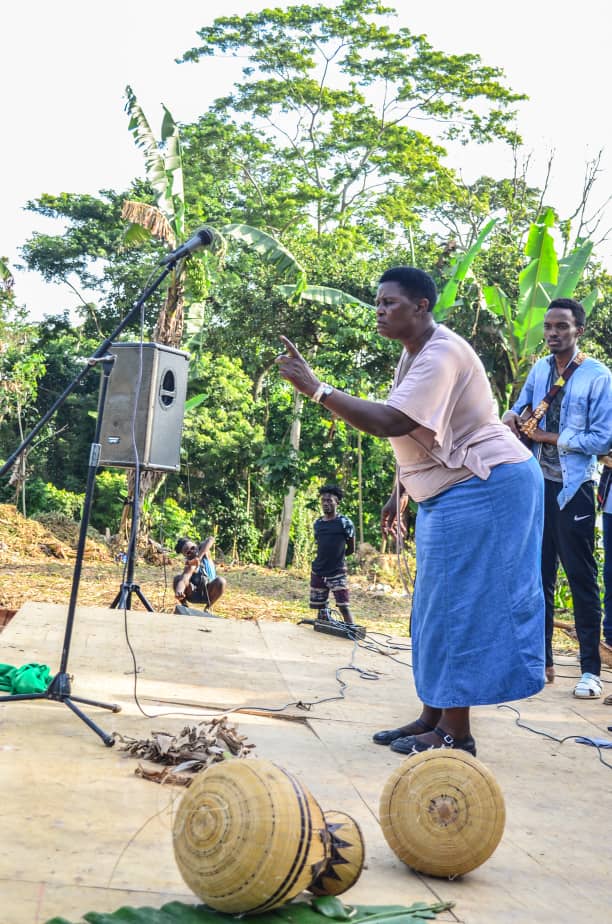
Nalongo performing Kampala Nga Gagwiire with Kitara Nation at the Bayimba Festival
Whereas she focuses on language, her message is loud—it screams to be heard. The title itself is metaphorical. “Kampala Nga Gagwiire” can loosely be translated as “It has rained in Kampala”. For those who might not know Uganda, Kampala is her capital city. And when you relate it to the book title, you realise that the writer is not just referring to the rain, but the chaos, corruption, government inefficiency, poor hygiene, moral degeneration, etc.; it is as if she is an artist with paper and pencil, and now she paints the exact picture of Kampala’s mayhem, but in words.
The book is purely an oral piece. It is nostalgic, that upon reading it, one imagines the early days when people sat around the evening fire and listened to different stories by the elders—you just don’t read, but you feel it—and for us who were born earlier, can easily relate to it. Besides, Nalongo dissects the very dominant topics in our vicinities; gossip among women, conflict between mothers and their daughters-in-law, the importance of farming, indecency, drug abuse by the youth, ignorance among young married men, insanity, death, the misuse of land in Busoga, where people grow cheap sugarcane instead of growing food—and while she presents all these ideas on paper, she is hitched to your mind—you can see and hear her performing, her hands spreading and her body moving—and this is the beauty of the African story in an African language.
In her first poem, Eitooke, Nalongo glorifies the Ugandan culture. As a Ugandan oral writer and performer, she understands that language is void without culture and that what makes up culture are the beliefs of a people and their food. In Uganda, almost all the Bantu, regardless of their inherent differences, prefer ‘Eitooke’ to other foods. Eitooke refers to bananas, which many call matooke. In some traditional homes, a meal is incomplete without Eitooke. In this poem, Nalongo, through her anonymous persona, reiterates the relevance of upholding one’s tradition. She reminds us of the uniformity of our local food—Eitooke is only an epitome of the various foods we have—our food is eaten along any sauce be it mashed ground nuts, beef, beans, fish, chicken, pumpkin leaves, etc., unlike modern foods like spaghetti, rice, noodles, among others. Nalongo hides her frustrations, but she must be critical of Ugandans who do not recognize our local foods, just like they renounced their mother tongues.
The second poem, “Okulima Ebikaadho” is rather a sad reality. The term “Okulima Ebikaadho” refers to growing sugarcane. In Busoga, especially in villages, people prefer growing sugarcane to farming food crops—and it is not their fault—the region reeks of poverty, which is why many people have resorted to growing sugarcane for monetary purposes; unfortunately, sugarcane farming only favours the Indians, who own sugar processing factories; they exploit the local growers. Nalongo brings this discussion to life—she wonders whether her people have educated all their children before using their small pieces of land to grow cheap sugarcane instead of coffee and food. Through a disgruntled speaker, she asks whether anyone has ever sensitised her people about the dangers of sugarcane growing on a limited piece of land. It is such a tragedy that now Busoga is full of factories, yet its people live like mice—they have no clean water; their schools are dilapidated; no medicines in the few health centres they have; teenage pregnancies have soared, etc. Alas, the policymakers are quiet.
In the third poem, “Ebibira”, Nalongo raises the issue of deforestation in Uganda. Ebibira refers to forests. The writer deliberately uses satire to scorn us—we are foolish—we cut down forests knowing there are habitats for many wild animals and fields of different herbs. Nalongo wonders whether we have no ears or eyes to see that forests are perishing, and she calls upon the dramatist to hit the drum—in Africa, a thumping drum is a sign of danger, and once it sounds, people have to gather and listen to what the council say, unfortunately, the Ugandan council—government, has nothing to say since its members are at the forefront of destroying forests. Nalongo’s drum calls for action—we have to do something urgently.
Kampala Nga Gagwiire is Nalongo’s fourth poem. This piece is a lamentation about our capital city, which is marred by chaos. For Lusoga non-speakers, the poem can loosely be translated as “It has rained in Kampala”. Nalongo carves her words with irony; though humorous, one might question why Kampala city is in such an ailing state as presented by the writer in the poem.
“Kino kyebeeta ekibuga Ekikulu mu Uganda?”
Is this the so-called biggest city in Uganda?—Nalongo wonders. She is irritated with the way the city has deteriorated to the extent that when it rains it floods everywhere and everyone fights for their life—of course, not to be washed away by the running water. The imagery is sharp. She calls upon each of us to hold each other’s hand—the persona urges us to cast down our luggage and bicycles and hold on to each other. She makes an acute juxtaposition—when she says that it is better in the village because there are no such lakes when it rains. It is ironic that in the early 1970s to 80s and 90s people dreamt of going to Kampala, but now, they prefer staying in their villages, because there is no misery like that in Kampala.
In this poem, Nalongo paints our city’s degeneration—she questions the efficiency of the government through the Minister for Kampala affairs—she wonders whether they are aware of Kampala’s state; the rubbish, corpses on streets, faeces, rubbish all over, etc. A writer indeed writes his/her time, and this poem reflects on the struggles of Nalongo’s time when politicians who should spearhead the building of the nation have left it in ruins. She also tackles the social stratification of our society, while the poor are struggling to survive the floods; the rich are in their cars, with all the windows closed. Nalongo concludes that she is not begging the government to make things better, because it is its responsibility to make everything better, anyway.
The fifth poem is "Olugambo", which means gossip. In Uganda, gossip is oil that softens people’s lips. Often, people sit in secrecy and talk about others wrongfully; accusing them of something they probably didn’t do. "Olugambo" is common among women, who occasionally sit at the well or by the roadside and talk about others. Nalongo tells us that gossip is a fire that burns even those who have not lit it. She says that gossip creates conflicts among us, so we should avoid it. What a stern warning!
Another intriguing poem in this collection is "Okwambala Obukunizo"—indecency—wearing short attires. Nalongo is not scared of feminists going after her. She confronts women and girls who wear short skirts and transparent clothes. The persona in this poem says that they are tired of seeing women’s nakedness; their tiny thighs and legs, and that breasts are meant for breastfeeding babies, not the public. Nalongo is comic in the most satirical way; she says that knickers have to be inside, not outside. The writer is critical of this generation, which is so detached from morality. She presents our society as a broken one, where even the rules that would restrict people from dressing indecently are docile.
Nalongo also punches the uncles in her poem, "Ba Kojja." Ba Kojja refers to uncles and the persona in this poem tackles the death of our cultural institutions, whereby the uncles have failed to groom the boy child. In the Oral Traditional Society, the uncles used to talk to boys about family and women—they would advise them on how to treat women and lead—and it was then that we saw boys growing into important men of society, unlike today where boys are left to themselves. Nalongo is uncertain of what has gone wrong, and that now young men change women like clothes and drink too much besides subjecting their wives to domestic violence. But whose fault is it?—Nalongo concludes that it is the uncles’. They have to speak to their boys before they get into marriage.
The writer spares mothers-in-law neither. In her piece Ba Inazaala (Mothers-in-law), Nalongo is disappointed in mothers-in-law, especially the boys’ mothers who think that those who bear girls do not hurt. She wonders why these mothers do not appreciate their sons’ wives enough; and why they exploit them, knowing that they are only their sons’ wives, but not theirs. Even though these girls might be wrong, Nalongo argues that most of them are only kids who need guidance, not suppression and dehumanisation. She also questions why fathers are quiet about their wives, who exploit their daughters-in-law. One outstanding trait of Nalongo is that she has solutions to every problem—in this poem; she writes that perpetrators should be taken to Nalufenya prison, where they will learn not to trivialise their son’s wives.
Okufa (Death) is the last poem in this collection. Nalongo is not only traditional but also philosophical. She splits death into fragments; she is not scared of death, but never returning terrifies her. Whereas she acknowledges that death is inevitable; that people, regardless of how they die never return, she dreads the ruthlessness of those the dead leave behind; they share one’s wives and properties, and bully one’s children, knowing the dead will never return to hold them accountable for messing up with their families—only this scares Nalongo—to lose even that she left behind.
This collection is breath-taking—you just won’t put down the book until you flip its last page; and Nalongo’s outstanding writing style—oral/spoken word, keeps you glued—you just want more and more. And being a performer herself, Nalongo knows how to tamper with your moods, and does it with a lot of ease—she knows when a reader should laugh, cry, or close the book and reflect on the poem, while spasms run in their veins. This book is a hidden treasure for the lovers of language—there is a lot of sophistication in its simplicity—the deeper you analyse a piece, the more you unveil its underlying pretext.
Nalongo is a word-weaver, whose dexterity is her simplicity. Electric!
About the author
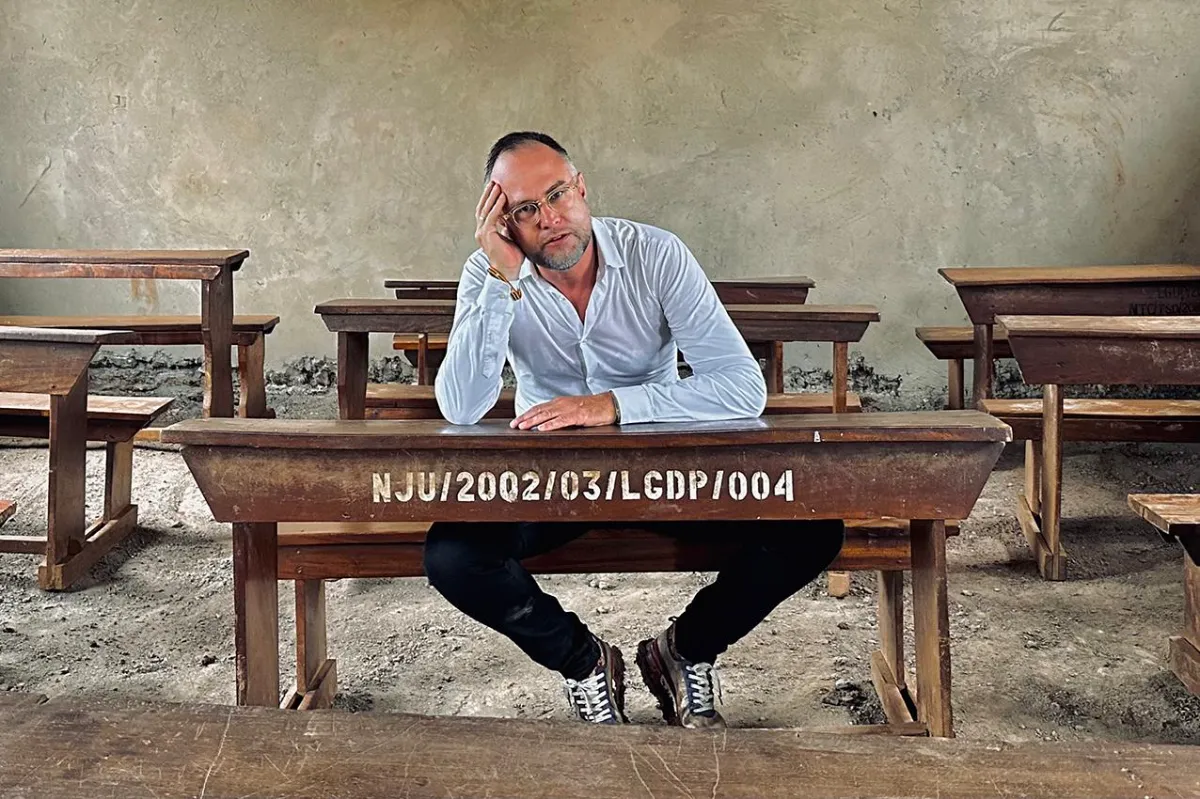
The author is a published novelist, and book editor at The World Is Watching, Berlin, Germany, columnist and human rights activist. He has written with The Observer Ug, The Ug Post, The Uganda Daily, Muwado, etc.