Do literacy gains explain—or contradict—Uganda’s electoral outcomes?
Educated but Disenfranchised? What Invalid Votes in recent Uganda's 2026 Elections Say About UPE and USE GAINS

20 Jan, 2026
Share
Save
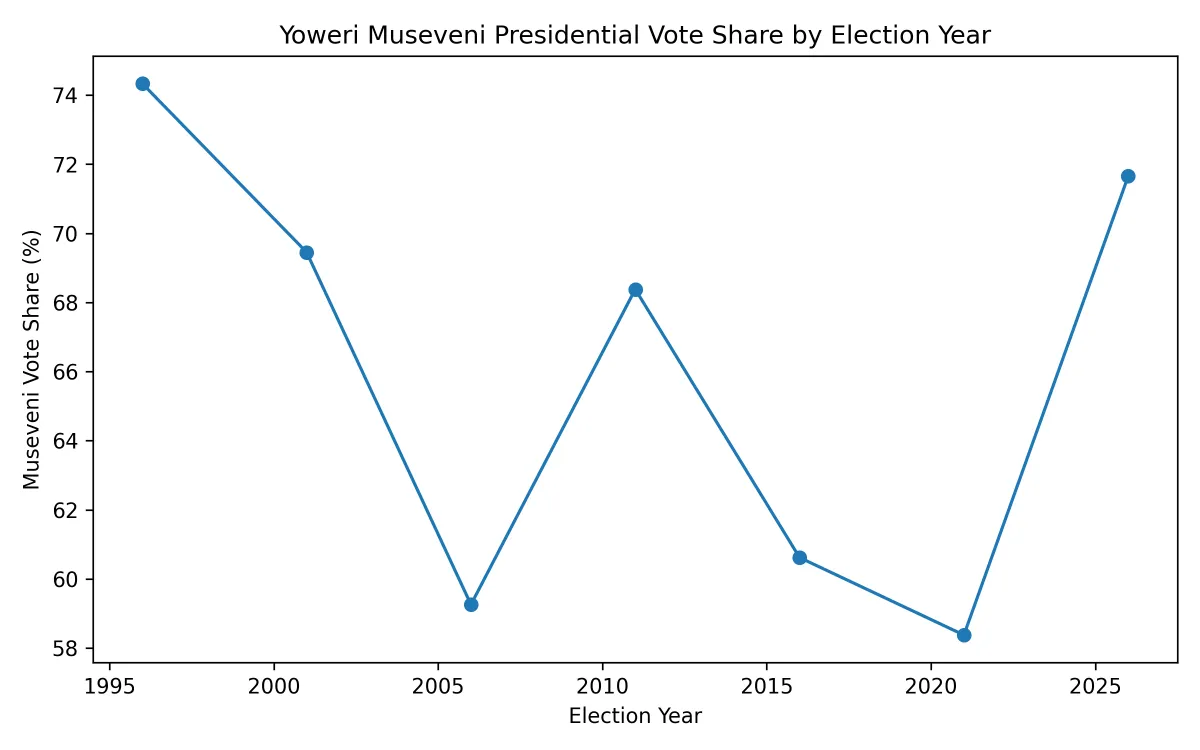
Kampala, Uganda, concluded its 2026 General Elections with the incumbent president securing yet another decisive victory, extending his long stay in power. The outcome, described by electoral authorities as a landslide, has once again been accompanied by strong government assertions that investments in Universal Primary Education (UPE) and Universal Secondary Education (USE) have significantly raised literacy levels across the country.
Yet, as celebrations fade, the elections have reopened an uncomfortable national conversation: how does a country that claims rising literacy levels continue to register high numbers of invalid votes?
A Troubling Electoral Record
Invalid votes—ballots rejected due to improper marking, multiple choices, or being left blank—have been a consistent feature of Uganda’s electoral landscape.
In the 2011 elections, a substantial number of votes were invalidated, raising early concerns about voter understanding and civic preparedness. The 2016 elections recorded the highest proportion of invalid votes, sparking criticism from observers who questioned the effectiveness of voter education initiatives.
In 2021, although the number declined slightly, invalid ballots remained significantly high. The 2026 elections, despite official claims of improved literacy under UPE and USE, once again recorded a striking number of invalid votes, reigniting public debate.
This pattern suggests that the problem is not isolated or incidental, but systemic.
Literacy Without Civic Power?
Throughout the 2026 campaign, the president credited UPE and USE for transforming Uganda into a more educated society. In theory, increased literacy should lead to better understanding of electoral processes and fewer mistakes at the ballot box.
However, the repeated presence of invalid votes challenges this assumption. Critics argue that while UPE and USE may have expanded access to schooling, they have not necessarily translated into functional civic literacy—the ability to meaningfully participate in democratic processes.
Being able to read and write does not automatically mean a voter understands electoral procedures, ballot design, or the political significance of their vote.
Protest, Confusion, or Structural Failure?
Political analysts caution against viewing invalid votes purely as evidence of illiteracy. In some cases, voters deliberately spoil ballots as a form of silent protest, expressing dissatisfaction with candidates or distrust in the electoral process.
Nevertheless, persistent administrative weaknesses—poor voter guidance, language barriers, inconsistent polling instructions, and limited civic education—continue to undermine voter confidence and clarity. These factors, combined with declining voter turnout, raise deeper questions about democratic inclusion.
A Mockery or a Warning?
Whether the continued prevalence of invalid votes is a direct mockery of UPE and USE remains contested. Supporters of the government argue that educational achievements should not be judged solely through electoral statistics. Critics counter that after more than two decades of universal education policies, repeated electoral errors expose a troubling gap between education access and democratic empowerment.
What is clear is that Uganda’s elections reveal a paradox: a population that is increasingly educated on paper, yet still struggling to fully exercise its most basic democratic right.
As the country looks beyond the 2026 polls, the challenge is no longer just expanding classrooms but ensuring that education produces confident, informed, and empowered citizens from the classroom to the ballot box.
About the author
Arinaitwe Reagan is a Ugandan wordsmith, philosopher, and social activist. His existence is a testament to the transformative power of language, which he wields to challenge societal norms, spark meaningful conversations, and inspire positive change. A voracious reader and astute observer of human nature, Reagan's literary pursuits are informed by a deep-seated desire to understand the complexities of the human condition. His poetry and prose are infused with a sense of wonder, curiosity, and empathy, reflecting his commitment to exploring the intricacies of the human experience. As a passionate public speaker, Reagan has honed his ability to convey complex ideas with clarity, conviction, and charisma. His oratory skills are matched only by his capacity for active listening, which enables him to engage with diverse perspectives and foster inclusive dialogue. Through his writing, speaking, and activism, Reagan seeks to contribute to a more just, equitable, and compassionate world. His work is a testament to the enduring power of words to inspire, educate, and uplift humanity. He completed his primary level from St.Joseph's Preparartory School (2017)in greater Bushenyi in Western Uganda and later in 2018 he joined the most prestigious boys School in East Africa where he notably established himself as the class coucillor in 2019,moat informed student 2019,president Debate Club president Writer's Club,President Peace Club,as well as the school junior head prefect. He participated in Olympics Youth Camp in 2018 just as a young lad in form one,represented Uganda in Yale Young Africa's Scholar Program 2018,finalist in the Uganda World Bank Bank Debate Championship 2019,founding president Divine Mentorship Hub to train young breeds of leaders for Africa's next generation .He is a true Pan Africanist who participated in the Transformation Citizens Encyclopedia (TRACE),won National SESEMAT Science Competition 2022,awarded best studentt leader if the years 2019,2022 respectively, participated in the National Students Anti Corruption Challenge 2021,2022 respectively and Climate change dialogues as well as very many easy writing Competitions .He later joined CORNERSTONE LEADERSHIP ACADEMY-BOYS Ffor his A LEVEL Studies in 2023 where he was the school speaker ,president Debate Club,President Writer's club at school level and District level and was the president Executive Committee of Nakasongola District and National Level Secondary Scools Writers and Deabtors clubs respectively He served as the president of UGANDA NATIONAL STUDENTS ASSOCIATION (UNSA ) at District level as President DEC and national secretariat as 34th Secretary for Inter-School Affairs a role that mandated him to head all Secondary School students in the country. He featured in UNESCO documentary about literacy levels in Africa. Currently he volunters with Educate Uganda,Wananchi Youth Patriotic Forum, member of Africa Kwetu Studebts Association and agraduate of leadership and governance from KRUMBUKA LEADERSHIP SOLUTIONS in kigali Rwanda *land of a thousand hills*.Currently he is law scholar at ISLAMIC UNIVERSITY IN UGANDA. He believes it takes a revolution to create a solution